


Download the Healthy Horse app and the Hay calculator.
Horse
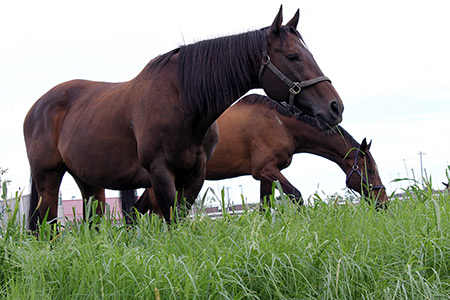
The University of Minnesota Extension horse program helps horse owners and professionals address issues ranging from horse health and nutrition to facilities management and genetics.
Extension provides unbiased, research-based information to Minnesota horse owners to increase their knowledge and improve the quality of care for horses and their habitats.
129,000
Approx. # horses in Minnesota
$541 million
Economic impact of the horse industry in the state
6,988
# Horse farms in Minnesota
Basic horse care and management
|
Basic first aid for your horse and preparing for emergencies
Know what is normal for your horse and how to check vital signs.
Learn what to keep in your horse’s first aid kit and what to have in the barn in case of emergency.
What to think about in an urgent situation.
Horse biosecurity tips for peak riding season — Biosecurity measures are key to keeping your horse healthy while traveling during the show and trail season.
Preparing for disaster — Have a first-aid kit, an evacuation plan, and other essentials ready in the event of severe weather, fire, or other emergencies. Learn ways to prevent barn fires.
Preventing hay fires — Proper moisture at baling is the single biggest hay fire risk factor.
Download these forms to help you plan for emergencies
- Fillable PDFs to outline essential livestock care if you or your managers experience illness, injury, or another emergency, when you may need outside people to provide care.
- These contingency plans cover only essential care. They are not comprehensive care plans.
- Use the appropriate form to complete your farm’s Operations Contingency Plan.
Basic care
Conformation of the horse — Conformation refers to the shape or structure of a horse, and it can impact a horse’s athletic ability.
Controlling flies around horses
Fly control video (05:57)
Fly control webinar (58:37)
Guidelines for the weight-carrying capacity of horses — Understanding the appropriate carrying capacity of your horse can ensure their welfare and continued partnership for years to come.
Carcass disposal
Owning and caring for a horse
- Caring for horses on a budget
- Coping with the loss of a horse
- Economic impact of the horse industry
- Horse science college programs in Minnesota
Legal considerations for owning a horse in Minnesota
- Companion Animal Welfare Act requirements
- (1:06:33; recorded March 20, 2018) - Get a better understanding of the Equine Liability Act and how to further minimize risk through contractual releases/agreements and insurance.
- Limiting your horse liability under Minnesota law
- Safeguarding your horse farm
- Trailering horses in Minnesota: which laws affect you
- Understanding equine law
- Understanding Minnesota’s horse liability statute
Grazing best practices
- Grazing horses on grass and legume mixed pastures
- Grazing horses on cool-season annual grasses
- Grazing horses on warm-season annual grasses
- When to initiate horse grazing (video - 6:53)
Pasture care
- Fall and spring pasture to-do list
- Frost seeding forages into established horse pastures
- How to take a soil sample for your pasture (video - (10:18)
- Managing established horse pastures
- Managing grazing livestock during wet weather
- Planning your horse pasture site
Pasture plants
- Cool-season perennial grasses
- Cover crops for horse pastures
- Grass mixtures for Midwest horse pastures
- Plants commonly found in horse pastures
- Sampling pasture plants for forage quality (video - 8:17)
- FAQs about pasture sampling (video - 2:52)
Weed control
- Grass pasture weed control
- Identifying and controlling weeds
- Weed management for pasture and fence line systems
Harmful pasture plants
- Black walnut: a toxic horse bedding
- Boxelder seeds cause seasonal pasture myopathy in horses
- Chokecherry: a lethal plant to horses
- Hoary alyssum: the most common poisonous plant to horses in Minnesota
- Are maple leaves toxic to horses?
- Oak buds and green acorns can harm horses
- Plants poisonous to livestock
- Plants that cause mouth blisters in horses
- Tall and smallflower buttercup: problem horse pasture plants
- Weed seeds toxic to horse
- White snakeroot: a toxic plant to horses
- Wild parsnip: problem plant in hay and pastures
Feeding and nutrition
|
- Carbohydrates and fats in your horse’s diet
- Encouraging your horse to drink
- Feeding a mature horse
- Feeding your horse a ration balancer
- Fitting teff into the horse diet
- Hay in horse diets
- Horse preference for oat color
Special diets
- Alternative feedstuffs for horses — You may need to consider alternative feedstuffs due to high hay costs or limited hay availability.
- Grazing horses prone to laminitis and metabolic disease
- Managing forage carbohydrate content
- Soaking your horse’s hay — Soaking hay can benefit horses with certain health issues by reducing water-soluble carbohydrates, potassium and dust.
- Blister beetles in alfalfa hay
- Don’t feed your horse moldy hay
- Evaluating amino acid levels in forages and horses
- Evaluating glucose and insulin levels in grazing horses
- Feeding clover to your horse
- Harvest moisture level and bale wrapping affects hay quality for horses
- How to take a hay sample (video - 10:57)
- Steaming horse hay to reduce the effects of mold and dust
Feeding equipment
Hay suppliers and storage
- Horse hay suppliers in Minnesota
- Selecting and storing horse hay
- Ten ways to stretch your horse's hay supply
Certified hay requirements
The certified noxious weed seed-free forage program assures that certified forage meets the minimum standards to limit the spread of noxious weeds.
- In Minnesota, it is voluntary to use certified hay when trail riding and camping in Minnesota public parks.
- If you plan a trail ride or camping trip with your horse on public lands in the western U.S., you must use certified hay.
- Contact the for a list of producers of certified noxious weed seed-free forage in Minnesota: 800-510-6242.
10.) The effectiveness of hay soaking
Soaking Minnesota-grown cool-season grass hay for 15 to 30 minutes is sufficient for the nonstructural carbohydrates to reach 12 percent or less, the current dietary guideline for horses diagnosed with obesity, laminitis, EMS, and Cushing’s disease. Cool-season grass hay should not be soaked for more than 60 minutes because of excessive dry-matter loss and reduced availability of key nutrients, such as phosphorus. Find more information on hay soaking.
9.) Grazing alternative forages
Horses can successfully graze teff, annual ryegrass and alfalfa. These forage species yield well and meet the nutritional needs of most classes of horses. Find information on cool-season annuals like annual ryegrass and warm-season annuals like teff.
8.) Differences between fly repellents
Leggings, leg bands and citronella spray help reduce fly aversion behaviors in horses. Learn about fly repellents.
7.) Hay rakes impact ash content
Our research found that alfalfa hay raked with a wheel rake contained the most ash (or soil contamination), while hay raked with a merger and sidebar rake contained the least amount of ash. Find more information on hay rake impact on ash content.
6.) Identifying key differences between forage types
We compared teff, alfalfa and cool-season grasses (Kentucky bluegrass) and found that teff had lower nonstructural carbohydrates and higher fiber values than cool-season grass and alfalfa. Blood insulin levels were lower for horses grazing teff than those grazing cool-season grasses in the fall and late fall. Find more information on evaluating glucose and insulin levels in grazing horses.
5.) Effectiveness of grazing muzzles
Grazing muzzles reduce forage intake, regardless of forage species, by about 30 percent. Find more information on grazing muzzles.
4.) Estimating actual and ideal horse bodyweight
We have collected data on almost 2,000 equines and developed more accurate equations for estimating body weight and new equations for estimating ideal body weight. This research led to the development of the Healthy Horse App. Find more information on horse body weight.
3.) Cool-season grass grazing preference
This research is the basis for all of our grazing research. We found that horses prefer Kentucky bluegrass with a lesser preference for orchardgrass when each species is planted alone. Find more information on cool-season perennial grasses for horse pastures.
We found that horses preferred mixtures of endophyte-free tall fescue, perennial ryegrass, Kentucky bluegrass and timothy. This mixture also yielded well, withstood grazing pressure, and met the nutritional needs of most classes of horses. Find more information on grass mixtures for Midwest horse pastures.
2.) Effectiveness of hay nets
When feeding from different nets, horses took 6.5 hours to consume hay from a small-holed net compared to about 3 hours when the hay was fed off the stall floor. Find more information on using slow-feed hay nets.
Overweight horses on a restricted diet, feeding from the hay nets, had lower peak insulin and cortisol values (a stress hormone) than those feeding from the stall floor. Find more information on horse weight loss.
1.) Importance of hay feeders
Using a hay feeder is critical for reducing waste when feeding hay. Our research showed that, when feeding round bales, not using a feeder resulted in 57 percent waste. Not using a feeder resulted in 13 percent waste when feeding small square bales. Find information on using round-bale feeders and small square-bale feeders.
Horse health
Determining a horse’s body weight is important for managing weight and feeding, and for administering medication. The Healthy Horse App allows horse owners and professionals to estimate body weight for several breeds using new equations developed through University research.
|
Resources for equine disease alerts
Infectious diseases
Equine herpesvirus: EHV-1 and EHM are contagious viruses that can cause neurological disease, respiratory disease, newborn death and abortion in horses. Practicing biosecurity and vaccination can help limit the spread of these diseases.
- Equine protozoal myeloencephalitis (EPM) is a neurologic disease that horses get from eating infected opossum feces.
- Pneumonia in the adult horse
Purpura hemorrhagica: a bad sequel to strangles — Purpura hemorrhagica (PH) occurs when blood vessels swell due to an improper immune response.
- Salmonella in horses
Genetic conditions
- Hereditary equine regional dermal asthenia (HERDA) — Signs of HERDA include stretchy skin, severe skin wounds and scarring along the back and withers.
- Hyperkalemic periodic paralysis (HYPP) in horses is a genetic disease noted by mild to severe episodes of muscle spasms and trembling.
- Junctional epidermolysis bullosa (JEB) is a fatal genetic skin disease in horses.
Overo lethal white syndrome (OLWS) is a genetic mutation that affects horses with white markings and can lead to death in foals.
- Polysaccharide storage myopathy (PSSM) is a disorder that causes muscle cramping in horses from abnormal glycogen (sugar) storage in the muscles.
Eye conditions
Equine recurrent uveitis (ERU) is an autoimmune disease affecting horses’ eyes.
- Glaucoma in horses
Other common conditions
Basic first aid for your horse and preparing for emergencies — Learn what to keep in your horse first aid kit and what to have in the barn in case of emergency.
Hooves
Joints and legs
- Bowed tendons in horses
- Crippling arthritis in Arabian horses
- Horse joint supplements
How to apply a standing wrap to a horse’s limb (video - 05:15)
How to bandage a horse's injured lower limb (video - 10:04)
Injecting the coffin joint for navicular — Navicular syndrome commonly causes lameness in horses.
More Extension resources

Plants poisonous or harmful to horses
Plants Poisonous or Harmful to Horses in the Midwest (2020 Edition) is for sale by the University of Minnesota Bookstore.
Give to the Extension Horse program
The horse program depends in part on individual gifts to support applied research, educational programming, and student research experiences.

Livestock operations
Learn best practices for raising livestock, farm safety, manure management, meat processing, and land stewardship and build on the profitability and success of Minnesota’s agricultural industry.
Horse online certificate courses
Horse certificate courses are self-paced on a specific topic, such as nutrition or manure management. Each course is six weeks long.
Equine Exhibition Manager training
This self-paced online course helps managers of equine exhibitions in Minnesota meet state requirements with greater confidence and host safer exhibitions for horses and attendees. The course covers the responsibilities of equine exhibition managers, the requirements for horses, and how to apply for exhibition permits.
Learn more from the horse team
News | Events | | | Newsletter sign-up
Contact the horse team
|
Page survey