

Quick facts
- Emerald ash borer (EAB) is a destructive insect pest that attacks all North American ash species.
- Ash trees are killed if not protected by insecticides.
- The Minnesota Department of Agriculture has quarantines on ash wood and materials to help control the spread of EAB.
Early detection of infestations can help reduce the spread to other areas. Please report any EAB beetles or tree symptoms you spot at Report a Pest.
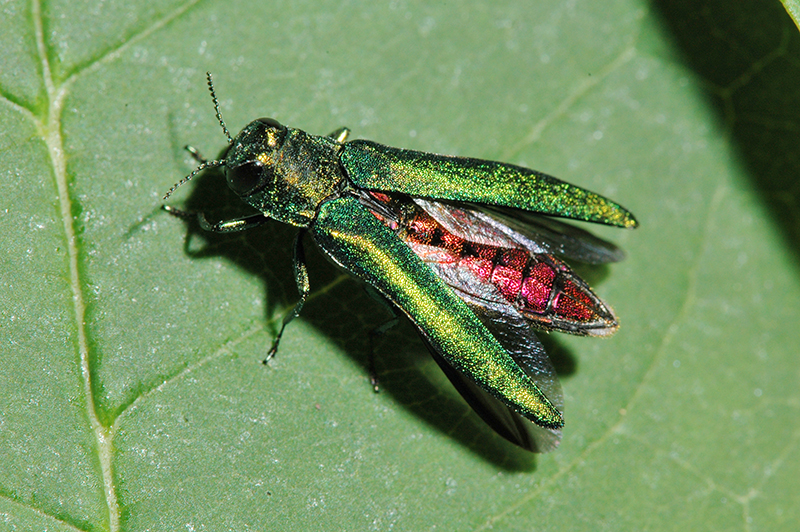
Why be concerned about emerald ash borer?
Emerald ash borer (Agrilus planipennis) is an invasive insect native to Asia that arrived in Minnesota around 1990. As of 2026, EAB is found in 38 States and the District of Columbia.
Emerald ash borer (EAB) has killed hundreds of millions of ash trees across North America.
American ash trees in the Fraxinus family have no chemical or physical resistance to EAB, and the insect will infest and kill trees from as small as one inch in diameter to large mature trees.
Minnesota has the highest number of ash trees in the United States, with close to one billion ash trees in cities and forests. Losing these ash trees can have extreme economic and ecological consequences for urban tree canopies and forest ecosystems.
Current status: Active
Avoid removal of ash branches, trees and stumps
Materials moved during the EAB high activity period may release adults into a previously un-infested area. If removal is necessary due to a hazardous condition:
- Chip outer one inch of bark or wood on-site and transport to the nearest ash tree waste disposal site within the quarantined area, or
- Transport outer one inch of bark or wood in a vehicle where it is 100% enclosed to the nearest ash tree waste disposal site within the quarantined area. Material should remain enclosed until it can be processed.
The high activity period for emerald ash borer typically begins in May and runs through October.
Help reduce the spread of EAB
Report suspected insects or declining ash trees
With early detection and reporting of emerald ash borer infestations, there may be time to protect lightly infested trees in the area or slow the spread to other areas. There have been many cases where the public was the first to find an initial infestation in an area.
- Learn how to identify emerald ash borer and the symptoms of an EAB-infested tree.
- Use this diagnostic tool to see if you can clearly rule out EAB.
- Contact the Minnesota Department of Agriculture to report suspected EAB.
Protect healthy trees
You may choose to treat healthy, high-value trees with insecticide to protect them from EAB. Healthy, mature trees improve the attractiveness of a landscape, raise property values, help reduce energy costs, and decrease stormwater runoff.
Treating ash trees may also help protect other ash trees nearby. Communities that treat 50% of their ash trees with pesticides emamectin benzoate or azadirachtin help preserve the crown condition of nearby untreated ash trees. This finding could be important for community forestry programs thinking about the costs and benefits of treating street and community ash trees.
Don't move ash wood
Most EAB will generally move only about one-half to one mile a year from infested sites. But with help from people, it can travel hundreds of miles when carried in firewood, other wood products or nursery stock. The Minnesota Department of Agriculture (MDA) monitors the status of EAB and quarantines the movement of ash wood and materials.
- Don't transport firewood when you go camping or buy it for home use; instead, buy the wood you need at local sites or at the campgrounds.
- During the EAB dormant period from November through April, take ash wood to your nearest ash tree waste disposal site.
- Avoid removing ash branches, trees and stumps during the EAB beetle active period from May through October. If removal is necessary due to hazardous conditions, follow the MDA’s best management practices for removing ash material in a quarantined area.
Emerald ash borer biology, symptoms and control
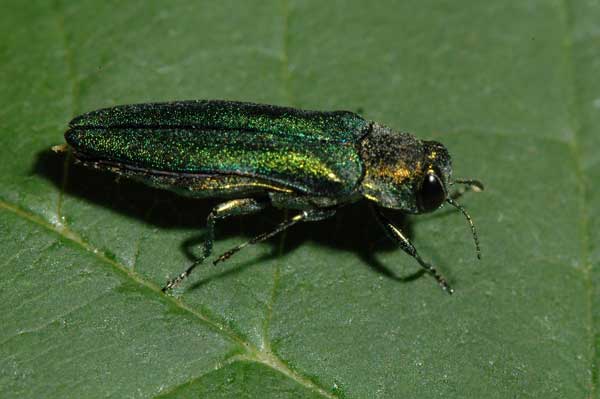
Emerald ash borer (Agrilus planipennis) is a metallic wood-boring beetle (family Buprestidae). It is a little larger and much more brightly colored than bronze birch borers and two-lined chestnut borers.
Emerald ash borers generally have a one-year life cycle that can extend to two years in a vigorously growing tree.
Adult stage
- The adult beetle has a bright iridescent emerald to coppery green-colored body. It has a purplish magenta abdomen under its wings and may have a copper-colored area behind the head.
- The slender body is 1/3 to 1/2-inch long, widest just behind the head and gradually tapering back to the abdomen.
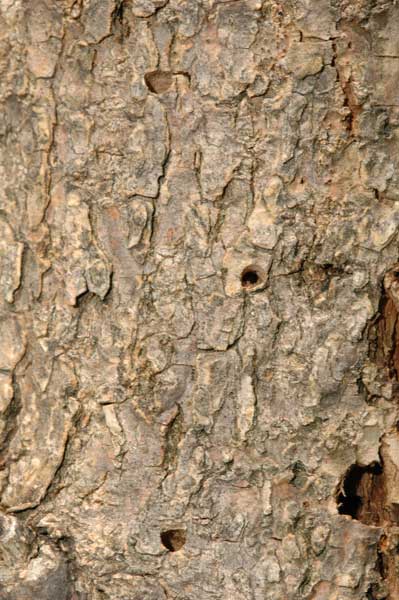
- Adults emerge from infested ash trees from late May to August, creating small, 1/8-inch D-shaped exit holes.
- After feeding on ash leaves, adults mate and females lay 40-200 eggs in small cracks in the bark.
Egg stage
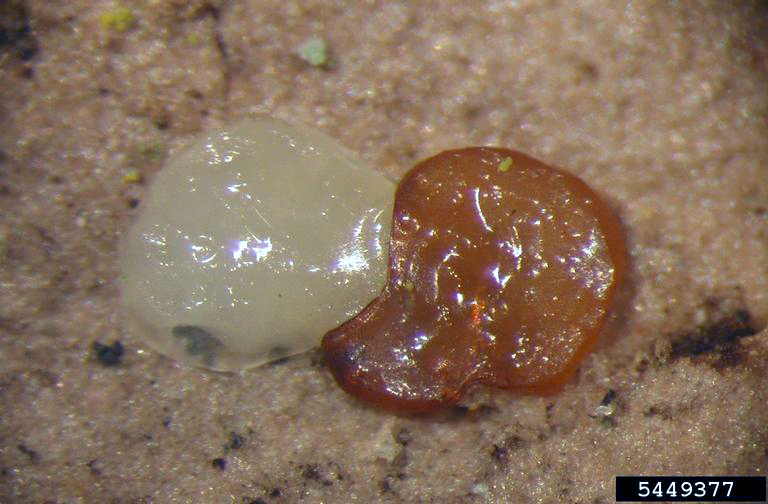
- Eggs are small (1 mm), difficult to find and rarely seen.
- Eggs hatch in about 7 to 10 days and larvae immediately bore into the tree.
Larval stage

- Larvae are 1 to 1-1/4 inches when fully grown.
- They have a flat, milky white body with a small brownish head.
- They have no legs but have a pair of small pincer-like appendages on the tip of the abdomen.
- After hatching, larvae tunnel just under the bark of ash trees and feed until fall.
- They create winding, S-shaped galleries in the outer sapwood and in the tissue (phloem) that carries food from the leaves to the rest of the tree. These tunnels girdle the trunk and branches, interrupting the flow of water and nutrients in the tree.
- Younger larvae live through the winter in their galleries. They will resume feeding in the spring.
- Once larvae are fully grown, they wait another winter until they pupate in early spring (2-year life cycle).
Pupal stage
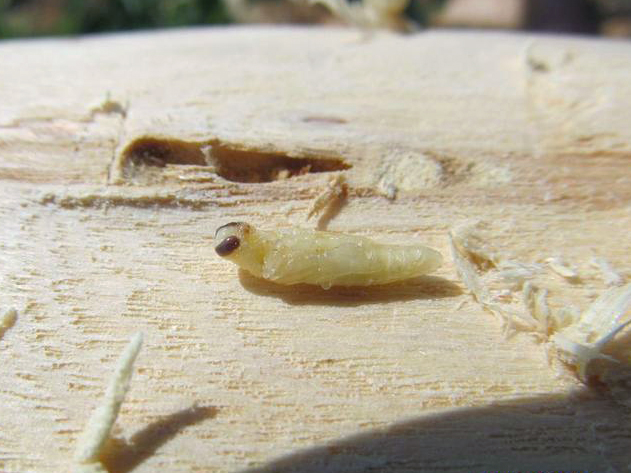
- Pupas are initially cream-colored and darken over time.
- They develop to look more like an adult beetle.
- Adult beetles emerge from the tree in late spring, completing the life cycle.
Ash can tolerate small numbers of EAB larvae. But as pest numbers rapidly increase, the trees are girdled and killed if left untreated. Trees are often killed in about four years, though it can take as little as two years. When EAB first attacks trees, the symptoms are hard to notice.
If you think you have EAB damage on your tree, first make sure the tree is an ash using this ash tree identification chart (PDF, Michigan State University).
Below are some common signs and symptoms of emerald ash borer infestation, but other problems can cause an ash tree to decline. Look for anything that may cause stress to the tree, such as drought, compacted soil, or root girdling (roots circling the trunk). Minnesota is also home to bronze birch borer and twolined chestnut borer, both metallic wood-boring beetles that may be confused with EAB.
Canopy and foliage dieback
The first symptom that you will notice is dieback in the tree's canopy. Smaller leaves and closely spaced buds are also indicators of stress.
During the second year, thinning foliage becomes apparent, and by the third year, canopy thinning is more pronounced. By the fourth year, the canopy has seriously declined and may even be dead.
Black ash in natural stands is prone to ash dieback without EAB. Urban green ash is also prone to branch abscission, which could be confused with dieback, again without EAB.
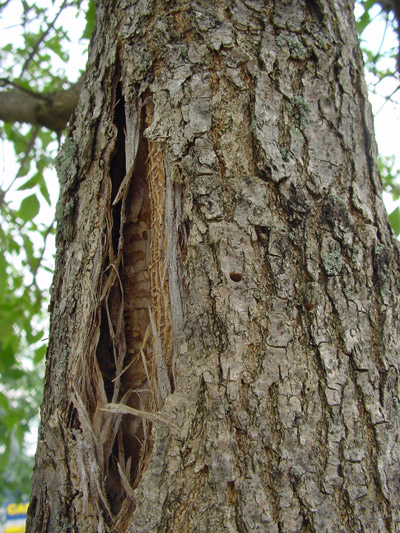
Bark splits
Vertical bark cracks are caused by the tree trying to heal over old galleries. Vertical bark splits may be caused by factors other than EAB, but they are a common symptom in EAB-infested ash trees.
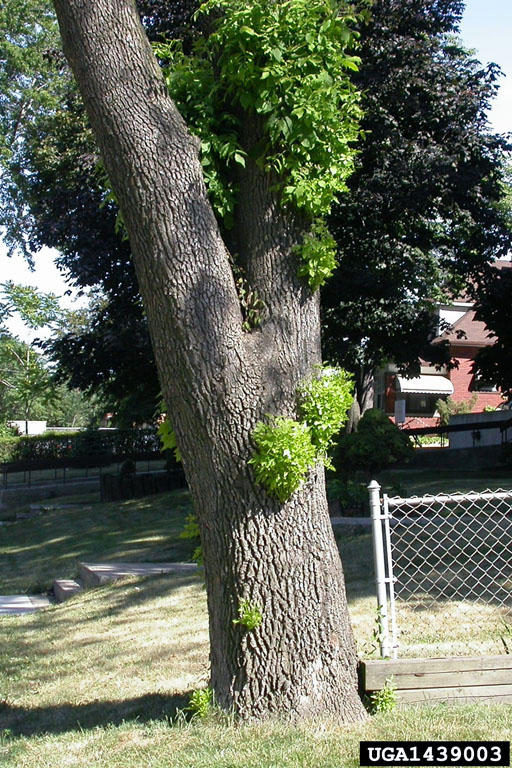
Trunk or branch sprouts
Suckers or sprouts, called epicormic shoots, are another indicator of stress in ash. You may see leafy sprouts, especially along the lower trunk. This can happen as a response to emerald ash borer tunneling. However, the presence of epicormic shoots alone does not mean a tree has EAB.
Insect galleries
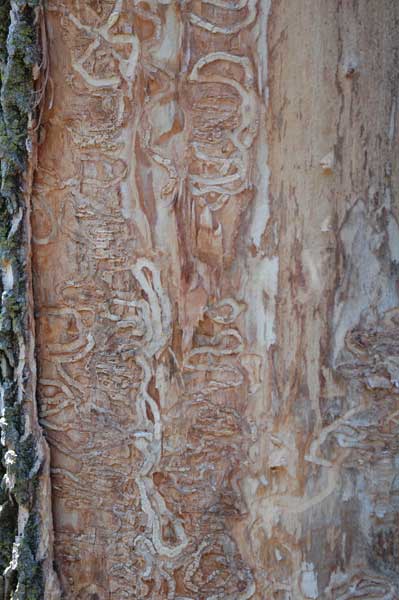
EAB larvae create winding, S-shaped tunnels called galleries in the outer sapwood and in the tissue (phloem) that carries food from the leaves to the rest of the tree. These tunnels interrupt the flow of water and nutrients, eventually girdling the trunk and branches.
The galleries become visible if you remove the bark on the trunk. Not all galleries in ash are caused by EAB.
See Recognizing insect galleries in ash trees (MDA).
Exit holes
Adults emerge in spring, creating small, one-eighth-inch, D-shaped exit holes. These holes might not be visible right away.
Woodpecker activity
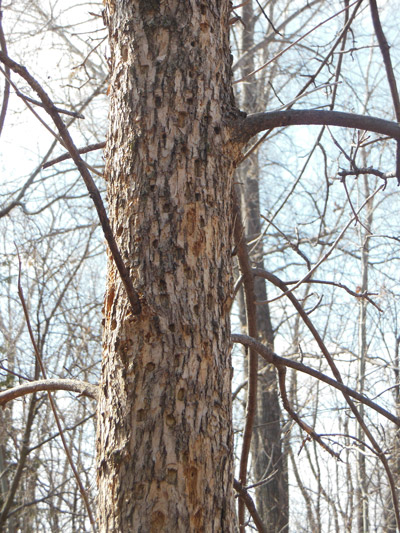
As woodpeckers search for EAB larvae to eat, they damage the bark surface. This causes the bark to appear pale yellow or light brown, called "blonding." This usually begins higher in the tree but may be seen all the way down its trunk and branches.
Woodpecker damage usually becomes apparent in the second year of infestation and becomes more pronounced by the third year.
Severe cold harms EAB and slows its spread and development.
Emerald ash borer larvae overwinter beneath the bark of ash trees. Research has shown that if the temperature reaches -20 degrees F, about 50% of EAB larvae will die. If the temperature reaches -30 degrees F, about 90% of EAB larvae will die.
In the forest, different factors influence whether or not EAB larvae can survive. The location of the tree (for example, whether it's found on a north- or south-facing slope), the diameter of the tree, and the snow depth can all influence whether or not EAB will survive at cold temperatures.
EAB is less vigorous in northern climates compared to more southerly ones. In northern latitudes, EAB larvae are smaller, take longer to develop into insects, and produce fewer eggs.
While cold weather can slow the spread of EAB, the climate alone may not eliminate EAB from Minnesota’s landscape. However, cold temperatures in northern parts of the state have helped limit the spread of EAB into its expansive ash forests.
The Minnesota Department of Agriculture (MDA) has released three parasitoid wasp species to help manage EAB. These wasps do not harm humans and may only be released by MDA.
The U.S. Department of Agriculture’s Animal and Plant Health Inspection Service (APHIS), working with the U.S. Forest Service, did extensive testing on these wasps to ensure they do not negatively impact the environment or other species. It is still unclear if they can slow the spread of EAB.
For more information, visit the MDA’s Biological Control webpage.
Treating or removing infected ash trees
If your ash tree is within 15 miles of a known infestation, it is at a higher risk of being attacked by EAB. See the Minnesota Department of Agriculture EAB status map to locate current infestations.
Ash tree species killed by EAB
- White ash (Fraxinus americana)
- Black ash (Fraxinus nigra)
- Green ash (Fraxinus pennsylvanica)
Tree species not harmed by EAB
- American mountain ash (Sorbus americana)
- Rowan mountain ash (Sorbus aucuparia)
- Showy mountain ash (Sorbus decora)
- Prickly ash (Zanthoxylum americanum)
Effectiveness of insecticides
- The insecticides available for treating EAB are effective in protecting ash.
- Insecticides can protect a tree if it still has most or all of its canopy. If it has lost half of its canopy or more, it is in poor health and treatment might not be effective.
- Insecticides need to be used every 2 or 3 years. Professional arborists can inject emamectin benzoate or azadirachtin into the trunk.
- The best time to treat is when the canopy is full, and the tree is most receptive to treatment. In Minnesota, the best time is May through late September.
- Late summer and fall trunk injections can provide an effective but somewhat lower level of EAB control for two years following treatment.
Treatment guidance for homeowners
- If your tree is beyond 15 miles from any known infestation, you do not need to treat it until EAB is confirmed in your area. The further your ash is from a known occurrence of EAB, the less likely it will become infested.
- Homeowners should only treat trees smaller than 15 inches DBH. Ash trees larger than this are generally best treated by a professional arborist.
- To get the diameter at breast height (DBH), measure the girth of the trunk at 4.5 feet above the ground and divide it by 3.
- Insecticides available from garden centers contain neonicotinoids, which are highly toxic to nectar-feeding bees and butterflies.
- For specific information on pesticides available for homeowners when treating EAB, see Emerald Ash Borer: Homeowner Guide to Insecticide Selection, Use, and Environmental Protection(PDF, MDA).
CAUTION: Mention of a pesticide or use of a pesticide label is for educational purposes only. Always follow the pesticide label directions attached to the pesticide container you are using. Be sure that the area you wish to treat is listed on the label of the pesticide you intend to use. Remember, the label is the law.
If you already have an ash tree in your yard and it is healthy, there is no reason to remove it. As long as it is a low-maintenance plant, keep it in your landscape. We strongly recommend not planting additional ash.
Ash tree removal considerations
- This is a valid option when faced with the risk of EAB.
- The larger the tree, the more expensive it is to remove.
- It is easier and less expensive to remove the tree while it is alive.
- Once an ash tree is dead, the branches become brittle, making it much more challenging and dangerous to cut down.
- EAB carries several decay fungi that can quickly rot branches. The branches become hazardous to people, pets, and property if the tree is not removed.
Ash tree removal best management practices
- Removal is best from November to April to lower the chances of spreading EAB when disposing of infested wood.
- Chipping wood to no more than 1 inch in two dimensions is adequate to kill EAB larvae.
- Cut ash trees, even if uninfested, may not be moved outside of quarantined counties.
- Not all yard waste sites take brush or EAB-infested material. Find the nearest ash tree waste disposal site within the quarantined county.
Hiring an arborist
- Be sure to ask for certificates of insurance and local references.
- Get at least two estimates and do not rush into a decision because you are promised a discount.
- See How to hire a tree care professional.
Using ash wood
The wood of ash trees killed by EAB can still be used for many wood products such as outdoor structures, park benches, tables and wall paneling.
Reviewed in 2026