

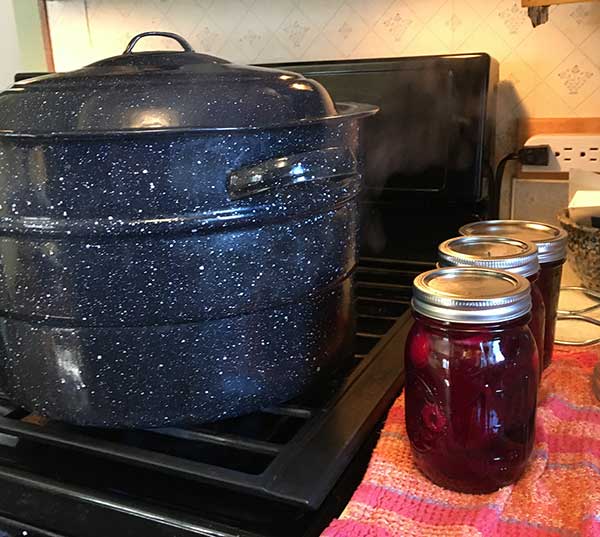
How to use these pressure canning charts
These charts are provided for experienced canners familiar with safe canning methods. The processing times and methods are adjusted for Minnesota altitudes of 1001-2000 feet.
These reference charts include:
- Style of pack
- Jar size
- Headspace
- Process time
Read instructions carefully for dial gauge and weighted gauge information, as well as notes about certain products. Time assumes a full 10-minute exhausting of the pressure canner. Once pressure is raised to the required pressure and stabilized, timing begins according to the chart.
For more complete canning instructions, refer to the National Center for Home Food Preservation.
Low-acid foods
Pressure canning
- Boiling water bath canning is not a safe method for processing low-acid foods. Pressure canning increases the internal temperature of food reached during processing to 240 to 250 degrees Fahrenheit. This higher temperature is needed to inactivate certain pathogens, such as Clostridium botulinum.
- Process time is the most notable variable to pay attention to.
- The style of pack is either hot or raw, but some foods have both packing styles listed.
- Jar size is either pints or quarts, but some foods have both jar sizes listed.
- Head space is often 1 inch, but varies for some foods. Pay close attention to the recipe. Leaving too much headspace and overfilling jars can both cause jars to not seal properly.
- The dial gauge is 11 PSI for all foods for elevations 0 to 2,000 feet. For every 2,000 feet increase in elevation, increase the PSI by 1 pound (eg. 12 PSI for elevations 2,001 to 4,000 feet).
- The weighted gauge is 15 PSI for all foods for elevations above 1,000 feet.
| Type of food and style of pack | Jar size | Headspace | Process time (minutes) |
|---|---|---|---|
| Asparagus, hot and raw | Pints | 1 inch | 30 |
| Asparagus, hot and raw | Quarts | 1 inch | 40 |
| Beans (fresh lima, small), hot and raw | Pints | 1 inch | 40 |
| Beans (fresh lima, small), hot and raw | Quarts | 1 ½ inches | 50 |
| Beans (fresh lima, large), hot and raw | Pints | 1 inch | 40 |
| Beans (fresh lima, large), hot and raw | Quarts | 1 ¼ inches | 50 |
| Beans (green and wax, whole or pieces), hot and raw | Pints | 1 inch | 20 |
| Beans (green and wax, whole or pieces), hot and raw | Quarts | 1 inch | 25 |
| Beans or peas (all varieties, shelled and dried), hot | Pints | 1 inch | 75 |
| Beans or peas (all varieties, shelled and dried), hot | Quarts | 1 inch | 90 |
| Beets (whole, cubed or sliced), hot | Pints | 1 inch | 30 |
| Beets (whole, cubed or sliced), hot | Quarts | 1 inch | 35 |
| Carrots (sliced and diced), hot and raw | Pints | 1 inch | 25 |
| Carrots (sliced and diced), hot and raw | Quarts | 1 inch | 30 |
| Corn (cream style), hot | Pints | 1 inch | 85 |
| Corn (whole kernel), hot and raw | Pints | 1 inch | 55 |
| Corn (whole kernel), hot and raw | Quarts | 1 inch | 85 |
| Fish, raw | Pints | 1 inch | 100 |
| Fish (smoked), raw | Pints | 1 inch | 110 |
| Meat (ground or chopped), hot | Pints | 1 inch | 75 |
| Meat (ground or chopped), hot | Quarts | 1 inch | 90 |
| Meat (strips, cubes or chunks), hot and raw | Pints | 1 inch | 75 |
| Meat (strips, cubes or chunks), hot and raw | Quarts | 1 inch | 90 |
| Mushrooms (whole or sliced) cultivated (not wild), hot | Half-pints, pints | 1 inch | 45 |
| Okra (whole or cut), hot | Pints | 1 inch | 25 |
| Okra (whole or cut), hot | Quarts | 1 inch | 40 |
| Peas (fresh green, shelled), hot and raw | Pints, quarts | 1 inch | 40 |
| Peppers (peeled - whole or sliced), hot | Half-pints, pints | 1 inch | 35 |
| Potatoes (sweet, pieces or whole), hot | Pints | 1 inch | 65 |
| Potatoes (sweet, pieces or whole), hot | Quarts | 1 inch | 90 |
| Potatoes (white, cubed or whole), hot | Pints | 1 inch | 35 |
| Potatoes (white, cubed or whole), hot | Quarts | 1 inch | 40 |
| Poultry and rabbit (without bones), hot and raw | Pints | 1 ¼ inches | 75 |
| Poultry and rabbit (without bones), hot and raw | Quarts | 1 ¼ inches | 90 |
| Poultry and rabbit (with bones), hot and raw | Pints | 1 ¼ inches | 65 |
| Poultry and rabbit (with bones), hot and raw | Quarts | 1 ¼ inches | 75 |
| Pumpkin and winter squash (cubed), hot | Pints | 1 inch | 55 |
| Pumpkin and winter squash (cubed), hot | Quarts | 1 inch | 90 |
| Soups (vegetable, dried beans/peas, meat, poultry, seafood) (no dairy, starches or thickening agents), hot | Pints | 1 inch | 60* (NOTE: For soups containing seafoods, processing time is 100 minutes) |
| Soups (vegetable, dried beans/peas, meat, poultry, seafood) (no dairy, starches or thickening agents), hot | Quarts | 1 inch | 75* (NOTE: For soups containing seafoods, processing time is 100 minutes) |
| Spinach and other greens, hot | Pints | 1 inch | 70 |
| Spinach and other greens, hot | Quarts | 1 inch | 90 |
| Stock (meat or poultry), hot | Pints | 1 inch | 20 |
| Stock (meat or poultry), hot | Quarts | 1 inch | 25 |
See a spreadsheet of this chart or download a PDF.
Fruit products
Pressure canning or boiling water bath canning
Many fruit products are naturally acidic. However, certain fruits require the addition of an acid ingredient during canning. Refer to the notes that accompany the chart below. Additionally, this chart does not provide processing information for fruit toppings, fruit butter or fruit syrups.
- The processing time is impacted by the style of pack, the jar size, and the type of canning (e.g., boiling water bath or pressure canning)
- The style of pack is either hot or raw, but some foods have both packing styles listed.
- Jar size is either pints or quarts, but some foods have both jar sizes listed.
- For fruit products, the headspace is mostly ½ inch. This provides enough room for the liquid in the jar to boil without interfering with the lid seal. The headspace can be different for certain fruits. Pay close attention to the recipe. Leaving too much headspace and overfilling jars can both cause jars to not seal properly.
- The dial gauge is 6 PSI for elevations 0 to 2,000 feet. For every 2,000 feet increase in elevation, increase the PSI by 1 pound (e.g., 7 PSI for elevations 2,001 to 4,000 feet).
- The weighted gauge is 10 PSI for elevations above 1,000 feet.
- Note: The weighted gauge pressure for berries is 5 PSI.
| Type of food and style of pack | Jar size | Headspace | Boiling water bath time (minutes) | Pressure canner time (minutes) |
|---|---|---|---|---|
| Apples (sliced), hot | Pints, quarts | ½ inch | 20 | 8 |
| Applesauce, hot | Pints | ½ inch | 20 | 8 |
| Applesauce, hot | Quarts | ½ inch | 25 | 10 |
| Asian pears (halved or sliced with acid ingredient added*), hot | Pints | ½ inch | 25 | N/A |
| Asian pears (halved or sliced with acid ingredient added*), hot | Quarts | ½ inch | 30 | N/A |
| Berries (whole), hot | Pints, quarts | ½ inch | 20 | 8 (NOTE: Weighted gauge pressure for berries is 5 PSI) |
| Berries (whole), raw | Pints | ½ inch | 20 | 8 (NOTE: Weighted gauge pressure for berries is 5 PSI) |
| Berries (whole), raw | Quarts | ½ inch | 10 | 8 (NOTE: Weighted gauge pressure for berries is 5 PSI) |
| Cherries (whole, sweet or sour), hot | Pints | ½ inch | 20 | 8 |
| Cherries (whole, sweet or sour), hot | Quarts | ½ inch | 25 | 10 |
| Cherries (whole, sweet or sour), raw | Pints, quarts | ½ inch | 30 | 10 |
| Crabapples (sliced with acid ingredient added*), hot | Pints | ½ inch | 25 | N/A |
| Cranberries (whole), hot | Pints, quarts | ½ inch | 20 | N/A |
| Fruit juices, hot | Pints, quarts | ¼ inch | 10 | N/A |
| Fruit juices, hot | Half gallons | ¼ inch | 15 | N/A |
| Fruit purees, hot | Pints, quarts | ¼ inch | 20 | 8 |
| Grapes (whole with acid ingredient added*), hot | Pints, quarts | 1 inch | 15 | N/A |
| Grapes (whole with acid ingredient added*), raw | Pints | 1 inch | 20 | N/A |
| Grapes (whole with acid ingredient added*), raw | Quarts | 1 inch | 25 | N/A |
| Peaches (yellow flesh, not white), apricots and nectarines (halved or sliced), hot | Pints | ½ inch | 25 | 10 |
| Peaches (yellow flesh, not white), apricots and nectarines (halved or sliced), hot | Quarts | ½ inch | 30 | 10 |
| Peaches (yellow flesh, not white), apricots and nectarines (halved or sliced), raw | Pints | ½ inch | 30 | 10 |
| Peaches (yellow flesh, not white), apricots and nectarines (halved or sliced), raw | Quarts | ½ inch | 35 | 10 |
| Pears (halved), hot | Pints | ½ inch | 25 | 10 |
| Pears (halved), hot | Quarts | ½ inch | 30 | 10 |
| Plums (whole or halved), hot and raw | Pints | ½ inch | 25 | 10 |
| Plums (whole or halved), hot and raw | Quarts | ½ inch | 30 | 10 |
| Rhubarb (stewed), hot | Pints, quarts | ½ inch | 20 | 8 |
Note: No pressure canning recipes available for fruit juices, cranberries, grapes, crabapples and Asian pears.
*Asian pears, crabapples and grapes require the addition of an acid ingredient before processing. See below for specific measurements.
Pints
- 1 tablespoon bottled lemon juice
OR - 2 tablespoon 5 percent vinegar
OR - ¼ teaspoon citric acid
Quarts
- 2 tablespoons bottled lemon juice
OR - 4 tablespoons 5 percent vinegar
OR - ½ teaspoon citric acid
See a spreadsheet of this chart or download a PDF.
Tomato products
Pressure canning or boiling water bath canning
- The processing time is impacted by the style of pack, the jar size, and the type of canning (e.g., boiling water bath or pressure canning).
- The style of pack is either hot or raw, but some foods have both packing styles listed.
- Jar size is either pints or quarts, but some foods have both jar sizes listed.
- For tomato products, the headspace is mostly ½ inch. This provides enough room for the liquid in the jar to boil without interfering with the lid seal. The headspace can be different for certain tomato products. Pay close attention to the recipe. Leaving too much headspace and overfilling jars can both cause jars to not seal properly.
- The dial gauge is 11 PSI for elevations 0 to 2,000 feet. For every 2,000 feet increase in elevation, increase the PSI by 1 pound (e.g., 12 PSI for elevations 2,001 to 4,000 feet).
- The weighted gauge is 15 PSI or elevations above 1,000 feet.
| Type of food and style of pack | Jar size | Headspace | Boiling water bath time (minutes) | Pressure canner time (minutes) |
|---|---|---|---|---|
| Crushed tomatoes (no added liquid), hot | Pints | ½ inch | 40 | 15 |
| Crushed tomatoes (no added liquid), hot | Quarts | ½ inch | 45 | 15 |
| Standard tomato sauce, hot | Pints | ¼ inch | 40 | 15 |
| Standard tomato sauce, hot | Quarts | ¼ inch | 45 | 15 |
| Tomatillos (whole and packed in water), hot | Pints | ½ inch | 45 | 10 |
| Tomatillos (whole and packed in water), hot | Quarts | ½ inch | 50 | 10 |
| Tomatoes (whole or halved with no added liquid), raw | Pints, quarts | ½ inch | 90 | 25 |
| Tomatoes (whole or halved and packed in water), hot and raw | Pints | ½ inch | 45 | 10 |
| Tomatoes (whole or halved and packed in water), hot and raw | Quarts | ½ inch | 50 | 10 |
| Tomatoes (whole or halved and packed in juice), hot and raw | Pints, quarts | ½ inch | 40 | 15 |
| Tomato juice, hot | Pints | ½ inch | 40 | 15 |
| Tomato juice, hot | Quarts | ½ inch | 45 | 15 |
| Tomato paste, hot | Half-pints | ½ inch | 50 | N/A |
| Tomato ketchup, hot | Pints | ⅛ inch | 20 | N/A |
Note: To ensure safe acidity in all canned tomato products, add bottled lemon juice or 5 percent vinegar or citric acid directly to the jars before filling with product. See specific measurements for pints and quarts below.
To offset an acid taste in tomato products, add sugar if desired. Do not reduce or omit the acid ingredient.
Pints
- 1 tablespoon bottled lemon juice
OR - 2 tablespoon 5 percent vinegar
OR - ¼ teaspoon citric acid
Quarts
- 2 tablespoons bottled lemon juice
OR - 4 tablespoons 5 percent vinegar
OR - ½ teaspoon citric acid
See a spreadsheet of this chart or download a PDF.
Reviewed in 2026