

This guide is designed especially for fruit and vegetable growers interested in adding cut flowers to their farm mix. It spotlights easy, low-input annual flowers that fit right into small-scale produce systems and can become a new source of income alongside your crops.
Over two growing seasons, Extension researchers tested 53 flower varieties and paired that research with real-world experience from two local farms—California Street Farm and R. Roots Garden in Minneapolis. Each flower was evaluated for bloom quality and harvestability, overall seasonal yield, and how well it attracted beneficial insects while keeping pest pressure in check.
The result? A short list of hardworking flowers that pull double duty—bringing in extra revenue while also supporting pollinators and other helpful insects in your fields. The varieties listed below are standouts, ranking highest for reliable blooms, strong yields, and abundance and diversity of beneficial insects.
Floral terms
Here is a list of terms that describe the functional roles, growth forms, and visual characteristics of flowers and foliage used in floral design and bouquet composition.
Focal: An often large, eye-catching bloom that captures the focus of viewers.
Filler: Flowers that fill in the spaces of a bouquet. Filler flowers are often smaller and in clusters or sprays.
Line: Blooms that grow along a single stem, often used to add height and vertical lines to a bouquet.
Foliage: Greenery used to fill a bouquet, complement flowers, and provide a full appearance.
Form: Blooms that are identifiable primarily by their shape, texture, or structure.
Spray: A cluster of flowers, often growing from one primary stem.
Umbellate: a flower structure in which small clusters of flowers form together to create the appearance of a single flat or slightly curved bloom.
Ombré: the fading of two colors together.
Sunflower ‘Starburst’

This vibrant focal flower produces large blooms from late spring through late summer, making it suitable for a variety of seasonal bouquets. Planting later may allow for usage in fall bouquets.
Harvest: Long, single stems allow for a quick harvest and simple processing. Stems are thicker than those of other flowers and can be dominant.
Insects: ‘Starburst’ was most commonly visited by native bees, soldier beetles, and parasitoid wasps.
Production notes: As the season progresses, usable stems become scarcer, and flowers decrease in size when harvested consistently.
- Sunflowers are relatively unaffected by weather conditions and can reach heights of 6-7 feet.
- Pinch back plants when there are more than four sets of true leaves to encourage branching.
- If growing a different sunflower variety, ensure it is a branching variety before pinching.
Zinnia ‘Benary’s Giant Mix’
Top bloom quality and harvest yield

This multicolored zinnia mix provides focal blooms from early summer to mid-fall. With a variety of vibrant colors, these zinnias can be used in a broad range of bouquets.
Harvest: Zinnia ‘Benary’s Giant Mix’ has predominantly long, straight stems that are easy to harvest and process. This flower produced the highest stem yield and was the focal point of our bouquets for most of the season.
Insects: Blooms were most often visited by syrphids, soldier beetles, and halictids. While not the most common visitors, zinnias were frequently visited by a variety of butterflies and moths, including swallowtails and monarchs.
Production notes: While this plant produces flowers for a majority of the growing season, foliage often begins to see powdery mildew towards the end of the season.
- Powdery mildew does not affect bloom or stem quality.
- ‘Benary’s Giant’ zinnias grow between 3-4 feet tall.
- Pinch back when they have 3-4 sets of true leaves.
- While netting was not used in our research, it may encourage upward growth from the flowers on the outside of the plant.
Matricaria ‘Magic Lime Green’
Prolific filler
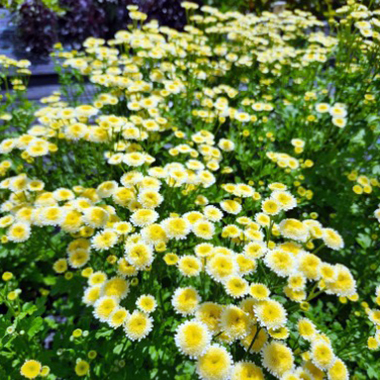
This prolific filler flower produces sprays from mid-spring to mid-summer that complement spring or pastel-colored bouquets.
Harvest: The sprays are easy to harvest; stems can be short, and their dense structure enables high yields from small areas. Processing time is relatively short.
Insects: ‘Magic Lime Green’ was primarily visited by adult syrphids that benefit pollination. However, these plants also supported tarnished plant bugs, a generalist pest of fruit and vegetables.
Production notes: Quality is consistently high throughout the season.
- Heavy rains can impair harvestability and reduce yield.
- Sprays take longer to dry after rain due to dense foliage.
- Although only growing 2-3 feet tall, individual sprays can be cut at the base, providing enough stem length for most bouquets.
Ammi ‘White Dill’
Top attractor of beneficial insects

This quick-growing umbellate filler flower produces blooms from early spring through mid-summer. This flower is often described as lacy and is suitable for a variety of bouquets.
Harvest: Although this flower grows vigorously, its density can sometimes increase the time required for harvesting. Stems are generally long and straight, but can also be curved and angled.
Insects: Ammi blooms were visited by numerous syrphids, halictids, and native bees. In the springtime, the number of insects is often noticeable both visually and audibly. A majority of swallowtail larvae were observed on ammi.
Production notes: This flower does not exhibit the common discoloration and damage issues often seen with white blooms.
- Its height, of approximately 3-4 feet, and density can crowd out other flowers if planted too closely together.
- Once this flower begins to seed, cutting back can be time-consuming.
- Phytophotodermatitis is possible due to Ammi’s high furocoumarin content; so, use gloves when handling this plant.
Salvia ‘Oxford Blue’
Top for attracting beneficial insects and insect diversity

This unique line flower provides a bright purple to a broad range of bouquets from mid-spring to mid-summer. Although this plant has small flowers that benefit pollinators, it is primarily valued for its colorful foliage.
Harvest: Salvia ‘Oxford Blue’ has long, straight stems that are simple to process and harvest; however, multiple stems (3-4) may need to be combined to have the same effect as other line flowers. Processing can also make hands and gloves sticky.
Insects: Salvia blooms were often visited by syrphids, bumblebees, and native bees, as well as cabbage whites, a pest of cabbage-family vegetables. After these flowers began to die back, they were predominantly visited by generalist predators, including spiders and stilt bugs.
Production notes: Growing to approximately 3 feet, this flower is highly prolific.
- Produces numerous high-quality stems throughout the season, even when not actively blooming.
- After the initial dieback, this flower can often be cut back and will regrow later in the season.
Snapdragon ‘Chantilly™ Light Salmon’
Top for harvest yield
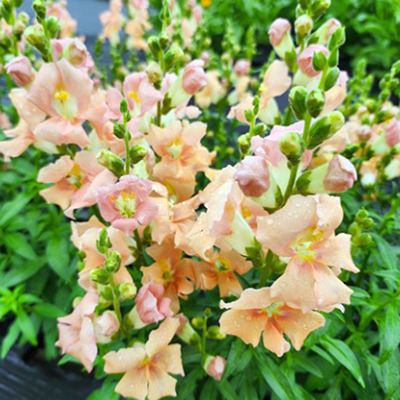
‘Chantilly Light Salmon’ blooms have an orange-salmon ombré appearance that fits into a variety of spring and summer bouquets as a line flower, often providing as striking a stature as many focal flowers. These stems can provide blooms from late spring to mid-fall.
Harvest: Snapdragons are easy to harvest and process because of their long, straight stems; however, they are also susceptible to gravitropism, which can cause stems to bend and angle if not supported or protected from environmental stressors.
Insects: While occasional halictids and syrphids visited snapdragons, they were consistently observed to host large numbers of stilt bugs.
Production notes: Ensure snapdragons are supported by netting or protected from strong winds and rain, as the blooms can become unusable if the stems begin to grow at different angles.
- Low tunnels and other coverings can reduce wind damage and cause stems, typically around 3 feet tall, to elongate.
- These flowers can produce a second, smaller harvest later in the season, after the first harvest is complete.
Amaranth ‘Hopi Red Dye’
Bold color and texture
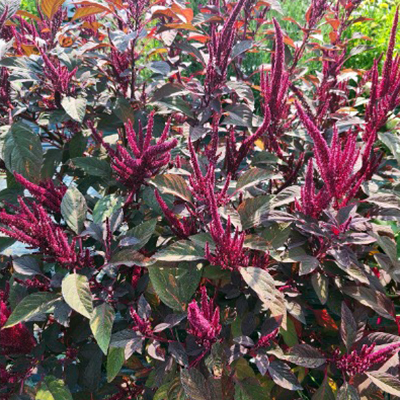
‘Hopi Red Dye’ Amaranth brings a deep red foliage that is attractive in both fall and dramatic bouquets. This flower grows vigorously from mid-spring to mid-fall and can be used for both its foliage and its blooms.
Harvest: Harvesting and processing ‘Hopi Red Dye’ foliage and blooms is relatively easy; however, removing foliage by hand can cause strings of plant material to be removed. Stems can become crooked when exposed to wind. Stems are typically thick and can occupy considerable space in a vase.
Insects: ‘Hopi Red Dye’ is most commonly visited by pests such as tarnished plant bugs and aphids; however, due to its proliferation, no damage is typically observed.
Production notes: As the season progresses, the deep red of the foliage may begin to fade.
- For fall bouquets, it may be advantageous to plant later in the season or to cut back existing foliage to encourage regrowth of fresh, deep-red leaves.
- When harvesting blooms, ensure the plant has not yet set seed, as this variety produces a large number of seeds.
- As this plant can grow up to 6 feet tall, there may be issues with toppling and breakage due to the weight of the flower heads.
Celosia ‘Raspberry Lemonade’
Top for harvest yield

‘Raspberry Lemonade’ is a plumed celosia variety with bright red flowers and a unique texture. It works as both a filler and a form flower. This bloom produces high-quality flowers and stems from early summer through mid-fall and is well-suited for summer and wedding bouquets.
Harvest: Celosia can often fill different roles depending on harvest times. As the plant grows, the plumes become larger and more dramatic. Stems are straight but can become thick with age.
Insects: ‘Raspberry Lemonade’ was visited primarily by bumblebees and syrphids in the late summer, but insect activity was overall relatively low.
Production notes: This variety of celosia can grow to 4-5 feet tall, allowing harvestable stems; other varieties can be much shorter.
When choosing a celosia, consider the flower shape (plumed, wheatlike, cockscomb) and its height for your desired bouquet style.
Availability of this specific variety may be limited; however, similar colors may be more widely available.
Marigold ‘Giant Yellow’ and ‘Giant Orange’
Top for bloom quality and insect diversity
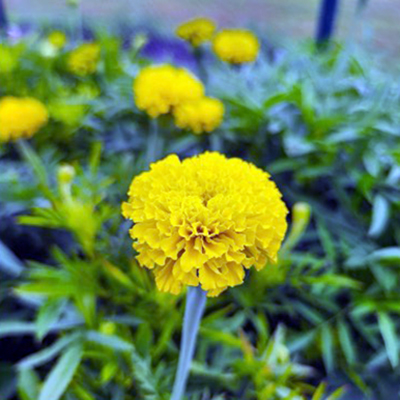
Both ‘Giant Yellow’ and ‘Giant Orange’ are varieties of focal marigolds that provide high-quality, large blooms from late spring to mid-fall. This bloom fits nicely into a broad range of bouquets, from rustic to modern (Hardiness Zone Range: 2-11).
Harvest: ‘Giant Orange’ and ‘Giant Yellow’ marigolds both have similar growth patterns, and when deciding between the two, the biggest concern is the desired color. ‘Giant Orange’ tended to arrive slightly later, but only by a few days. Harvesting marigolds is relatively easy, with long, straight stems. However, when removing foliage, pruners may be required because the stems can break if removed by hand.
Insects: ‘Giant Orange’ and ‘Giant Yellow’ were most often visited by beneficial insects such as syrphids, soldier beetles, and minute pirate bugs, as well as pests including tarnished plant bugs. Although these marigolds did not attract many insects overall, they supported a broad diversity of insects.
Production notes:
- These marigold varieties can grow up to 4 feet tall, providing high-quality stems for bouquets.
- Blooms remain harvestable for the longest period.
- Occasionally, the stems can become thick, taking up space in the vase.
Ageratum ‘Dondo Blue’
Top for harvest yield and beneficial insects
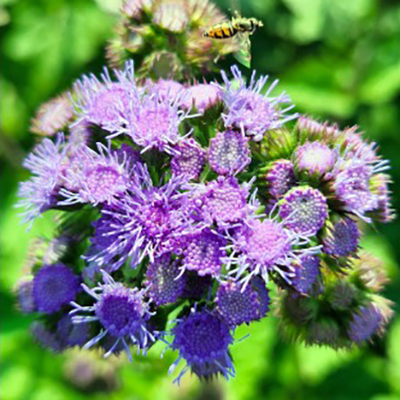
‘Dondo Blue’ is a long-stemmed variety of ageratum that acts as both a filler and a form flower. This bloom is harvestable from early summer to early fall and has a unique purple-blue color that pairs well with both garden and wedding bouquets.
Harvest: Due to the numerous long stems, harvesting a large number of blooms required minimal input. One of the primary difficulties encountered was having more usable ageratum stems than our bouquets could accommodate, so many went unused during peak season.
Insects: ‘Dondo Blue’ was most often visited by beneficial insects, such as syrphids and halictids, ranking among the top 5 most-visited plants. We also observed soldier beetles on ageratum blooms.
Production notes: ‘Dondo Blue’ ageratum grows up to 3 feet tall and has stems that are relatively easy to harvest.
- After heavy rainfall, the shape of the blooms can trap water in the flowerhead.
- If the water remains for extended periods, it can cause the blooms to become discolored.
Reviewed in 2026