

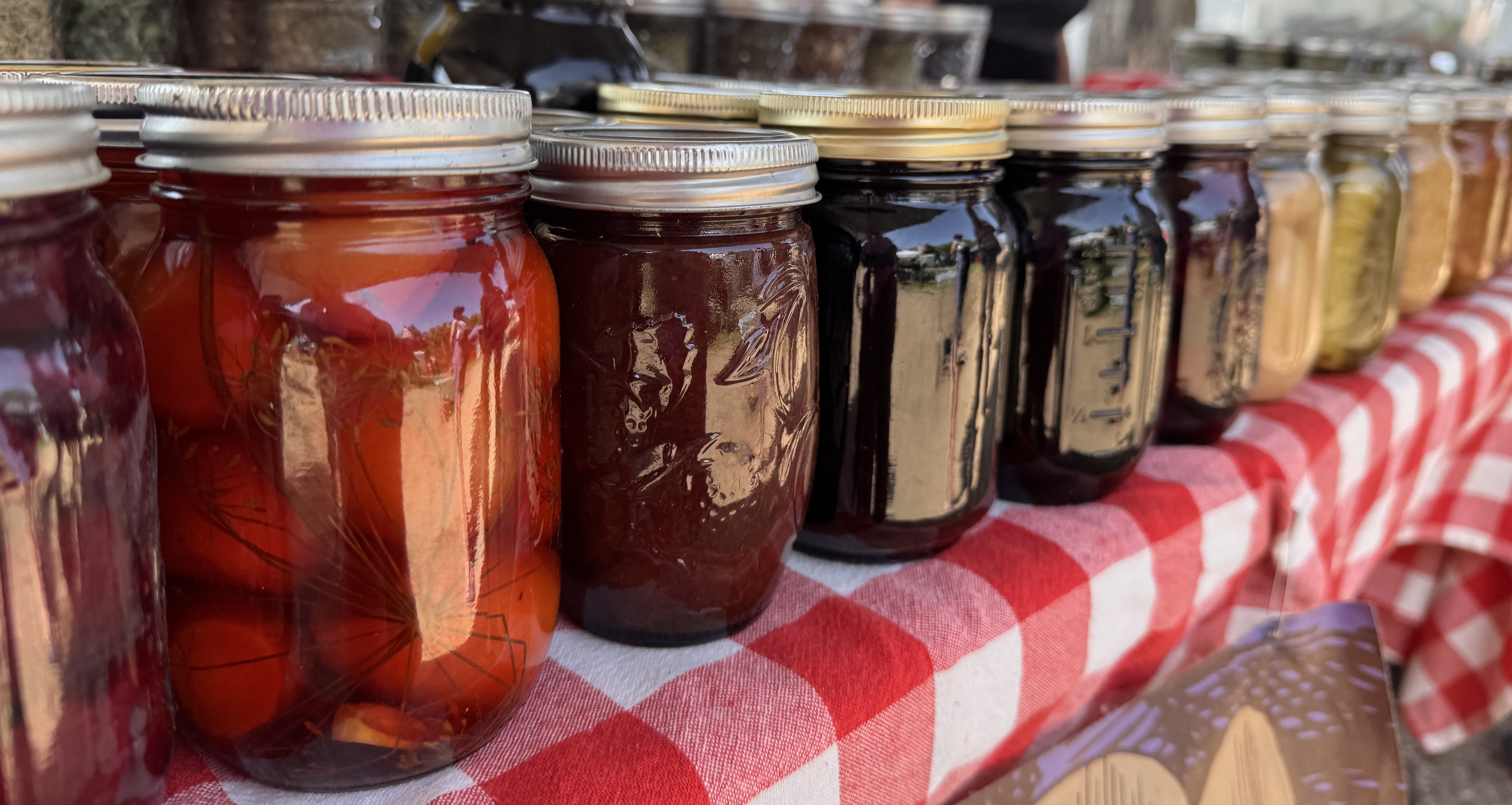
Canning can be a safe and personally rewarding way to preserve quality food at home. Canning special products for family and friends is a fulfilling experience and a source of pride for many people.
To preserve safe, high-quality food at home:
- Follow a research-based recipe. We recommend The National Center for Home Food Preservation.
- Use fresh, high-quality foods.
- Understand key food safety terminology.
- Know how to inspect your final product for quality and safety.
What impacts the quality and safety of home-canned foods?
Food quality
Always select good-quality produce and use safe handling practices when preparing produce for fruit spreads, naturally acidic fruits, pickled and acidified produce, and low-acid foods.
Acidity
Knowing the acidity of the produce you are preserving determines which canning method you will use.
Oxygen
Canning creates an anaerobic environment inside the jar. This slows oxidation or the change in color of preserved food over time, especially when stored correctly in a cool, dry, dark place.
Temperature and time
Processing jars of food at the correct temperature for the required amount of time inactivates pathogens that may lead to foodborne illness and stops ripening enzymes. This also ensures a hermetic, air-tight, seal on the jar which prevents contamination from pathogens, such as mold, during storage.
If foods are not properly canned, they may still look, smell and taste “normal”, but are potentially unsafe. However, by controlling these food safety factors and following research-based recipes and procedures, home-canned foods are shelf stable and may be stored for 12 months.
Once canned foods are opened, they must be refrigerated until used.
Home canning methods
Boiling water bath canning, atmospheric steam canning and pressure canning are all safe options for canning your food at home.
Suggested methods and recipes
For recipes to get started, we suggest using research-based recommendations from .
Cut food into uniform-sized pieces
This will allow an even transfer of heat during processing.
Inspect and clean jars before use
- Do not use jars with chips or cracks.
- Hand-wash jars in soapy water, then rinse with fresh water, or wash in a dishwasher.
Sterilize jars that will be filled with food and processed for less than 10 minutes
This is important as it reduces the risk of cross-contamination. To sterilize jars:
- Place a rack in the bottom of a large pot and set the empty jars, right side up, on top of the rack.
- Fill the pot and jars with warm water. Cover the tops of the jars with at least 1 inch of water.
- Bring the water to a boil.
- Boil the jars for the required amount of time:
- 10 minutes for elevations at or below 1,000 feet (sea level)
- Add 1 additional minute for each additional 1,000 feet of elevation. In Minnesota, the sterilization time will be 11 minutes.
- Remove the jars from the water and let them air-dry.
Follow the manufacturer's instructions for the metal lid flat type you are using
- A two-piece lid is the standard for home canning. It is made of a flat metal lid with a sealing compound along the edge that helps form an airtight seal on the jar, and a metal screw band that holds the lid in place during processing.
- Certain metal lid flats should not be warmed before placing them on the jar.
- A metal lid flat should only be used once for canning. Recycle the used lid flat, or label them “used” and use them for other purposes, such as storing dried foods (e.g., pasta, dry beans) or non-food items in jars. These foods or items do not need an airtight seal. The metal screw band may be reused until it becomes dented or rusted.
After filling jars with food
Release air bubbles by inserting a flat plastic (not metal) spatula between the food and the jar.
Slowly turn the jar and move the spatula up and down to allow air bubbles to escape.
Adjust the headspace, then clean the jar rim (sealing surface) with a damp paper towel.
Place the lid, gasket down, onto the cleaned jar-sealing surface. Uncleaned jar-sealing surfaces may cause seal failures.
Fit the metal screw band over the flat lid. Follow the manufacturer's guidelines enclosed with or on the box for properly tightening the jar lids. Do not re-tighten lids after processing jars. As jars cool, their contents contract, pulling the self-sealing lid firmly against the jar to create a high vacuum.
If rings are too loose, liquid may escape from jars during processing, and seals may fail. If rings are too tight, air cannot vent during processing, and food will discolor during storage.
Overtightening also may cause lids to buckle and jars to break, especially with raw-packed, pressure-processed food.
Getting started
Boiling water bath canning is used to process naturally acidic and acidified foods with a pH of 4.60 or less.
Examples of naturally acidic and acidified foods include:
Pickled produce
Many fruits
Acidified tomato products
Preserved fruit spreads
Relishes
Chutneys
Fermented produce
Finding the right tools
A boiling water bath canner is typically made of stainless steel, aluminum, or enamel. A large pot may be used instead of a canner, as long as it has a secure-fitting lid or cover.
Whether you use a canner or a large pot, it must meet the following criteria:
- A rack in the bottom of the canner or pot. The jars of food must sit on the rack to ensure even water circulation and heating.
- Tall enough that the top of the jars can be covered with 1 to 2 inches of water without water boiling over the edge of the pot.
- Fits on the burner and has a flat bottom. Do not use the canner or pot if it extends 2 or more inches beyond the burner (One inch on each side of the canner or pot).
- Avoid using a ceramic cooktop for canning. Many manufacturers do not recommend this. The size and weight of the pan, along with extended cooking times, can damage the cooktop and may void the warranty if the manufacturer advises against it. Check your cooktop manufacturer's recommendations.
Steps for safe boiling water bath canning
Always follow the manufacturer's instructions for your specific device.
- Put the rack in the bottom of the canner or pot.
- Fill the canner or pot with enough water so the tops of the jars are covered by 1 to 2 inches of water.
- Preheat and maintain the water temperature as specified by the pack style.
- Place the filled jars into the canner or pot, leaving space between each jar for the water to flow freely.
- Do not tilt jars when loading into the canner. Food and liquid in the jar could slide into the seal.
- Adjust the water level as needed to ensure 1 to 2 inches of water is above the jars.
- For processing times of 30 minutes or longer, the water level should be at least 2 inches above the jars.
- Place the lid on the canner or pot. Turn up the heat to bring the water to a boil.
- Once the water is at a rolling boil, start the processing time. Adjust the heat down as needed, so long as the water remains at a rolling boil.
- Follow the processing time based on your elevation as detailed in the recipe.
- During processing, if the water level falls below the tops of the jars, add more hot water to the canner by pouring it around the jars, not directly onto the lids. (Pouring directly onto a lid may interfere with the seal.)
- If you add additional hot water, restart the processing time.
- Once the processing time is complete, turn off the heat.
- Remove the canner or pot lid.
- When removing the lid, open it away from you to prevent steam from blowing directly into your face.
- Leave the jars in the canner or pot for 5 minutes to allow the water to cool down slightly.
- Carefully remove the jars using a jar lifter or tong and allow them to cool at room temperature for 12 to 24 hours.
- Do not touch the jars with your bare hands.
- Do not force the jars to cool, as this can affect lid sealing.
- Once cooled, test that the lids have sealed. Press down on the middle of the lid. If the lid clicks or springs up when released, the lid did not seal. If this happens, reprocess or refrigerate the jar.
- Remove the screw band from all properly sealed jars for storage.
- Label and date each jar with the contents and the date they were processed.
Getting started
Atmospheric steam canning is an alternative to boiling water bath canning for naturally acidic and acidified foods that are thermally processed for less than 45 minutes. An atmospheric steam canner uses less water than a boiling water bath canner, which limits the processing time.
Products that can be processed using this method:
Preserved fruit spreads
Pickled produce
Some acidified tomato products
Finding the right tools
An atmospheric steam canner is typically made of lightweight aluminum and has these components:
- A Shallow base and a rack that sits in the bottom of the base. This is important to allow the steam to circulate around all sides of the jars.
- A tall dome cover that has vent port(s) on the side. The vent port allows steam to push the air out during heating. A pot cannot be used in place of an atmospheric steam canner because of the vent ports.
- A temperature sensor or gauge in the lid to monitor the steam temperature.
- Avoid using a ceramic cooktop for canning. Many manufacturers do not recommend this. The size and weight of the pan, along with extended cooking times, can damage the cooktop and may void the warranty if the manufacturer advises against it. Check your cooktop manufacturer's recommendations
Steps for safe atmospheric steam canning
Always follow the manufacturer's instructions for your specific device.
- Preheat and keep the jars warm before filling with food. This must be done regardless of the pack style used.
- When filling the base of the atmospheric steam canner with water, ensure the water line is not above the rack. The water does not need to be preheated.
- Place the filled jars into the steam canner, leaving space between each jar for the steam to flow freely.
- Do not tilt jars when loading into the canner. Food and liquid in the jar could slide into the seal.
- Cover with the canner dome.
- Follow the processing time based on your elevation listed on recipes for boiling water bath canning.
- Processing time begins when steam steadily flows from the side vents. The steam flow may be 4 to 6 inches tall. This means the water in the base has reached boiling point, the dome is full of steam, and all air is pushed out of the canner. At this point, the steam will effectively heat the food in the jars to the safe minimum internal temperature, and an airtight seal will form.
- Follow your specific device instructions. Some may have a built-in temperature sensor in the lid. If it does not, it is recommended to keep a dial-stem or digital thermometer inserted in the canner through the vent. The temperature must stay at boiling.
- Once the steam is flowing out of the vent port(s), you may turn down the heat but maintain the flow of steam and/or use the temperature sensor in the lid. The dome cover should not be rocking or whistling. If this happens, it indicates there is too vigorous of a boil and the canner may run dry before processing is complete.
- If the canner runs dry, more water must be added to the base and the processing time starts over once the steam is steadily flowing again. Alternatively, you can stop the atmospheric steam canning process and refrigerate or freeze the food instead.
- Once the processing time is completed, turn off the burner.
- Allow the canner to cool before lifting the lid. When opening the lid, tilt it away from you so any residual steam flows away from you.
- Carefully remove the jars and let them cool to room temperature. Do not force cool the jars as this can impact the sealing of the lids.
- Test that the lids have sealed. Press down on the middle of the lid. If the lid clicks or springs up when released, the lid did not seal. If this happens, reprocess or refrigerate the jar.
Getting started
Pressure canning is the only safe option for canning low-acid foods. It may also be used to process certain acidic fruits and acidified tomato products. The food and liquid inside the jars reach an internal temperature between 240 and 250 degrees Fahrenheit. These temperatures are above the boiling point of water and are achieved by changing the pressure into the canner.
Finding the right tools
There are two types of pressure canners. It is important to know which type you are using, as this determines the processing pressure and time you must follow.
Weighted-gauge pressure canners
The pressure inside the canner is monitored using a pressure regulator or counterweight. The pressure regulator may be one- or three-piece, and will be able to regulate for 5, 10, and 15 pounds of pressure per square inch (PSI). When the pressure inside the canner is at the desired PSI, the regulator will rock or jiggle.
Dial-gauge pressure canners
The pressure inside the canner is monitored by a dial on the canner lid. An indicator arrow will move along the scale indicating the pressure inside the canner. The dial gauge should be tested annually to verify its accuracy.
Key features: Dial-gauge and weighted-gauge pressure canners
The features of pressure canners may vary by brand and model. These are key features to be able to identify and inspect to ensure your canner is functioning properly.
- Jar rack: Insert into the bottom of the canner. Place the jars on the rack so water and steam can move freely around them.
- Gasket: This rubber seal around the lid creates an airtight seal with the base of the canner. Over time the gasket may become worn or cracked. It is important to be sure it is pliable (not cracked or dried out) and replace it as needed.
- Air vent or cover lock: This vents air from inside the canner as pressure is building.
- Locking bracket: This mechanism prevents the lid from being opened when there is pressure inside the device.
- Safety fuse or overpressure plug: This automatically pops up to release steam in case the vent pipe becomes blocked.
- Vent port or pipe: Also called a steam port or petcock, this hollow pipe extends from the inside of the canner to above the lid. Air and steam are exhausted or vented from inside the canner. Once exhausting (venting) is completed, the pressure regulator is placed over the vent pipe to monitor the pressure.
Steps for safe atmospheric steam canning
Always follow the manufacturer's instructions for your specific device.
- Fill the pressure canner with 2 to 3 inches of water.
- Preheat and maintain the water temperature as specified by the pack style.
- Heat an extra pot of water and keep it warm in case additional boiling water is needed once the jars are added to the canner.
- Preheat and keep the jars warm before filling with food. This must be done regardless of the pack style used.
- Place the filled jars into the pressure canner, leaving space between each jar for the steam to flow freely.
- Do not tilt jars when loading into the canner. Food and liquid in the jar could slide into the seal.
- Secure the canner lid.
- Leave the vent port open. This is also called a steam port or petcock.
- Heat the canner until the water is boiling and steam flows steadily from the open vent port. Allow the device to vent or exhaust for 10 minutes. This is important to allow pressure to build once the vent port is closed.
- Place the pressure regulator on the vent port to close it. The canner will now begin to pressurize.
- For a dial-gauge canner allow the pressure to build rapidly until 8 PSI is reached. Then turn down the heat and allow the pressure to build slowly to the required PSI for your elevation.
- For a weighted-gauge canner allow the pressure to build rapidly until the gauge is rocking or jiggling. Then turn down the heat but maintain a steady rocking or jiggling.
- The processing time begins when the correct PSI is reached.
- Follow the processing time based on your elevation listed on the recipes for the specific type of pressure canner.
- As needed, adjust the heat to maintain the pressure.
- If the processing is interrupted, the processing time must start over.
- Once the processing time is complete, turn off the heat. Allow the canner to cool. This is called depressurizing. Do not force cool the canner.
- Once the canner is depressurized, remove the pressure realtor from the vent port.
- Wait 10 minutes before removing the canner lid. When removing the lid, open it away from you to prevent steam from blowing directly into your face.
- Carefully remove the jars using a jar lifter or tongs and allow them to cool at room temperature for 12 to 24 hours.
- Do not touch the jars with your bare hands.
- Do not force-cool the jars, as this can affect lid sealing.
- Once cooled, test that the lids have sealed. Press down on the middle of the lid. If the lid clicks or springs up when released, the lid did not seal. If this happens, reprocess or refrigerate the jar.
Immediately after processing
When you remove hot jars from a canner, don’t re-tighten their jar lids. Re-tightening of hot lids may cut through the gasket and cause seal failures.
Cool the jars at room temperature for 12 to 24 hours.
Jars may be cooled on racks or towels to minimize heat damage to counters.
The food level and liquid volume of raw-packed jars will be noticeably lower after cooling. Air is exhausted during processing, and food shrinks. If a jar loses too much liquid during processing, don’t open it to add more.
Testing jar seals
After cooling jars for 12 to 24 hours, remove the screw bands and test the seal by pressing the middle of the lid with a finger or thumb. If the lid springs up when you release your finger, the lid is unsealed.
Reprocessing unsealed jars
If a jar fails to seal, remove the lid and check the jar sealing surface for tiny nicks. If necessary, change the jar, add a new, properly prepared lid, and reprocess within 24 hours using the same processing time.
Headspace in unsealed jars may be adjusted to 1½ inches, and jars could be frozen instead of reprocessed.
Foods in single unsealed jars could be stored in the refrigerator and consumed within several days.
Storing canned food
If lids are tightly hermetically (heat-sealed and airtight) sealed on cooled jars:
- Remove screw bands.
- Screw bands are not needed on stored jars. When removed, washed, dried and stored in a dry area, screw bands may be used many times. If left on stored jars, they become difficult to remove, often rust, and may not work properly again.
- Use a clean, soapy cloth to wash the lid and jar to remove food residue.
- This is important to minimize the risk of any mold growth.
- Rinse and dry jars
- Label and date the jars
- Store jars in a clean, cool, dark, dry place at 50 to 70 degrees Fahrenheit. Exposure to light can cause certain foods to lose quality. If exposed to moisture, the lid may rust.
- Avoid stacking home-canned jars, as this can put pressure on the seal.
- If storage space is limited and you need to stack jars, offset them so they overlap instead of placing them directly on top of each other. Do not stack higher than two layers.
Storage times
Home-canned foods have a shelf life of 12 months. This is shorter than commercially canned foods because the equipment used for commercial canning results in a much stronger seal that has a lower risk of failing during storage.
Factors limiting shelf-life
- Metal lids on glass jars can rust. When rust is deep enough, tiny holes open in the can or lid that may let spoilage agents in. corrosion. Food reacts chemically with the metal lid, especially high-acid food like canned tomatoes and fruit juices.
- Temperatures over 100 degrees Fahrenheit are harmful to canned foods. The risk of spoilage jumps sharply as storage temperatures rise. At prolonged storage temperatures above 75 degrees Fahrenheit, nutrient loss in canned foods increases. Light can cause color changes and nutrient losses in foods canned in glass jars.
Types of food: Acidic, acidified, and low-acid
Acidic and acidified foods
Naturally acidic and acidified foods have a pH of 4.60 or less. Depending on the type of food and recipe, these foods are safely processed using a boiling water bath canner, an atmospheric steam canner, or a pressure canner.
Examples
- Most fruits
- Pickled produce
- Fermented produce
- Preserved fruit spreads (e.g. jams, jellies)
- Acidified tomato products
Low-acid foods
Pressure canning is the only safe option for canning low-acid foods.
A concern with canning low-acid foods is botulism. Botulism is the foodborne illness caused by consuming improperly processed low-acid foods. Clostridium botulinum spores are found naturally throughout the environment, in the soil, air, and on the surfaces of food. The spores are not a concern until a low-acid food is preserved in an anaerobic (low oxygen) and low acidity (pH above 4.60) environment, such as in a canning jar.
Low-acid foods must be thermally processed at a very high temperature, between 240 and 250 degrees Fahrenheit, for a specific amount of time to destroy any spores that may be present. When a low-acid food is improperly processed, the spores germinate to vegetative cells. These vegetative cells produce the botulinum toxin that causes botulism when the contaminated food is eaten.
Examples
- Vegetables
- Beans
- Legumes
- Meat
- Poultry
- Seafood
Key terms
It is important to understand each of these terms as they have a direct impact on the safety of your home canned foods.
Jar size
Mason-style jars are made from tempered glass to prevent shattering during canning. Jars are available in regular and wide-mouth sizes. Use the correct size two-piece lid for sealing the jar. The most common jar sizes used for home canned foods are:
- Quarter-pints: ½ cup or 4 ounces
- Half-pints: 1 cup or 8 ounces
- Pints: 2 cups or 16 ounces
- Quarts: 4 cups or 32 ounces
- Half-gallon: 8 cups or 64 ounces
Pack style
The method for filling jars with food and canning liquid.
Raw pack (or cold pack)
- You may also see this referred to as cold pack.
- The food is not cooked in the canning liquid before filling the jar, however, the canning liquid is warm.
- Before placing the filled jars in the canner, the water inside the canner is heated to 140 degrees Fahrenheit. This is to prevent the jars from shattering and to ensure the food is properly heated during processing.
- This pack style is the preferred method for:
- Pickled produce that can lose its shape or color easily during processing, such as sliced onions, asparagus, or green beans.
- Some low-acid vegetables, acidified tomato products, and naturally acidic fruit recipes may use the raw pack style.
Hot pack
- The food is cooked in the canning liquid for 2 to 5 minutes before being filled into the jar.
- The jars are filled with hot food and canning liquid.
- Before placing the filled jars in the canner, the water inside the canner is heated to 180 degrees Fahrenheit.
- This pack style is the preferred method for:
- Pickled produce that is firm or dense and acidified tomato products: heat speeds up the acidification process.
- Fruit spreads like jams and jellies that are processed for a short period of time.
- Low-acid vegetables that are dense and starchy.
Headspace
This is the empty area in a jar between the top of the food or liquid and the lid.
- The amount of headspace is determined by the type of food being canned.
- During canning, the liquid in the jar will boil.
- Adequate space is needed so the boiling liquid does not interfere with the seal of the jar.
- Measure the headspace after adding food and liquid to the jar. Adjust the level of food or liquid as needed.
- During processing, oxygen is driven out of the jar until a vacuum is created inside of the jar and the seal seals.
- Do not adjust the headspace.
Elevation
The elevation of your kitchen will impact the temperature at which water boils. The average elevation in Minnesota is 1,200 feet. Look up your elevation before canning.
At the elevation of 0 feet (sea level) to 1,00 feet, water boils at 212 degrees Fahrenheit. As elevation increases, water boils at a lower temperature due to lower atmospheric pressure. This impacts the processing time needed to ensure a safe product. As the elevation increases, processing time increases because it takes food longer to reach a safe internal temperature. A research-based recipe will include the processing times based on elevation.
Processing time
This is the amount of time a filled jar is thermally processed in the canner. It should not be adjusted. If processing is interrupted, you must restart the processing time.
The processing time is determined by:
- Jar size
- Pack style
- Headspace
- Elevation
Identifying spoiled canned foods
How to check jars thoroughly
- As each stored jar is selected for use, examine its lid for tightness and vacuum. Lids with concave centers have good seals.
- Next, while holding the jar upright at eye level, rotate the jar and examine its outside surface for streaks of dried food originating at the top of the jar.
- Look at the contents for rising air bubbles and unnatural color.
- While opening the jar, smell for unnatural odors and look for spurting liquid and cotton-like mold growth (white, blue, black or green) on the top food surface and underside of the lid.
What to do if you detect spoilage
Do not taste food from a jar with an unsealed lid or food showing signs of spoilage. You can more easily detect some types of spoilage in jars stored without screw bands. Growth of bacteria and yeast produces gas, which pressurizes the food, swells lids, and breaks jar seals.
Never use foods from containers with these warning signs:
- Loose or bulging lids on jars
- Color changes
- Cloudy liquid
- Sediment in jars
- Bubbles in the food
- Slimy food
- Bulging, leaking or badly dented cans, especially along the top, side and bottom seams
- Foul odor - remember not all spoiled foods will have an odor.
If canned food has spoiled
Dispose of it by following these recommendations from the National Center for Home Food Preservation.
Reviewed by Amy Johnston, Extension Educator, Food Safety
Reviewed in 2026