

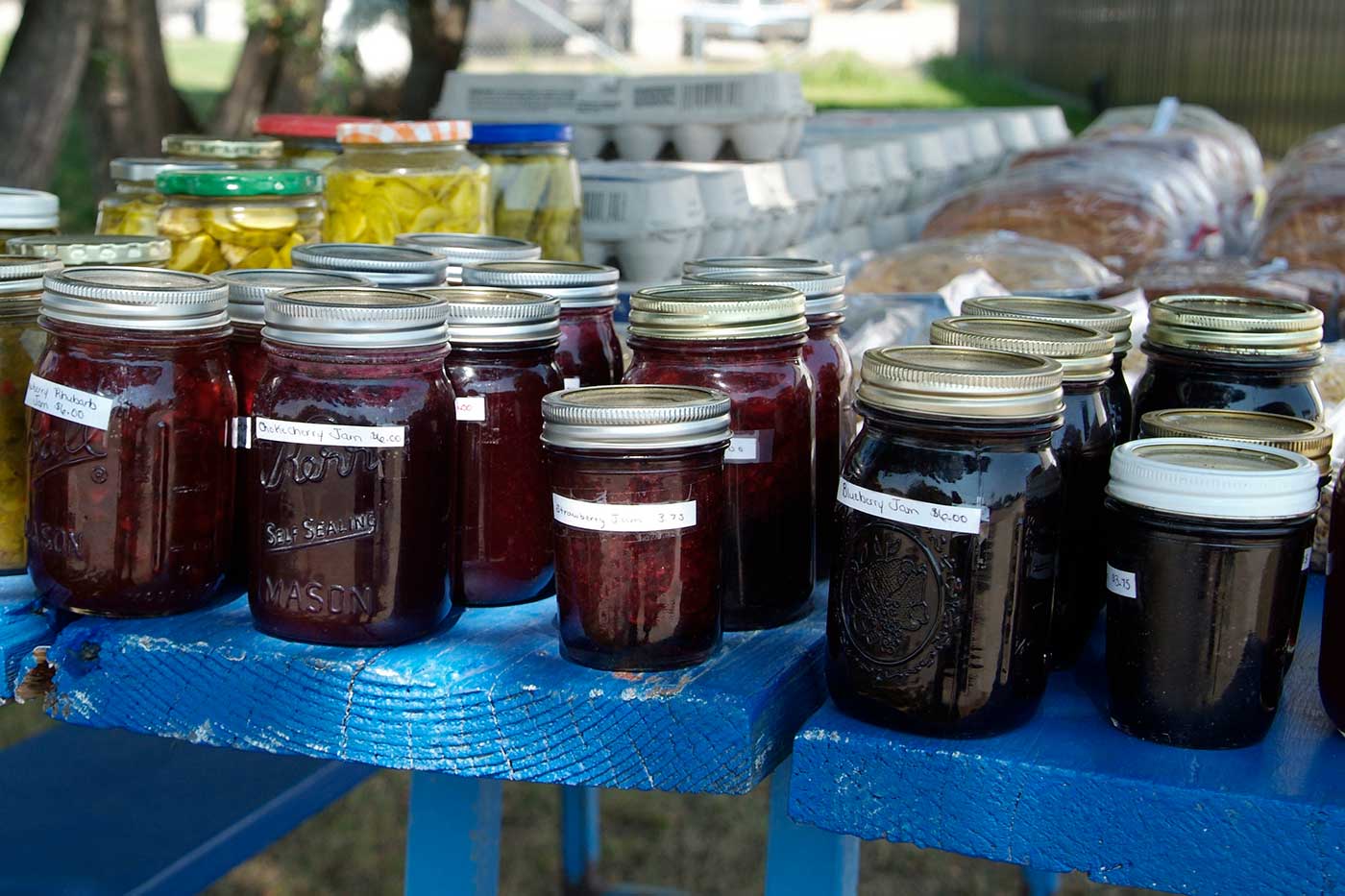
There are a variety of fruit spreads you can make and preserve at home. Once prepared, these fruit spreads may be canned for shelf-stable storage, refrigerated for immediate use or frozen.
For recipes to get started, we suggest using research-based recommendations from . While their preparation may vary slightly, all of these fruit spreads are preserved by lowering their water activity and are acidic.
Types of fruit spreads
- Jellies are a clear, semi-solid mixture of fruit juice and sugar. They are cooked to a specific temperature, the jelly point, to ensure gel formation.
- Jams are made from crushed or ground fruit and usually have a thick consistency due to high pectin content.
- Marmalade is a jelly with pieces of fruit suspended in it. Citrus peel and juice are frequently the basis of marmalade.
- Preserves contain whole fruit or small pieces of fruit in a thick sugar syrup.
- Conserves are jams made from a mixture of fruits. They usually contain citrus fruit, nuts and raisins.
- Fruit butters are smooth, thick spreads that are made by cooking a fruit pulp with sugar and seasonings.
- Fruit syrups are a concentrated fruit juice and sugar mixture
- Fruit honey is a thick fruit syrup made by reducing a fruit juice and sugar mixture to the consistency of a honey.
4 key ingredients
Before preparing fruit spreads, it is important to understand the quality and food safety roles each key ingredient plays.
Always wash fruit before using. Avoid using pieces that are damaged with cracks, holes or severe bruising. These can be entry points for pathogens and lead to contamination.
The fruit provides:
- A flavor and aroma. For the most flavorful product, use fruit that is in season. You may use frozen fruit but properly thaw before using.
- A water source to dissolve other ingredients. Use fruit that is at room temperature as it will release its juice faster
- A source of pectin. The amount of natural pectin will vary depending on the type of fruit and its ripeness
- A source of acid. Most fruits are naturally acidic (pH of 4.60 or less).
Pectin is a starchy carbohydrate that helps give structure to the cell walls of plants. In fruit spreads, pectin molecules bind together to create a mesh or web-like structure that forms a gel.
All fruits contain some pectin.
The amount of pectin varies depending on the kind of fruit.
When making fruit spreads, use one-quarter slightly under ripe fruit and the remaining three-quarters as ripe fruit.
Avoid using over-ripe fruit as the gel may not form.
Fruit high in pectin
Fruits naturally high in pectin work well without an added commercial pectin. These include:
- Apples
- Crabapples
- Gooseberries
- Some plums
- Highbush cranberries
- Citrus peel
Fruit low in pectin
Fruits that are naturally lower in pectin may require added commercial pectin or be used in combination with fruits that naturally have higher pectin. You can make thicker products with these fruits by combining them with fruit rich in pectin or with powdered or liquid commercial pectin. These include:
- Blueberries
- Strawberries
- Cherries
- Huckleberries
- Rhubarb
Commercial pectin
Commercial pectin is manufactured from citrus or apple peels and sold as a liquid or powder. Both forms give good results but the methods of adding ingredients differ:
- Liquid pectin is added to the cooked fruit and sugar mixture and then heated again.
- People sensitive to sulfites may experience an allergic reaction to fruit spreads made with liquid pectin. Liquid pectin may contain sulfites as an ingredient. If this is a problem, it’s best to use powdered pectin. Be sure to label the fruit spread if you are giving it as a gift.
- Powdered pectin is added to the unheated crushed fruit.
- Commercial pectin is also available as regular (traditional or classic) and modified. Modified pectin may be referred to as low-, less-, or no-sugar added. Modified pectin can be used in recipes that are formulated to have a lower amount of sugar added.
Use the type of pectin identified in the recipe. Commercial pectin types cannot be substituted for one another as they require different amounts of sugar and acid to produce a safe product.
It’s best to purchase new regular pectin (powder or liquid) each season because using old pectin can result in a weak gel formation. If you need to save powdered pectin, store it in moisture-vapor-proof containers in the freezer.
The ideal pH of a fruit spread is between 3.0 to 3.5. For fruits lacking in natural acid, like strawberries, recipes call for the addition of lemon juice, citric acid, or combining with naturally acidic fruit. Commercial pectin products contain organic acids that increase the acid content of the fruit spread.
Acid has two roles in fruit spreads:
In order for pectin molecules to bind to each other, they need to be exposed to enough acid. The acid changes the structure of pectin molecules so that the molecules can stick together. Without an acid, the pectin molecules would only bind with water molecules and would not form a web or mesh-like structure. If too little acid is present, a gel will not form. If too much acid is present, the gel will be too strong and will lose liquid or weep.
The pH of the fruit spread must be acidic to be processed in a boiling water bath or atmospheric steam canner.
Sugar contributes to the flavor by adding sweetness, and acts as a preservative by reducing the water activity of the fruit spread. Sugar molecules bind with water molecules, which improves the ability of pectin molecules to bind with each other, and inhibits mold formation during storage.
- In general, ½ cup of fruit is needed for 1 cup of crushed fruit or fruit juice.
- Corn syrup or honey can replace half of the sugar in a recipe.
- Use light colored, mild-flavored honey. Too much honey can overpower the fruit flavor.
- Artificial sweeteners cannot be substituted for regular sugar because they do not reduce the water activity.
- Use recipes that contain modified pectin for a lower sugar option.
Preparing jelly for canning: Extracting juice
Making a jelly takes more steps than other fruit spreads because first you need to extract the juice from the fruit.
- Add cold water to the washed and cleaned fruit in a saucepan.
- For fruits like berries and grapes that have a thin skin and contain a lot of water, add just enough cold water to prevent the fruit and juice from scorching or burning when you begin to heat it.
- For apples and hard fruits, use 1 cup of cold water per 1 pound of cleaned fruit to yield approximately 1 cup of fruit juice once cooked and strained. Add the peels and cores into the mix because these contain more pectin and will be strained out.
- After the fruit and the water have been added to the saucepan, crush the fruit to start the release of the juice. Bring the mixture to a boil on high heat. Stir to prevent scorching or burning.
- Once the fruit mixture has come to a boil, reduce the heat and let it cook until the fruit is soft and juice is seeping from the fruit.
- For soft fruits like grapes and berries, this may be 10 minutes or less.
- For hard fruits like apples, this may need to be 20 to 25 minutes.
- Drain the mixture and collect the juice.
- Press any fruit pieces using a fruit press and strain the mixture through a colander to remove the large pieces.
- Collect the juice in a bowl or other container. Then strain the juice through a jelly bag or a double layer of cheesecloth.
Water-to-fruit proportions
| Fruit | Preparation | Amount of water to use per pound of fruit | Minutes to cook fruit |
|---|---|---|---|
| Apples | Cut in pieces | 1 cup | 20 to 25 |
| Crabapples | Cut in pieces | 1 cup | 20 to 25 |
| Blackberries | Crushed | None or 1/4 cup | 5 to 10 |
| Gooseberries | Crushed | 1/4 cup | 5 to 10 |
| Grapes | Crushed or halved | None or 1/4 cup | 5 to 10 |
| Plums | Cut in pieces | 1/2 cup | 15 to 20 |
Preparing jelly for canning: 4 key steps
1. Extract juice
See instructions and table above to obtain the juice for your jelly.
2. Cook juice and sugar: Long and short boil methods
Once you have extracted the juice, prepare the jelly using the long boil or the short boil method. There are two methods for making jelly:
The long boil method
If you choose to forgo adding pectin to your jelly, use the long boil method.
The short boil method
Long boil method
- Add sugar and acid (if needed) to the fruit juice.
- Stir to dissolve.
- Boil the juice mixture until the gel is formed.
- Monitoring the temperature of the mixture is the most dependable way to get the right gel consistency. For the majority of Minnesota, jelly forms at a temperature of 216 to 218 degrees Fahrenheit.
- At 0 feet of elevation (sea level), a jelly is done at 220 degrees Fahrenheit. This is 8 degrees above the boiling point of water. For each 1000 feet of altitude above sea level, subtract 2 degrees Fahrenheit.
- To take the temperature of the mixture:
- Submerge the bulb of the thermometer in the mixture. Do not touch the bottom of the pan.
- Read the temperature while the thermometer is in the pan. Do not remove and then read.
- Adjust the heat to maintain the temperature at 216 to 218 degrees Fahrenheit. If the temperature rises above this range, the consistency of the jelly may be too firm or sticky.
- You can also do the spoon test to determine if the jelly is the right consistency. Dip a cool metal spoon into the boiling mixture. Raise the spoon above the steam level and turn on its side. When the mixture forms a sheet and hangs off the edge of the spoon, the jelly consistency has been achieved.
- Once done, remove the mixture from the heat and quickly skim off any foam. The foam is air bubbles trapped in the fruit mixture.
Short boil method
- Add sugar and acid (if needed) to the fruit juice.
- Stir to dissolve.
- Add the pectin and cook according to the recipe instructions.
3. Fill jars
Fill the sterilized jars leaving 1/4 inch headspace from the top of the jar.
Wipe the rim of the jar with a clean cloth or paper towel.
Place the flat lid on top of the jar and screw down the screw band.
Put the jar into the canner.
Repeat for the remaining jars and process for the required amount of time.
4. Process jars
The jelly may be preserved using:
Preparing marmalades, preserves, and conserves for canning: 7 key steps
1. Prepare fruit
- After washing the fruit remove any caps, pits, and seeds.
- Cut the fruit, except for small berries, into uniform-sized pieces. This ensures the fruit releases its natural sugar, pectin, and acid, and cooks evenly. Large pieces may result in an undesirable texture.
2. Mash fruit
Add the fruit in small or divided portions to make mashing easier. Mashing the fruit helps to get the fruit juices flowing, which releases the sugar, pectin, and acid. Room temperature fruit can be easier to mash compared to cold fruit. Remember not to let cut fruit sit out at room temperature for more than two hours.
3. Measure fruit
Measure the fruit after mashing, as this will give you the correct ratio of ingredients. Save extra fruit in the refrigerator or freezer.
4. Add pectin
Add the pectin according to the recipe instructions. Remember, the type of pectin will determine when it is added to the fruit mixture.
5. Cook fruit
Add the sugar and acid (if needed). Cook according to the recipe instructions and until the desired consistency is reached.
Conserves
Monitor the temperature as a way to test for doneness. Cook the fruit mixture to the jelly point (220 degrees Fahrenheit at 0 feet of elevation, or 216 to 218 degrees Fahrenheit in Minnesota).
Preserves
Additional water may need to be added to ensure enough jellied syrup.
Marmalades
Cook to 9 degrees Fahrenheit above the boiling point of water (221 degrees Fahrenheit at 0 feet of elevation, or 217 to 219 degrees Fahrenheit in Minnesota).
6. Fill jars
Fill the sterilized jars leaving 1/4 inch headspace from the top of the jar.
Wipe the rim of the jar with a clean cloth or paper towel.
Place the flat lid on top of the jar and screw down the screw band.
Put the jar into the canner.
Repeat for the remaining jars and process for the required amount of time.
7. Process jars
The marmalades, preserves, and conserves may be preserved using:
Refrigerating and freezing: All fruit spreads
You can preserve fruit spreads with cooked or uncooked fruit in the refrigerator or freezer.
Refrigerator and freezer fruit spreads contain similar ingredients to canned fruit spreads, but these types of fruit spreads are not shelf-stable. It is important to use sterilized jars as these fruit spreads will not receive a heat treatment.
Cooked fruit spreads
Cooked fruit spread recipes will be very similar or identical to recipes for canned fruit spreads. However, once the jars are filled, you will either store them in the refrigerator or freezer.
If freezing, leave additional headspace, around 1/2 inch, to allow for expansion.
Cooked refrigerator fruit spreads have a one-month shelf life or keep in the freezer for one year.
Uncooked fruit spreads
Uncooked fruit spread recipes will use pureed or mashed fruit with its own juice. The fruit is not cooked. Gelatin, modified food starch, or pectin is used to form the gel.
Uncooked refrigerator fruit spreads can be stored in the refrigerator for three weeks, or in the freezer for one year.
Once a cooked or uncooked frozen fruit spread is thawed, use it within three to four weeks. Weeping, or liquid loss from the gel, may occur.
Alternative ingredients
Since refrigerator and freezer spreads are not canned, ingredients used may differ from those in canned recipes. You may also see differences in a recipe, depending on whether or not the spread is cooked or uncooked.
Pectin
There are types of pectin specifically for freezer use, but you can also use a regular type and follow the manufacturer instructions. For an uncooked jam, dissolve the pectin in water and boil for one minute. Follow the instructions for ingredient quantities.
Gelatin
Gelatin may be used for uncooked, refrigerator fruit spreads. Do not use it to make a freezer fruit spread. The gel will break during thawing.
Sugar substitutes
Non-caloric sugar substitutes that are heat sensitive are okay to use in uncooked fruit spreads, as the product is stored in the refrigerator or freezer. The temperature control will minimize the risk of pathogen growth and is not affected by the water activity.
Reviewed in 2026