With the first hints of spring, Minnesota gardeners often dream of working the soil, eager to get out and plant. As the climate warms, many are wondering whether we should be shifting our yard and garden plans: planting earlier, for example, or choosing different plant varieties.
Here are 10 tips for climate-ready gardening in Minnesota.
1. Right plant, right place
Climate projections suggest Minnesota’s soil conditions will increasingly shift between overly wet and overly dry, driven by heavy rain events and periods of reduced summertime rainfall and increased evapotranspiration.
The healthier your plants are overall, the more resilient they will be to these challenges.
“Put the right plant in the right place” is a helpful refrain for climate-ready landscape design. Plants should be placed in a location appropriate for their current USDA hardiness zone, sun requirements, and soil preference, including moisture and drainage needs. As the climate continues to shift, choose plants that are adaptable to the current and projected future climatic conditions for your area.
2. Avoid working in wet soils
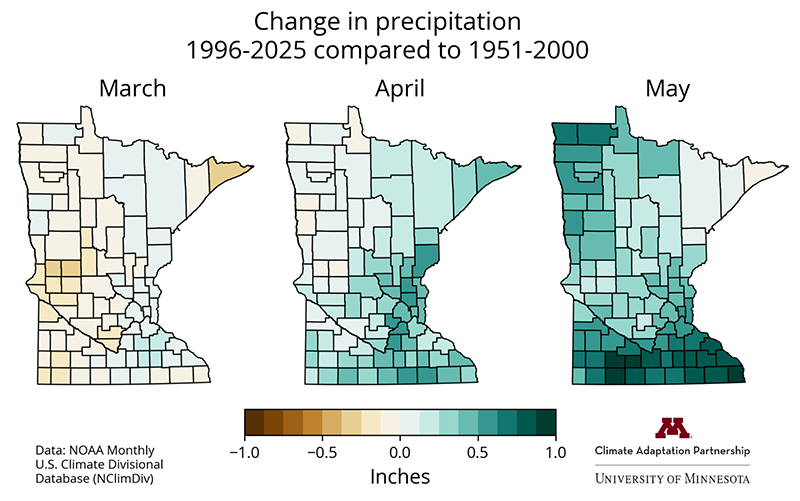
Change in spring (March - May) precipitation, 1996-2025 relative to 1951-2000. Explore these data at the DNR’s Minnesota Climate Trends tool. The maps demonstrate that Minnesota is now experiencing more precipitation in May and less in March, as compared to historic trends.
Minnesota springs (March through May) have gotten significantly wetter over the last 75 years. Some southern areas of the state now receive 2 to 2.5 more inches of spring precipitation than they did at the start of the 20th century.
This trend is expected to continue, with climate models projecting up to an additional 2 inches of spring precipitation on average by the end of the century, according to the Climate Adaptation Partnership’s climate projections under a very high emissions scenario.
Wet soils are vulnerable to compaction, which can significantly reduce plant health.
Whenever possible, avoid working in waterlogged soils. If you need to walk across a wet area, consider dissipating your weight with plywood boards or another wide surface.
3. Use caution when considering early planting
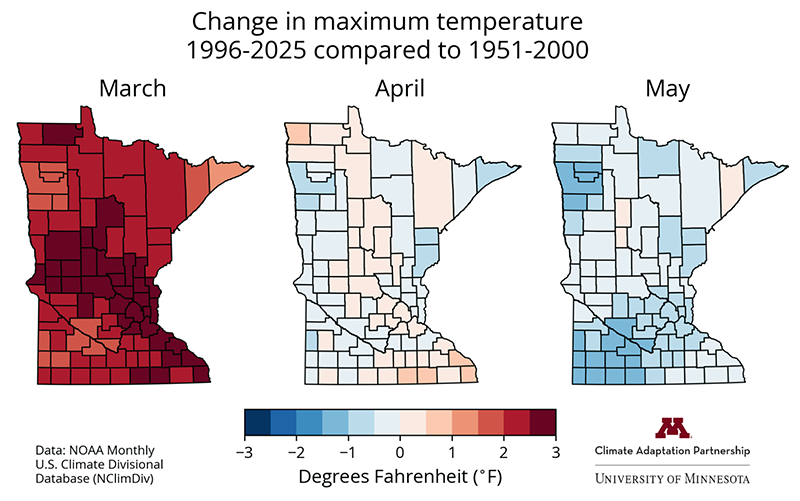
Change in spring (March - May) maximum daily temperatures, 1996-2025, relative to 1951-2000. The maps demonstrate Minnesota is now experiencing much warmer temperatures in March and moderately cooler temperatures in May, as compared to historic trends.
Spring weather is variable across Minnesota and will continue to be so even as warmer temperatures shift earlier in the year.
Gardeners are often eager to get annuals in the ground. But many warm-season plants are vulnerable to temperatures below 50°F and will be damaged when nighttime temperatures drop after a warm spell.
Since 1951, springtime low temperatures have warmed across most of Minnesota, and the growing season has lengthened in many parts of the state.
Climate models project that spring warming will also accelerate overall in the coming decades. But there’s nuance in these trends. Even though there have been several notable warm stretches in recent springs, we’ve seen high variability, and daily highs have actually cooled on average in most parts of the state in April and May.
Be cautious about planting early in the season. If you need to get plants in the ground, covering your garden beds with sheets or other fabric can prevent some damage if temperatures dip.
Moisture retention: Mulch helps soil hold water, reducing the need to water; especially helpful during prolonged hot and dry periods.
Weed suppression: Mulch blocks sunlight, making it harder for weeds to grow.
Soil improvement: Organic mulch breaks down over time, adding nutrients.
Temperature regulation: Mulch insulates roots from extreme heat and cold.
Erosion prevention: Mulch reduces soil runoff during heavy rains.
5. Know your soil type and adjust accordingly
Soil type will determine how your garden space responds to wet and dry conditions. Sandier soils drain faster and can be more resilient to heavy precipitation events, but are less resilient to drought conditions. Clay-rich soils retain moisture; this can be beneficial in dry conditions, but can lead to ponding or flooding during heavy rainfall events.
Consider testing your soil to better understand your specific site conditions.
Make note of any areas where water tends to pool and adjust your plantings accordingly.
6. Add protection from wind and sun
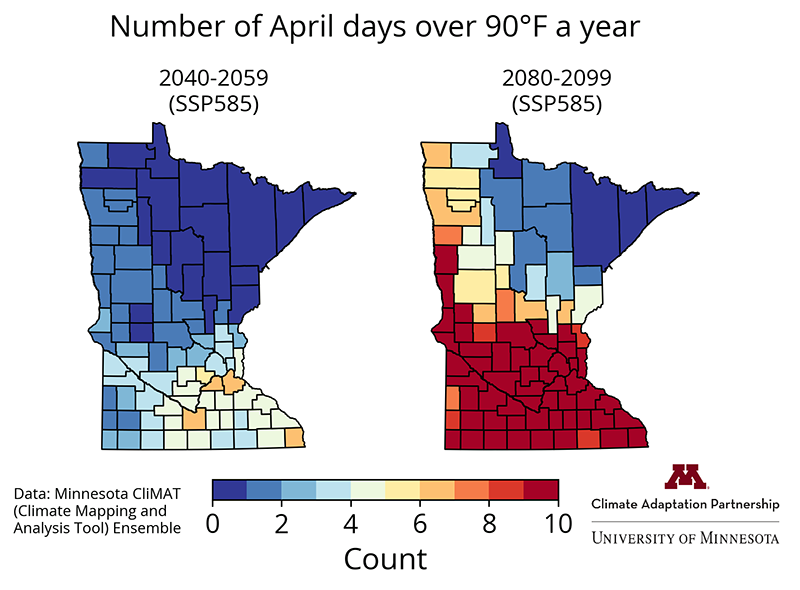
Projected annual average number of April days over 90°F in 2040-2059 and 2080-2099 under an intermediate emissions scenario (SSP 245) and a very high emissions scenario (SSP585). Explore these data at the Climate Adaptation Partnership’s MN CliMAT Climate Projections tool. The maps show that southern Minnesota could see four to eight April days above 90°F by mid-century and up to 10 by late-century.
Climate change may extend the season for severe thunderstorms and other high-wind events that can be damaging to trees and shrubs.
Physical structures like fences and buildings, hedges or wind breaks, and plastic or fabric coverings can offer protection from wind, hail, and sun for vulnerable plants.
Adding shade can significantly lengthen the season for annuals that prefer cooler temperatures, such as lettuce and peas.
7. Consider containers
In some situations, like if your soils are clay-heavy, containers can offer more control of soil moisture and growing location.
Containers can also be placed on wheels and be easily moved in the event of severe weather or harsh conditions.
8. Seek out pest- and disease-resistant varieties
We expect to see more pest and disease challenges in the coming decades. Many annuals, particularly vegetables and fruits, are offered in a variety of cultivars that can be resistant to pests and diseases. As you seek out plants for your yard and garden, look for varieties that are adaptable to different site conditions; they may be more resilient in the long term.
Consider adopting other best management practices as well to reduce the spread of diseases and pests: rotating vegetable crops, avoiding overhead watering where possible, watering during prolonged dry spells, and scouting early for any issues.
9. Adapt your mindset (it’s ok if things don’t go as planned)
Even in years when weather conditions are ideal, the best laid plans can sometimes go astray. This may be all the more true as the climate changes. A mindset of adaptability will go a long way in navigating these challenges.
10. You are not alone!
Build connections and resources in your community by talking to your neighbors and friends about what they’re experiencing and what’s working for them in their yards and gardens.
Ask a Master Gardener is a resource that lets you ask UMN Extension Master Gardeners about tough garden problems.
The Climate Adaptation Partnership’s Community Climate Leaders program is another great opportunity to gain insight and connections for climate resilience.
By sharing experiences and best practices, we can adapt and learn together.
These tips are from a Climate Adaptation Partnership’s Seasonal Climate Conversations webinar; watch the full presentation here (YouTube, 2026; 1:02:00).
Join the conversation
Our Seasonal Climate Conversations webinar showcases Minnesota's weather and climate trends, impacts, and solutions. Featuring climate scientists and Extension experts, this series will help you deepen your understanding of how weather and climate impact Minnesota, now and in the future, and how to adapt to anticipated changes.
These online sessions are informal and open to the public. Presentations will be followed by a short Q&A.