

Quick facts
-
You can either transplant or direct seed melons.
-
For best performance, plant melons in hot, sunny locations with fertile, well drained soils.
-
Plant melon seeds 1 week to 10 days before the last spring frost date.
-
Watermelon and honeydew are more cold-sensitive than cantaloupe.
-
Melons will not all ripen at the same time, so plan to pick them as they become ready.
Challenges to growing melons in Minnesota
It is a challenge to grow melons in Minnesota. Melons demand special care but reward gardeners with juicy, sweet fruit.
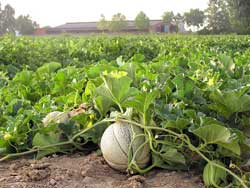
Most winters our soils freeze deeply and can be slow to warm up, and melons must have truly warm soil to thrive. Once summer comes, our long, bright, hot days are good for developing the vines, flowers and fruits.
Melon quality—flavor, aroma, texture, and sweetness—is best when the sugar content of the fruit is high. Sweet melons need lots of sunlight, warm temperatures, enough water, and freedom from diseases and insects.
Plant stress, whether from insects, leaf diseases, weeds, poor nutrition, too much or too little water, or cold or cloudy conditions, will prevent the fruits from creating enough sugar.
Preparing to plant melons
- Have your soil tested to determine pH.
- Melons grow best on well-drained, sandy loam soils, with a pH between 6.0 and 6.5.
- Soils with a pH less than 6.0 will produce plants with yellow foliage that set few or no fruit.
- You can improve your soil by adding well-rotted manure or compost in spring or fall. Do not use fresh manure as it may contain harmful bacteria and may increase weed problems.
- Build raised beds to ensure adequate drainage, which these crops require.
Different melons for different purposes
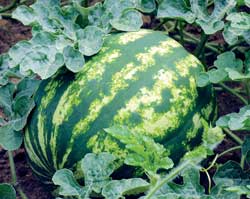
- Cantaloupe and muskmelon have netted skin, a strong aroma and moist fruit that is usually orange, but may also be green.
Choosing melons suited to Minnesota
- Only varieties with short growth cycles of less than 90 days to maturity can produce a ripe fruit in the north, and the first ripe fruit might be the last.
- Choose varieties with fewer days to harvest (65 to 80) to increase the chances of harvesting more fruit that has ripened under warm conditions.
- Even in the southern part of the state, and in the Twin Cities heat island, varieties with fewer days to maturity are more likely to provide a satisfying harvest.
Pollination needs and variety selection
- Cantaloupe and honeydew vines produce two flower types: male flowers and perfect flowers (having both male and female parts).
- Slender stems attach male flowers to the vine.
- A short, thick ovary, which will become the fruit, attaches female and perfect flowers close to the vine.
- Cantaloupe flowers have a pollination window of one day.
- Pollen needs to transfer from the male flower to the female flower on this day for seed set and fruit development.
- The number of seeds set helps determine fruit size and shape.
- Poorly pollinated flowers either fail or produce misshapen fruit.
- Watermelon has separate male and female flowers, usually on the same vine.
- Even seedless watermelon varieties require pollination to set fruit.
- You can buy seedless watermelon plants with a small number of seeds of a different variety to be the pollinizer.
- You must grow both types to get any fruit from the seedless variety.
Using season extension techniques such as soil-warming mulches, hot caps and low tunnel row covers, gardeners can get the soil to heat up sooner and protect melons in late summer if there is an early frost.
For both direct-seeded and transplanted melon plants, these techniques and materials can allow planting two or three weeks earlier.
- Plastic mulch
- Warms the soil
- Conserves water
- Helps to control weeds
- Allows earlier planting and maturity
- Reduces ground rot of the fruit
- Cut holes in the plastic mulch for seeds or transplants at the time of planting, not before.
- Hot caps protect the individual melon plants from cold during their first weeks in the garden.
- Low tunnels are row covers supported by wire hoops.
- Under the cover, daytime and nighttime temperatures are higher than outside the tunnel.
- The tunnel also protects the plants from wind and flying insects.
- Remove covers once fear of frost has passed to avoid injury from too much heat, and to allow bees and other pollinators access to the flowers.
- Later in the season, use floating row covers to protect plants during cool spells.
Planting
- You can direct seed or transplant melons into the garden between mid-May in southern Minnesota and late June in northern Minnesota.
- In the northern part of the state, melons planted in late June must be ready for harvest before mid-September, when frost is likely.
- Melons perform best in hot, sunny locations with fertile, well-drained soils.
Plant melon seeds 1 week to 10 days before the average last spring frost date, it is important to wait until the soil is warm enough.
- Use a thermometer to take the temperature of the top two inches of soil.
- Melon seed germination is best between 70°F and 90°F.
- Plant only after the soil temperature has reached 65°F, when nights as well as days are warm.
- Planting in cooler soil can lead to soil-borne root diseases, which can stunt or kill melon plants, and the plants will grow slowly even if they do not show signs of disease.
- In the southern half of Minnesota, most soils are not usually warm enough to plant melons until after May 20.
- In the northern half of the state, the soil may not reach this temperature until sometime in mid-June.
Prepare the soil for the melon planting about 2 weeks before the average last spring frost date in your area.
- Use compost and fertilizer.
- Form six to eight inch high raised beds to speed soil warming and have good drainage.
- Plant the seeds ½ to one inch deep.
- Sow 2 or 3 seeds in groups 18 to 24 inches apart.
- Space rows 5 to 6 feet apart.
- After the seedlings emerge, choose the strongest plant in each group and remove the others.
Transplanting can add two to four weeks to the growing season, but melons are especially sensitive to root disturbance. In the case of a broken or damaged root, the plant may never recover, or it may grow slowly all season, leading to a disappointing harvest.
Start melon seeds indoors before transplanting to your garden outside.
- Sow seed indoors at the end of April, about 2 to 4 weeks before the last spring frost date.
- Use peat pots or other biodegradable containers that you can place directly into garden soils.
- Use larger pots than you would for other vegetables.
- Large peat pots with a diameter of 4 inches will allow the root system to develop.
- Bottom heat is essential. Use a heat mat.
- Harden off seedlings before planting them in the garden.
- Transplants should have 2 or 3 true leaves when you move them into the garden.
- Transplant when soil temperatures reach at least 65°F.
- If you do not use plastic mulch, be sure to remove the first growth of weeds before setting the plants in the garden. This removal will reduce weed growth later in the season.
- Plant the potted seedlings about two feet apart, in rows five feet apart.
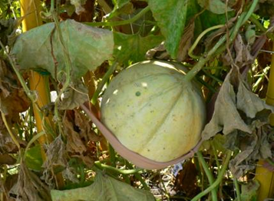
You can grow small-fruited melon plants in small gardens by training the plant to a fence or trellis.
After the fruits begin to enlarge, they will need support, or the fruit weight may damage the vines.
You can make slings to hold up the fruit using wide strips of fabric tied to the trellis, with the melon fruit resting its weight on the fabric.
How to keep melons healthy and productive
- Water deeply and infrequently, one to two inches per week.
- Use drip hose, soaker hose, or careful watering of the soil, so that the leaves stay dry.
- Do not use a sprinkler or spray the plants with a hose.
- Always soak the soil thoroughly when watering.
- Gradually reduce watering as the fruits ripen, to improve flavor.
- Too much watering during the last two weeks of ripening can cause the fruits to split.
Learn more about watering wisely.
- Frequent, shallow cultivation will kill weeds before they become a problem.
- The roots of melons are close to the surface of the soil, so do not to cultivate too deeply or too close to the plants.
- Cultivate with a hoe or hand tool just deeply enough to cut the weeds off below the surface of the soil.
- Continue cultivating as long as you can do so without injuring the vines, usually when the vines begin to spread between the rows.
- When cultivation is no longer possible, pull large weeds by hand.
- If you use mulch such as straw or compost to help control weeds, do not apply it until the soil has warmed to 75°F. These mulches can slow soil warming.
Learn more about weed management.
Harvest and storage
Cantaloupe requires 35 to 45 days to mature after flowering, depending on the temperature.
Visible changes as the fruit approaches maturity:
- The netting on the skin surface becomes coarse and rough.
- The background color of the fruit turns from green to yellow and loses its shine.
- The tendrils on the stem dry and turn brown.
Harvest by twisting the fruit gently.
- At full maturity and peak flavor, the fruit breaks away from the vine easily if slightly twisted.
- Melons will not all ripen at the same time, so plan to pick them as they become ready.
- Do not wait for the melons to separate from the vine on their own, as they will be over-ripe.
- Plan to eat them as they ripen, since they will only keep for about a week in the refrigerator.
Identifying ripe watermelon and honeydew melons is more difficult, since they do not slip from the vine. Use a combination of indicators to determine ripeness.
Visible changes as the fruit approaches maturity:
- Tendrils near the fruit stem become brown and dry.
- The leaf closest to the fruit becomes yellow.
- The fruit surface becomes rough to the touch.
- The fruit color becomes dull.
- The bottom of the watermelon, where it lies on the soil, changes from light green to yellowish.
Watermelon and honeydew are more cold-sensitive than cantaloupe. You should eat them the day you pick them, or refrigerate them for only a day or two.
Managing pests, diseases, and disorders
The environment, plant diseases, insects and wildlife can cause changes in physical appearance and plant health. To address what you’re seeing, it is important to make a correct diagnosis.
You can find help identifying common pest problems by using Ask a Master Gardener to share pictures and get advice, or by sending a sample to the .
- Striped cucumber beetles damage plants by eating leaves as well as flowers, stems, and fruit. They also spread bacterial wilt.
- Spotted cucumber beetles migrate to Minnesota every year, and once here they feed on all above-ground parts of the plant.
- Squash vine borers burrow into the crown and vines of melon plants, causing the entire plant to wilt.
- Squash bugs can often be found in large groups, and their feeding gives leaves a ragged appearance.
- During periods of hot, dry weather, spider mites can feed on leaves, giving them a bleached or bronzed appearance.
- Aphids can colonize tomato plants in large numbers. You may notice leaf curling, discoloration, and sticky leaves. If you have aphids, you may see natural enemies nearby feeding on them.
Many of the same cultural practices help prevent a wide variety of melon diseases.
- If plants suddenly wilt, bacterial wilt could be the cause.
- Powdery mildew is a fungal disease that causes powdery white spots to form on leaves and vines.
- If new growth on the plant is off-color, twisted, or distorted, it could be a cucurbit virus.
- Anthracnose can cause large, tan spots on leaves.
- Angular leaf spot causes small, blocky spots on leaves, which are surrounded by a yellow halo.
- Gummy stem blight and black rot can infect leaves, stems, and fruit, causing leaves to brown at the edges and black, rotten areas on melon fruit.
- Poor fruit set could be due to not enough pollination. Cold, rainy or cloudy weather can reduce pollination.
- Melons can become tasteless due to dark, cloudy weather, disease, or premature picking.
Reviewed in 2026