

Key concept
To convene a meeting that makes progress, take time beforehand to clarify its purpose and plan an agenda. Planning a thoughtful agenda with tasks and processes that engage group members will help create more effective meetings and good results.
How can you plan for an effective meeting?
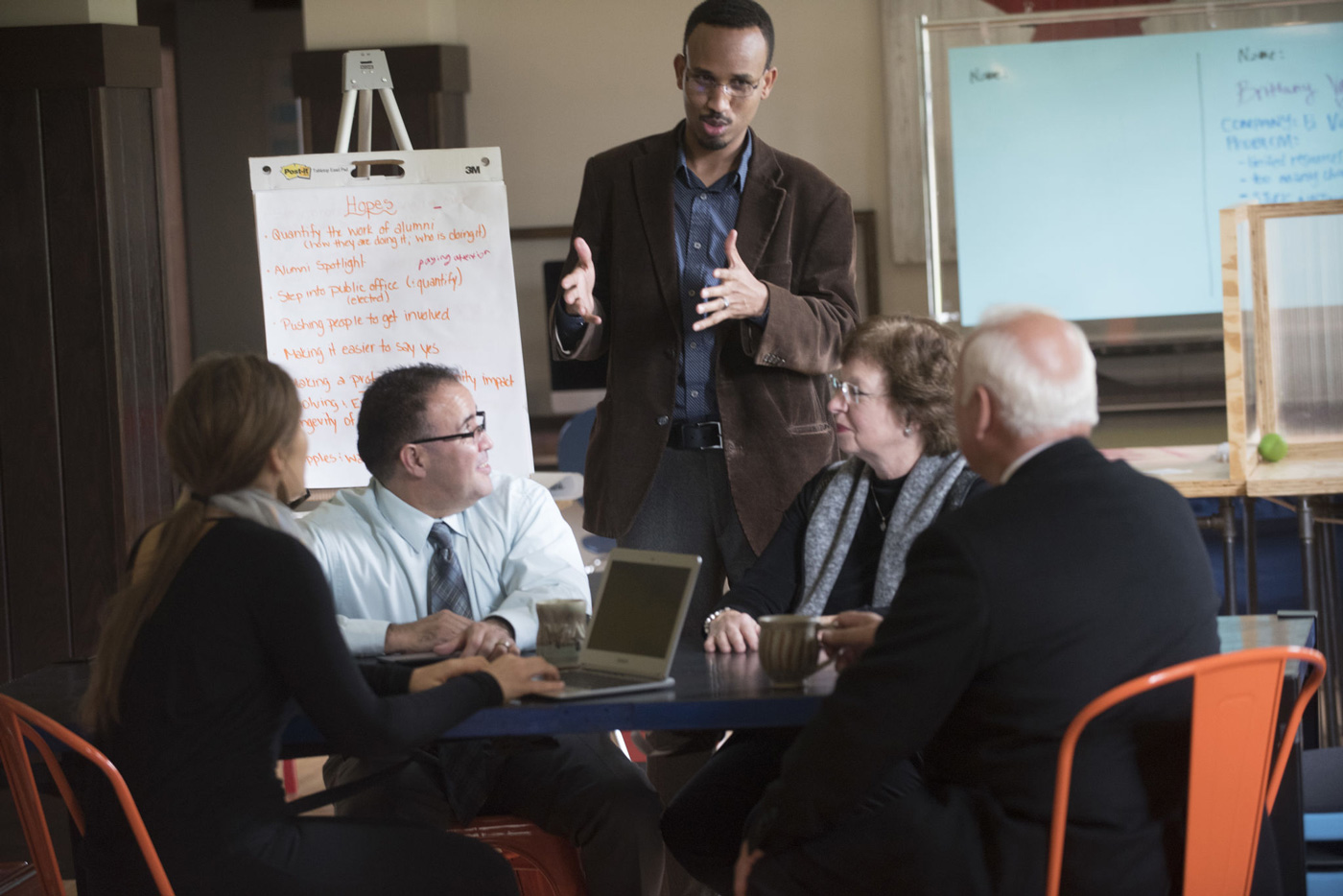
Tip: Create an agenda with a purpose
Public meetings should make progress toward the goal of solving public problems. The guide below describes a way to plan public gatherings that help groups achieve goals.
Consider purpose and process
When you are leading a meeting, it is your responsibility to plan the agenda. If you have been asked to facilitate someone else's meeting, meet with conveners ahead of time to plan it. If you are a group member, consider whether it is appropriate to offer help creating an agenda beforehand. (Read more about pros and cons of using internal and external facilitators.)
Whoever is involved, a key step to designing an effective meeting is to be clear about its purpose. Once the purpose is clear, communicate the meeting’s purpose to those involved, and plan meeting strategies that support the thoughtful involvement of those attending.
Sending an agenda before a meeting lets participants know what will be discussed, and gives them time to think about issues and opportunities. If that's not possible, creating an agenda as the meeting starts still gives the meeting and participants important focus so meeting purpose can be achieved.
Steps for planning a meeting agenda
Here is a sequence of steps to plan an effective meeting agenda.
- First, define results. What does your group need to achieve by the end of the meeting? Write down a set of clear goals. If there is not a defined purpose, consider whether there really is a reason to meet.
- Decide on the meeting's time frame. How much time is needed to achieve the meeting's purpose? Different time frames fit different purposes — from the five-minute daily check in to the two-day retreat. Match the amount of time to the needs and the frequency of the group's gathering.
- List the meeting topics. Identify topics that need to be covered to accomplish the results. Consider what information the group needs in order to discuss a topic or make a decision knowledgeably, and then decide on a logical order for discussing the topics or making decisions. A good agenda considers the following:
- What topics do we have to cover to accomplish our goal?
- What outcome/s do we want for each topic?
- What information do we need?
- Who will make the decision/s?
- How will we make the decision/s?
- Allot time frames for each topic. Considering the total time available, assign realistic time slots for each item. During the meeting, if the group hasn't reached a decision within the time provided, suggest next steps or refer the item to the next meeting or committee.
- Plan participation strategies to address each topic. Different methods of discussion can be used to make the best use of participant input for each topic. Be clear about expectations for involving participants to ensure involvement builds trust and authentic action. Ultimately, participants need to support the decisions made by the group.
- Plan time for meeting closure. Plan for a few minutes at the end of the agenda to review what needs to happen next and, perhaps, to ask for feedback on what participants thought of the meeting so that the group is clear about next steps and has a chance to improve its meeting process.
- Do a reality check. After you review your agenda, consider whether what you want to do is really "doable" in the amount of time you've got. If not, scale back expectations or schedule another meeting to address some of the topics.
Suggested participation strategies
To engage members, do a survey in advance or generate ideas at the meeting. If at the meeting, the meeting leader can go around the table and ask each participant to share items relevant to the topic at hand. Listing ideas on a flip chart as they are mentioned can help everyone at the meeting see them all easily.
To involve members in decisions, consider listing all ideas and giving participants several votes to cast. For example, each participant could place three votes among six-to-eight ideas. In the end, the group's preferred priorities are evident. Alternatively, the group could use a consensus approach, inviting members to identify or create a decision that is good enough for all.
Kearny, L. (1995). The facilitator's tool kit: Tools and techniques for generating ideas and making decisions in groups. Amherst, MA: HRD Press.
Scheffert, D., Anderson, M., Anderson, S., et al. (2001). Facilitation resources, volume 3: Getting focused: Vision/mission goals. St. Paul, MN: University of Minnesota Extension.
How can Extension help
Extension leadership and civic engagement (LCE) educators work across the state of Minnesota. They provide educational programs and consultations that help communities solve problems and make decisions.
Contact an educator near you or program leader Holli Arp.
Reviewed in 2026