

Improved surface and subsurface drainage is necessary for some Minnesota soils to optimize the crop environment and reduce production risks.
To assure an effective and profitable system, it's important to couple a good design process with the thorough evaluation of such on-site factors as soil type, topography, outlet placement and existing wetlands. This, along with a quality installation, will ensure a drainage system that performs effectively for many years to come.
Why have a drainage system?
Many soils in Minnesota and throughout the world would remain wet for several days after a rainfall without adequate drainage, preventing timely fieldwork and stressing growing crops. Saturated soils don’t provide sufficient aeration for crop root development, and can be an important source of plant stress.
That's why artificial drainage of poorly draining soils has become integral to maintaining a profitable crop production system. Some of the world's most productive soils are drained, including 25 percent of the farmland in the United States and Canada.
Planning factors
Planning an effective drainage system takes time and requires you to consider a number of factors, including:
Local, state and federal regulations.
Soil information.
Wetland impact.
Adequacy of system outlet.
Field elevation, slope (grade) and topography assessment.
Economic feasibility.
Present and future cropping strategies.
Environmental impacts associated with drainage discharge.
Easements and right-of-ways.
Installation quality.
Regulations and restrictions
The Department of Agriculture Food Security Act and the farm bills of 1985, 1990, and 1996 created many special wetlands restrictions and mandates that all drainage projects, including upgrades, must follow.
It's also very important that the landowner, system designer and contractor understand other applicable federal laws, as well as the local watershed and state laws dealing with drainage. People considering installing a drainage system should also know their rights and responsibilities regarding the removal of water from land and its transfer to other land.
The first steps of any installation project should always include visits to the offices of the Soil and Water Conservation District (SWCD), the Natural Resources Conservation Service (NRCS) and the local watershed administrative unit.
Sources of information
As you develop a drainage plan and specifications, it's useful to consult a number of information sources.
These include county soil and site topography surveys, the Minnesota Drainage Guide, local drainage experts, Farm Service Agency aerial photos and ditch and downstream water management authorities. It’s also a good idea to evaluate a field’s surface and subsurface.
Profitability and economics
To decide whether a new drainage system (or improving an existing system) makes economic sense, determine or estimate the following:
What the crop response might be for the area to be drained.
The system’s impact on the timeliness and convenience of field operations.
Input changes and other costs associated with a drainage system.
Needless to say, it's not easy to estimate some of these factors. Data gathered from a combine yield monitor may offer good information on the field’s yield range and variability, as well as how crops responded to previous drainage activities. Crop response information from specialists in Iowa, Ohio, and Ontario could also be helpful.
Other potential sources for yield response information related to improved drainage include neighbors, county Extension educators, and the SWCD office.
Analysis tools
Many county soil surveys have also identified each soil type’s potential yield for common crops using sound management practices.
You can also perform a simplified online profitability analysis, developed by the University of Minnesota Extension and hosted on the Prinsco website. Advanced Drainage Systems (ADS) also offers an app that allows users to do a simplified profitability analysis for drainage investments.
Contact your local dealer for more information. These simplified analyses can give you a first guess at overall profitability, but lack the sophistication required to fine-tune investment decisions.
Designing a drainage system
To protect crops, a subsurface drainage system must be able to remove excess water from the upper portion of the active root zone 24 to 48 hours after a heavy rain.
More information on excess/drainable soil water
The drainage system capacity selected for most northern Midwest farmlands should provide the desired amount of water removal per day, commonly referred to as the drainage coefficient. This figure is often between 3/8 and 1/2 inch of water removal per day.
Drainage coefficient guidelines
The tables below show drainage coefficient guidelines for crop production on land with adequate surface drainage.
Only refine these drainage coefficient guidelines after you’ve consulted with drainage experts and local drainage contractors. NRCS guidelines suggest you may need to increase the drainage coefficient if one or more of these situations occur:
The crop has high value (e.g., sugarbeets or other vegetable/truck crops).
Soils have a coarser texture.
Crops have a lower tolerance to wetness.
The topography is flat (implying poorer surface drainage).
Large amounts of crop residue are left on a field.
There’s little or poor surface drainage.
Crop evapotranspiration is low.
Frequent and low-intensity rain is common.
Planting and harvest times are critical.
General drainage coefficients without surface inlets; amount of water to be removed, in inches per 24 hours*
| Soil type | Field crops | Truck crops |
|---|---|---|
| Mineral | 3/8 to 1/2 inch | 1/2 to 3/4 inch |
| Organic | 1/2 to 3/4 inch | 3/4 to 1.5 inch |
*Figures are from Chapter 14 of the NRCS Engineering Field Handbook.
General drainage coefficients with surface inlets; amount of water to be removed, in inches per 24 hours*
| Soil type | Field crops: Blind inlets | Field crops: Open inlets | Truck crops: Blind inlets | Truck crops: Open inlets |
|---|---|---|---|---|
| Mineral | 3/8 to 3/4 inch | 1/2 to 1 inch | 1/2 to 1 inch | 1 to 1.5 inches |
| Organic | 1/2 to 1 inch | 3/4 to 1.5 inch | 3/4 to 2 inches | 2 to 4 inches |
*Figures are from Chapter 14 of the NRCS Engineering Field Handbook.
If you need to convey surface water to the subsurface drainage system through surface inlets, NRCS guidelines suggest using the drainage coefficients in Table 2, depending on the inlet and soil type. Apply the selected coefficient to the entire watershed that contributes runoff to the surface inlet, unless a portion of the runoff is drained differently.
The goal of drainage system layout and design is to adequately and uniformly drain a field or area. Field topography and outlet location/elevation are typically the major factors considered when planning a drainage system layout, with topography greatly influencing which layout alternatives are possible.
Creating a topographic map
It’s best to create a topographic map of the field that shows the elevations of the potential or existing outlet(s). You can use many methods to create the map, including standard topography surveys, a GPS or a laser system.
The topography map helps the designer assess overall grade and identify a field’s high or low spots that might pose challenges.
Drainage outlet guidelines
Whether an open channel or a closed pipe, it must be large enough to carry the desired drainage discharge from a field quickly enough to prevent significant crop damage.
Typically located three to five feet below the soil surface.
Pumping is sometimes required to create an adequate outlet.
Locate the bottom of an outlet pipe above the normal water level in a receiving ditch or waterway. Floods or high water levels may briefly submerge the outlet.
Keep outlets clean of weeds, trash and rodents.
Protect outlets from erosion, machinery and cattle damage and ice in flowing water.
Selecting the layout
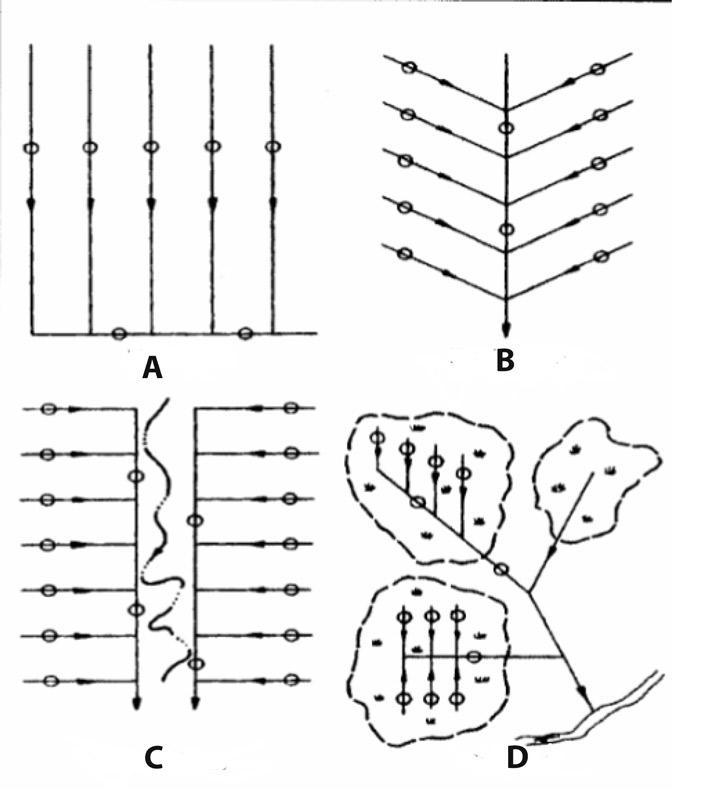
Although there may be many possible layout alternatives for a given field, evaluate specific drainage goals to find the best layout. Goals include removing water from an isolated problem area, improving drainage in an entire field, intercepting a hillside seep, and so on.
Approach system layout and drainage needs in a broad, comprehensive manner, anticipating future needs where possible. Even if you install a drainage system incrementally—some this year, more next year, and so on—system planning shouldn’t be piecemeal.
It’ll be much easier to add to a system if the established mains are already large enough and appropriately located.
Positioning laterals, mains and submains
When selecting a layout pattern for a particular field or topography, orient lateral drains or field laterals with the field’s contours as much as possible. This way, laterals can intercept water as it flows downslope.
On the other hand, you can position mains and submains (also called collectors) on steeper grades or in swales to facilitate the placement of laterals.
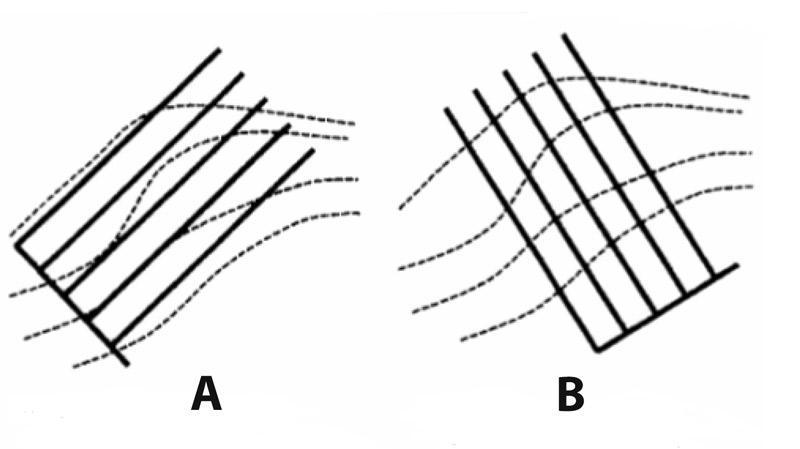
A close relationship exists between soil permeability and the recommended drain spacing and depth. When using a system of parallel laterals, drain spacing and depth should be simultaneously considered, based on:
Soil type.
Soil permeability and stratification.
The crops to be grown.
The desired drainage coefficient.
The degree of surface drainage.
If there’s an abrupt transition from lighter to heavier soil, it’s better to keep the drains above the heavy layer, when possible. Spacing drains closer together results in a higher drainage coefficient and faster drainage.
Distance between drains
Determining how close is close enough involves balancing costs and benefits. Simply stated, you can only justify the increased cost associated with narrower drain spacings to a point. After that, decreasing profits is the only result.
Aim for uniform depth
An ideal drainage system would have a uniform drain depth. In the real world, topography and system layout determine drains’ actual depths.
A system layout that poorly matches field topography will result in a wide variation of drainage depths and uneven field drainage. Avoid a system layout with many points of minimum cover (2 to 2.5 feet) and excessively deep cuts.
Make decisions about drain spacing and depth after consulting NRCS guidelines and talking to people in the area with drainage experience.
General spacing and depth recommendations
The following table shows general spacing and depth options you might consider during the early planning phase of a new or improved system. It recommends drain spacing in feet between drains. Drainage coefficients (fair, good and excellent) are expressed in inches per day.
General recommendations for parallel lateral drain spacing and depth
| Soil type | Subsoil permeability | Drain spacing: Fair drainage (1/4 inch) | Drain spacing: Good drainage (3/8 inch) | Drain spacing: Excellent drainage (1/2 inch) | Drain depth |
|---|---|---|---|---|---|
| Clay loam | Very low | 70 feet | 50 feet | 35 feet | 3.0-3.5 feet |
| Silty clay loam | Low | 95 feet | 65 feet | 45 feet | 3.3-3.5 feet |
| Silt loam | Moderately low | 130 feet | 90 feet | 60 feet | 3.5-4.0 feet |
| Loam | Moderate | 200 feet | 140 feet | 95 feet | 3.8-4.3 feet |
| Sandy loam | Moderately high | 300 feet | 210 feet | 150 feet | 4.0-4.5 feet |
The following table is an example of a recommendation from the Minnesota Drainage Guide.
Drainage spacing recommendations in feet between drains for a Blue Earth series soil at 36- and 48-inch depths
| Drain depth | Drainage coefficient: 1/4 inch per day | Drainage coefficient: 3/8 inch per day | Drainage coefficient: 1/2 inch per day | Drainage coefficient: 3/4 inch per day |
|---|---|---|---|---|
| 36 inches | 95 feet | 74 feet | 62 feet | 49 feet |
| 48 inches | 121 feet | 96 feet | 81 feet | 64 feet |
Pipe capacity
The maximum amount of water a drainage pipe can carry (its capacity) depends on the pipe’s inside diameter, the grade or slope at which it’s installed and what the pipe is made of. For example, a smoother pipe has a greater flow capacity, all else being equal.
You can typically get full-flow pipe capacities for specific grades, pipe sizes and pipe materials from a number of sources:
Apps and online tools from companies such as Prinsco and ADS.
Nomographs (charts) in the Minnesota Drainage Guide.
Manufacturers’ literature.
Local drainage contractors and engineers.
Flow capacity
To estimate the required flow capacity (Q) in cubic feet per second (cfs), multiply the area you want to drain by the desired drainage coefficient and divide by the conversion factor (23.8).
Q in cfs = [area in acres x drainage coefficient in inches per day] / 23.8
To use the equation in this form, area and dc must be in units of acres and inches per day, respectively.
Pipe grade, material and diameter
Once you determine Q, you can select the pipe grade, material, and ultimately the diameter to meet the required flow capacity. Topographical constraints typically determine the pipe grade, so the pipe size is selected after the material is selected (e.g., corrugated polyethylene pipe, smooth-interior pipe, etc.).
Flow velocity
Besides flow capacity, design drainage systems to provide a certain minimum velocity of flow so it self-cleans or self-scours.
If fine sands and silt are present, the minimum recommended velocity is 1.4 feet per second to prevent sediment accumulation in the system. Drainage systems in more stable soils can tolerate slower flow velocities, as low as 0.5 feet per second.
Grades are supported by the American Society of Agricultural Engineers (ASAE) EP260 standards. Flatter grades result in slower flow and run the risk of failure. Always avoid reverse grades.
Drains not subjected to fine sand or silt have a minimum velocity of 0.5 feet per second, while drains where fine sand or silt may enter have a minimum velocity of 1.4 feet per second. CPE drains refer to corrugated polyethylene plastic pipe, and smooth refers to smooth-wall plastic pipe or concrete or clay tile.
Minimum recommended grades (percent) for drainage pipes
| Drain’s inside diameter | Smooth drains not subjected to fine sand or silt | CPE drains not subjected to fine sand or silt | Smooth drains where fine sand or silt may enter | CPE drains where fine sand or silt may enter |
|---|---|---|---|---|
| 3* inches | 0.08% grade | 0.10% grade | 0.60% grade | 0.81% grade |
| 4* inches | 0.05% grade | 0.07% grade | 0.41% grade | 0.55% grade |
| 5* inches | 0.04% grade | 0.05% grade | 0.30% grade | 0.41% grade |
| 6* inches | 0.03% grade | 0.04% grade | 0.24% grade | 0.32% grade |
| 8-12* inches | -- | 0.07% grade | -- | -- |
| 12 or more* inches | -- | 0.05% grade | -- | -- |
*Recommendations for drain sizes are from the Minnesota Drainage Guide from the Natural Resource Conservation Service (NRCS).
Flow velocity example
Example: Find the flow capacity needed to drain 80 acres with a 1/2 inch per day drainage coefficient:
Q(cfs) = 80 acres x 0.5 inches per day / 23.8 = 1.7 cfs
Because excess water velocities could cause some pressure problems at drain joints or tube openings that might result in unwanted soil erosion around the drain, there are also suggested maximum grades for drain sizes and soil types. Chapter 4 of the Minnesota Drainage Guide outlines these suggestions.
Potential land area that can be drained
The following tables show the potential land area that can be drained with various grades, drain sizes, and pipe materials using 1/4-, 3/8-, and 1/2-inch drainage coefficients.
When computing drain size with any tool or chart, always round an intermediate size to the nearest larger commercially available size. For example, if a calculation calls for a 6.8-inch diameter pipe and a 7-inch pipe isn’t available, select an 8-inch pipe.
In tables 6, 7, and 8, CPE denotes corrugated polyethylene pipe (3 to 8 inches, n=0.015; 10 to 12 inches, n=0.017; more than 12 inches, n=0.02). Smooth denotes smooth-wall CPE, concrete or clay tile (n=0.01).
Potential acres drained by drain size, type and grade for a drainage coefficient of 1/4 inch per day
| Grade | Drain type | 4-inch drain | 5-inch drain | 6-inch drain | 8-inch drain | 10-inch drain | 12-inch drain | 15-inch drain | 18-inch drain |
|---|---|---|---|---|---|---|---|---|---|
| 0.1% | CPE | 5.0 acres | 9.0 acres | 14.6 acres | 32 acres | 50 acres | 82 acres | 126 acres | 206 acres |
| 0.1% | Smooth | 7.5 acres | 13.5 acres | 22 acres | 47 acres | 86 acres | 140 acres | 253 acres | 411 acres |
| 0.2% | CPE | 7.0 acres | 12.7 acres | 21 acres | 45 acres | 71 acres | 116 acres | 179 acres | 291 acres |
| 0.2% | Smooth | 10.5 acres | 19.1 acres | 31 acres | 67 acres | 121 acres | 197 acres | 358 acres | 582 acres |
| 0.3% | CPE | 8.6 acres | 16 acres | 25 acres | 55 acres | 87 acres | 142 acres | 219 acres | 356 acres |
| 0.3% | Smooth | 12.9 acres | 23 acres | 38 acres | 82 acres | 149 acres | 242 acres | 438 acres | 712 acres |
| 0.4% | CPE | 10 acres | 18 acres | 29 acres | 63 acres | 101 acres | 164 acres | 253 acres | 411 acres |
| 0.4% | Smooth | 14.9 acres | 27 acres | 44 acres | 95 acres | 172 acres | 279 acres | 506 acres | 823 acres |
| 0.6% | CPE | 12 acres | 22 acres | 36 acres | 77 acres | 124 acres | 201 acres | 310 acres | 504 acres |
| 0.6% | Smooth | 18 acres | 33 acres | 54 acres | 116 acres | 210 acres | 354 acres | 620 acres | 1008 acres |
| 0.8% | CPE | 14 acres | 25 acres | 41 acres | 89 acres | 143 acres | 232 acres | 358 acres | 582 acres |
| 0.8% | Smooth | 21 acres | 38 acres | 62 acres | 134 acres | 243 acres | 395 acres | 715 acres | 1163 acres |
| 1% | CPE | 16 acres | 28 acres | 46 acres | 100 acres | 160 acres | 260 acres | 400 acres | 650 acres |
| 1% | Smooth | 24 acres | 43 acres | 69 acres | 150 acres | 271 acres | 441 acres | 800 acres | 1301 acres |
| 1.5% | CPE | 19 acres | 35 acres | 57 acres | 122 acres | 195 acres | 318 acres | 490 acres | 797 acres |
| 1.5% | Smooth | 29 acres | 52 acres | 85 acres | 183 acres | 332 acres | 540 acres | 980 acres | 1593 acres |
| 2% | CPE | 22 acres | 40 acres | 66 acres | 141 acres | 226 acres | 367 acres | 566 acres | 920 acres |
| 2% | Smooth | 33 acres | 60 acres | 98 acres | 212 acres | 384 acres | 624 acres | 1131 acres | 1840 acres |
Potential acres drained by drain size, type and grade for a drainage coefficient of 3/8 inch per day
| Grade | Drain type | Drain size: 4 inches | Drain size: 5 inches | Drain size: 6 inches | Drain size: 8 inches | Drain size: 10 inches | Drain size: 12 inches | Drain size: 15 inches | Drain size: 18 inches |
|---|---|---|---|---|---|---|---|---|---|
| 0.1% (change in ft. per 100 ft.) | CPE | 3.3 acres | 6 acres | 9.8 acres | 21 acres | 34 acres | 55 acres | 84 acres | 137 acres |
| 0.1% | Smooth | 5 acres | 9 acres | 15 acres | 32 acres | 57 acres | 93 acres | 169 acres | 274 acres |
| 0.2% | CPE | 4.7 acres | 8.5 acres | 14 acres | 30 acres | 48 acres | 77 acres | 119 acres | 194 acres |
| 0.2% | Smooth | 7 acres | 12.7 acres | 21 acres | 45 acres | 81 acres | 132 acres | 238 acres | 388 acres |
| 0.3% | CPE | 5.7 acres | 10 acres | 17 acres | 36 acres | 58 acres | 95 acres | 146 acres | 237 acres |
| 0.3% | Smooth | 8.6 acres | 16 acres | 25 acres | 55 acres | 99 acres | 161 acres | 292 acres | 475 acres |
| 0.4% | CPE | 7 acres | 12 acres | 20 acres | 42 acres | 67 acres | 109 acres | 169 acres | 274 acres |
| 0.4% | Smooth | 9.9 acres | 19 acres | 29 acres | 63 acres | 114 acres | 186 acres | 337 acres | 548 acres |
| 0.6% | CPE | 8 acres | 15 acres | 24 acres | 52 acres | 82 acres | 134 acres | 207 acres | 336 acres |
| 0.6% | Smooth | 12 acres | 22 acres | 36 acres | 77 acres | 140 acres | 228 acres | 413 acres | 672 acres |
| 0.8% | CPE | 9 acres | 17 acres | 28 acres | 59 acres | 95 acres | 155 acres | 238 acres | 388 acres |
| 0.8% | Smooth | 14 acres | 25 acres | 41 acres | 89 acres | 162 acres | 263 acres | 477 acres | 776 acres |
| 1% | CPE | 10 acres | 19 acres | 31 acres | 67 acres | 106 acres | 173 acres | 267 acres | 434 acres |
| 1% | Smooth | 16 acres | 28 acres | 46 acres | 100 acres | 181 acres | 294 acres | 533 acres | 867 acres |
| 1.5% | CPE | 13 acres | 23 acres | 38 acres | 81 acres | 130 acres | 212 acres | 327 acres | 531 acres |
| 1.5% | Smooth | 35 acres | 57 acres | 122 acres | 222 acres | 360 acres | 653 acres | 1062 acres | 1593 acres |
| 2% | CPE | 15 acres | 27 acres | 44 acres | 94 acres | 150 acres | 245 acres | 377 acres | 613 acres |
| 2% | Smooth | 22 acres | 40 acres | 66 acres | 141 acres | 256 acres | 416 acres | 754 acres | 1226 acres |
Potential acres drained by drain size, type and grade for a drainage coefficient of 1/2 inch per day
| Grade | Drain type | Drain size: 4 inches | Drain size: 5 inches | Drain size: 6 inches | Drain size: 8 inches | Drain size: 10 inches | Drain size: 12 inches | Drain size: 15 inches | Drain size: 18 inches |
|---|---|---|---|---|---|---|---|---|---|
| 0.1% (change in ft. per 100 ft.) | CPE | 2.5 acres | 4.5 acres | 7.3 acres | 16 acres | 25 acres | 41 acres | 63 acres | 103 acres |
| 0.1% | Smooth | 3.7 acres | 6.8 acres | 11 acres | 24 acres | 43 acres | 70 acres | 126 acres | 206 acres |
| 0.2% | CPE | 3.5 acres | 6.4 acres | 10 acres | 22 acres | 36 acres | 58 acres | 89 acres | 145 acres |
| 0.2% | Smooth | 5.3 acres | 9.6 acres | 16 acres | 33 acres | 61 acres | 99 acres | 179 acres | 291 acres |
| 0.3% | CPE | 4.3 acres | 8 acres | 13 acres | 27 acres | 44 acres | 71 acres | 110 acres | 178 acres |
| 0.3% | Smooth | 6.5 acres | 12 acres | 19 acres | 41 acres | 74 acres | 121 acres | 219 acres | 356 acres |
| 0.4% | CPE | 5 acres | 9 acres | 15 acres | 32 acres | 50 acres | 82 acres | 126 acres | 206 acres |
| 0.4% | Smooth | 7.5 acres | 14 acres | 22 acres | 47 acres | 86 acres | 140 acres | 253 acres | 411 acres |
| 0.6% | CPE | 6 acres | 11 acres | 18 acres | 39 acres | 62 acres | 101 acres | 155 acres | 252 acres |
| 0.6% | Smooth | 9 acres | 17 acres | 27 acres | 58 acres | 105 acres | 171 acres | 310 acres | 504 acres |
| 0.8% | CPE | 7 acres | 13 acres | 21 acres | 45 acres | 71 acres | 116 acres | 179 acres | 291 acres |
| 0.8% | Smooth | 11 acres | 19 acres | 31 acres | 67 acres | 121 acres | 197 acres | 358 acres | 582 acres |
| 1% | CPE | 8 acres | 14 acres | 23 acres | 50 acres | 80 acres | 130 acres | 200 acres | 325 acres |
| 1% | Smooth | 12 acres | 21 acres | 35 acres | 75 acres | 136 acres | 221 acres | 400 acres | 650 acres |
| 1.5% | CPE | 10 acres | 17 acres | 28 acres | 61 acres | 98 acres | 159 acres | 245 acres | 398 acres |
| 1.5% | Smooth | 14 acres | 26 acres | 43 acres | 92 acres | 166 acres | 270 acres | 490 acres | 797 acres |
| 2% | CPE | 11 acres | 20 acres | 33 acres | 71 acres | 113 acres | 184 acres | 283 acres | 460 acres |
| 2% | Smooth | 17 acres | 30 acres | 49 acres | 106 acres | 192 acres | 312 acres | 566 acres | 920 acres |
What are drain envelopes?
A drain envelope, or “sock,” is a material placed around a drain pipe to provide either a hydraulic function, which facilitates flow into the drain, or a barrier function, which prevents certain-sized soil particles from entering the drain.
Drain envelopes aren’t filters. Filters become clogged over time; drain envelopes do not. Many types of envelope material exist, from thick gravel and organic fiber to thin geotextiles.
Synthetic drain envelopes have a rather long useful life, provided they’re not left in the sun for extended periods or exposed to excessive ultraviolet radiation.
Do you need one?
Fine-textured soils with a clay content of 25 to 30 percent are generally considered stable and therefore don't need drain envelopes. A geotextile sock is recommended for coarse-textured soils free of silt and clay. These soils are considered unstable even if undisturbed, so particles may wash into pipes.
For intermediate soils (clay contents of 25 to 30 percent or less), it’s best to let a professional contractor or soil and water engineer determine whether an envelope is needed, because soil movement is more difficult to predict.
Subsurface tile drainage systems can convey soluble nitrate-nitrogen (N) from the crop root zone.
Implementing nitrogen fertilizer best management practices can reduce the potential loss of nitrate-N. Adding perennial crops to the rotation may also reduce N losses to surface waters and decrease drainage.
Farmers installing new or improved field drainage systems should consider using crop management practices and landscape structures that reduce nitrogen, sedimentation and water discharge rates.
Purpose of surface inlets
Surface inlets remove ponded water that forms in closed basins or potholes in a field. These inlets, however, can provide a direct pathway for surface waters that may carry sediment and other pollutants to drainage ditches and other downstream surface water.
The general public, resource managers and others are concerned about surface inlets’ potential impacts to both the quality and quantity of downstream waters.
Configurations
From a water quality perspective, almost any inlet configuration is preferable to using an open pipe that’s flush with the ground surface. Of the traditional intakes available, the slotted or perforated riser is a good option because it promotes some settling of sediments in the basin during flow events.
Farmers in some areas have begun replacing traditional inlets with blind or rock inlets. These have the advantage of being farmable, and anecdotal evidence suggests they can effectively remove water.
There are still questions, however, about the effective life of rock inlets. University of Minnesota researchers have been investigating the performance characteristics of these and other drainage practices, such as bioreactors, controlled drainage and constructed wetlands.
Why installation is important
A great deal of careful consideration goes into installing a drainage system. Drain depth, grade, pipe size and field layout are all extremely important design factors that’ll determine how well a system performs.
In addition, the installation method is key to a successful system. It’s why you should take special care to ensure every installation is on grade and of high quality.
Because quality installation is important, an experienced installer is usually an asset. It’s also important to know the equipment’s limitations.
Equipment limitations
Although pull-type and tractor-mounted drainage plows or trenchers often can adequately perform, they face limitations in the field. If these are improperly accounted for, it can result in installation and performance problems.
Field irregularities such as dead furrows, lines, swales and rocks can pose installation problems for these machines. In addition, operators have found it difficult to make cuts deeper than five feet.
U.S. Department of Agriculture Natural Resource Conservation Service (NRCS). Minnesota Drainage Guide.
Kanwar, R.S., Baker, J.L., & Mukhtar, S. (1988). Excessive soil water effects at various stages of development on the growth and yield of corn. Transactions of the ASAE, 31, 133-141.
Schwab, G.O., Fausey, N.R., & Weaver, C.R. (1975). Tile and surface drainage of clay soils: II. Corn, oats and soybean yields (1962-1972). Ohio Agricultural Research and Development Center Research Bulletin (No. 1081).
Schwab, G.O., Fausey, N.R., Desmond, E.D., & Holman, J.R. (1985). Tile and surface drainage of clay soils: IV. Hydrologic performance with field crops (1973-80) and V. Corn, oats and soybean yields (1973-80). Ohio Agricultural Research and Development Center Research Bulletin (No. 1166).
Irwin, R.W. (1997). Handbook of Drainage Principles (Publication 73, RP-01-97-500). Ontario Ministry of Agriculture and Food.
Eidman, V. (1997). Minnesota farmland drainage: Profitability and concerns. Minnesota Agricultural Economist, 688.
Zucker, L.A., & Brown, L.C. (Eds.). (1998). Agricultural drainage: Water quality impacts and subsurface drainage studies in the Midwest. Ohio State University Extension Bulletin (871).
University of Minnesota Department of Biosystems & Agricultural Engineering (1997). Minnesota River surface tile inlet research-modeling component (LCMR Report). St. Paul: Bruce Wilson, et al.
American Society of Agricultural Engineers (ASAE). (1996). Design and construction of subsurface drains in humid areas (Standards, EP260).
Drablos, C., & Melvin, S. Planning a subsurface drainage system. In National Corn Handbook.
Reviewed in 2026