

Identification of Japanese beetle

(Popillia japonica)
Adult
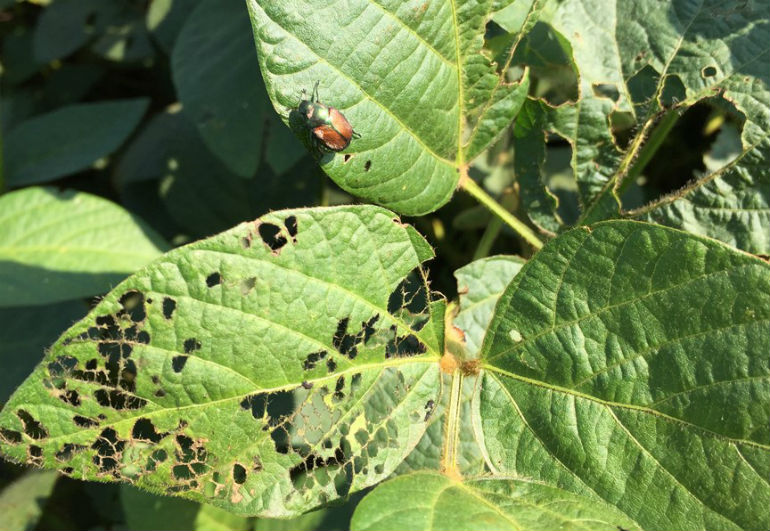
- Approximately 1/3 to 1/2 inch long.
- Metallic green head with copper-brown wing covers (elytra).
- The sides of the abdomen have five white patches of hair and the tip of the abdomen has two patches of white hair.
Egg
Eggs are laid in the soil and generally not seen.
Larva (grub)

- C-shaped, white to cream-colored grubs.
- Up to about 1 inch long.
Natural history
Japanese beetles were originally from Asia and were first detected in the U.S. in the early 1900s. They now occur throughout much of the eastern United States.
Japanese beetles are most commonly found in the Twin Cities metropolitan area and southeast Minnesota. The MDA maintains an updated distribution map of Japanese beetles.
Japanese beetles overwinter as grubs in soil in grassy areas. In spring, grubs move toward the soil surface, pupate, and emerge as adults in mid to late June.
Japanese beetles feed on over 300 different plant species, including soybean. Adults aggregate and feed on foliage and occasionally flower structures of many plants.
Adults mate and females lay eggs in nearby grassy areas (particularly turf), but will occasionally lay eggs in soybean fields. Eggs hatch after about one to two weeks, and the grubs feed primarily on the roots of grasses, but will occasionally feed on the roots of other plants, such as soybean.
As soils cool in the fall, grubs dig deeper in the soil, where they overwinter.
Japanese beetles have one generation per year in Minnesota.
Impacts
Adults feed between leaf veins of soybean leaves, resulting in a lace-like appearance (skeletonizing). Heavy infestations can cause significant defoliation, which can lead to reduced soybean yield.
Grubs may feed on soybean roots but rarely cause economic damage.

Scouting and management
Management decisions for Japanese beetle are based on estimates of defoliation. Because this pest and its defoliation are often highly aggregated in fields, sampling should be performed throughout fields and consider the entire canopy (top, middle, and bottom leaves).
Scouting
Estimate defoliation from at least 10 plants from throughout the field. To estimate percent defoliation:
- Select a leaf from the top, middle, and bottom third of each plant.
- Use the defoliation chart to estimate percent defoliation for each leaf and then determine the average percent defoliation across the three leaves from each plant and then across multiple plants.
- The average percent defoliation for the field's canopy can be compared to the treatment thresholds discussed below.
Treatment thresholds
- From vegetative plants (before flowering), treat if adults are present and defoliation reaches 30 percent.
- For reproductive plants (flowering to pod fill stage), treat if adults are present and defoliation reaches 20 percent.
- Labeled rates of insecticides can be used to manage this pest. Follow the directions on the product label.
CAUTION: Mention of a pesticide or use of a pesticide label is for educational purposes only. Always follow the pesticide label directions attached to the pesticide container you are using. Be sure that the area you wish to treat is listed on the label of the pesticide you intend to use. Remember, the label is the law.
Reviewed in 2024