

Quick facts
- Large numbers of soldiers beetles may be seen in gardens in the summer.
- Adults are active from late July to September.
- Adult beetles are particularly attracted to yellow flowers.
- They are harmless to plants and are beneficial as pollinators.
- There is no need to control them. Just ignore them and they will go away on their own.
How to identify soldier beetles
(Chauliognatha pennsylvanicus)
Adults
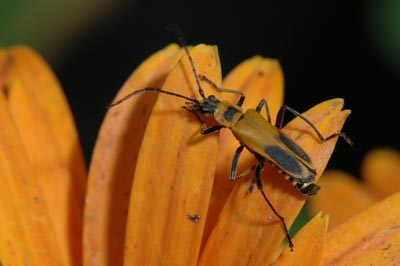
- About ½ inch long, yellowish to tannish-brown with soft wing covers.
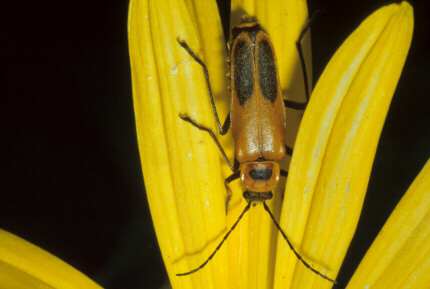
- Black head, black legs with a black spot behind the head and an oval, black spot on each wing cover.
- Wing covers do not completely cover the body, leaving abdominal segments exposed.
- The head is clearly visible and they have chewing mouth parts.
- Soldier beetles are related to fireflies but do not have the light-producing organs that fireflies have.
Larvae
- Larvae look like mini alligators and are usually dark colored.
- They can grow up to ¾ inch long.
Adult soldier beetles are noticeable, but larvae are rarely seen.
Biology
- Soldier beetles live through winter as larvae.
- During spring they are active in leaf litter, plant debris, loose soil and other areas where high humidity occurs.
- They mainly feed on insect eggs and larvae.
- Larvae transform into pupae in early summer with adults first emerging in late July.
- They are active through August and into September.
- Adults will lay eggs some time at the end of the summer.
- Larvae hatch from the eggs and they remain in this stage for the winter.
- There is one generation a year.
Behavior
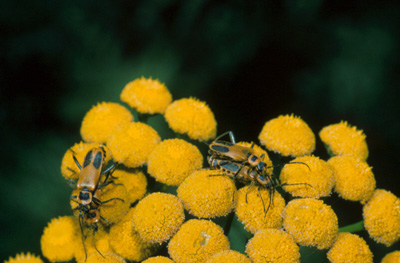
- Soldier beetles are very active and readily fly.
- They look like wasps or bees moving quickly and often between flowers.
- Soldier beetles are often seen mating on flowers.
- They protect themselves by secreting defensive chemical compounds to make them a less attractive target for predators.
- Their yellowish color is thought to signal that they don't taste good.
Soldier beetles are beneficial insects
- Soldier beetles mainly feed on pollen and nectar.
- Because of their frequent contact with flowers, soldier beetles are important pollinators.
- They do not damage flowers or other plants and are harmless to people.
- There is no need to control them. Just ignore them and they will go away on their own.
Reviewed in 2023