

Quick facts
- Noble corydalis (Corydalis nobilis) is not native to Minnesota.
- It is a perennial plant that blooms in the early spring.
- Look for it in woodlands, rocky areas, yards and disturbed areas.
- Please report this species so we can better understand its distribution in the wild.
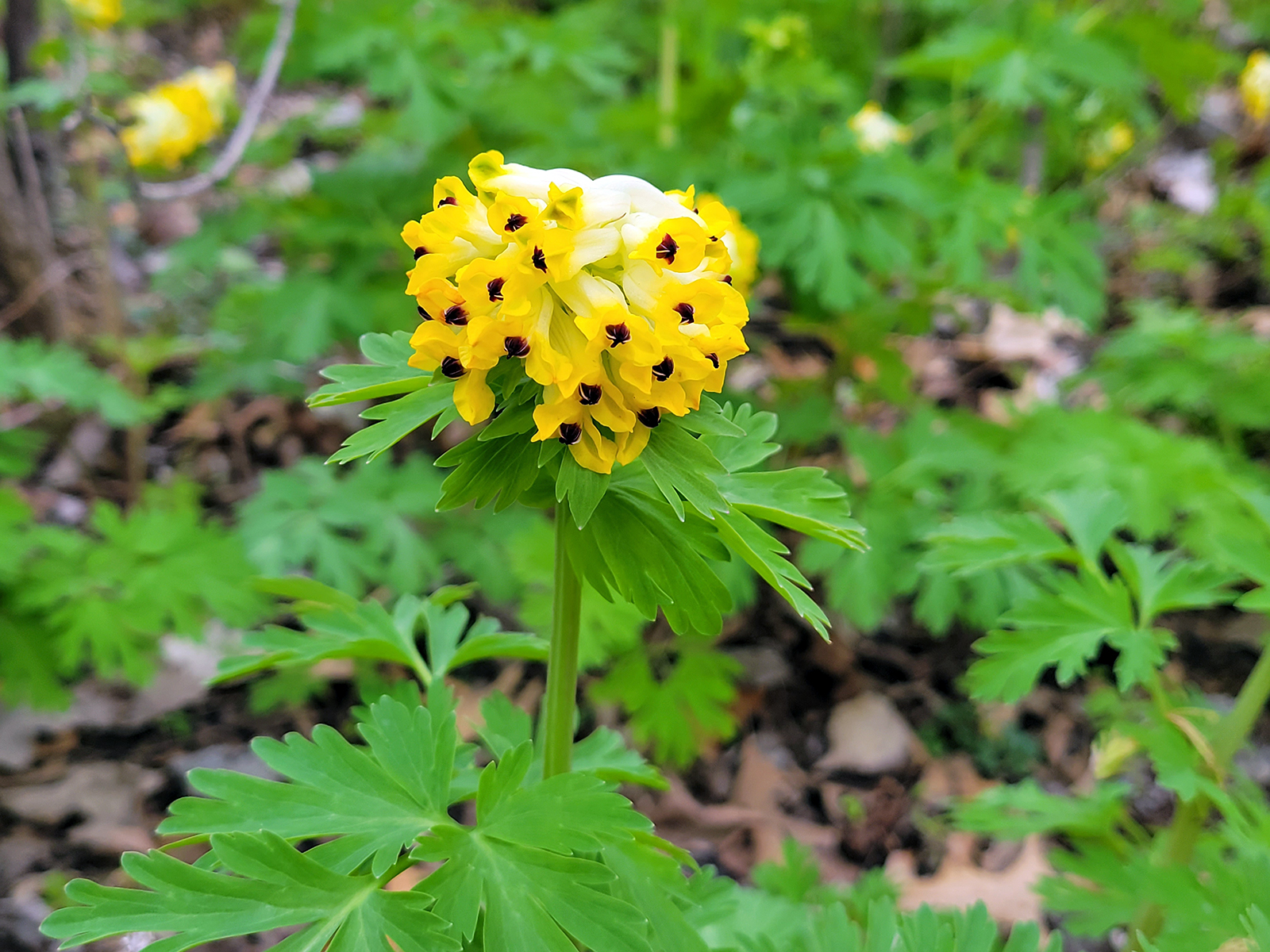
Noble corydalis is a non-native perennial plant that has been found in the Twin Cities. Look for it blooming in the early spring in woodlands, rocky areas, yards and disturbed areas.
Noble corydalis spreads quickly. It produces elaiosomes, a high-fat nutrient that attracts ants and is attached to most seeds. Ants carry away the seeds to feed on the elaiosome, consuming it without harming the seed and thus facilitating seed dispersal.
How to identify noble corydalis
Noble corydalis is a short plant, 15 to 24 inches tall and blooms in the early spring.
- Stems: Erect, 15-24 inches tall with multiple hollow stems.
- Leaves: Bluish-green leaves are alternate and stalked. They are pinnately compound, often with 3 leaflets.
- Flowers: Flowers are clustered in groups of 25 to 35 to form a flowerhead.
- Flower petals have bright yellow tips and fade to white near the stem.
- There is a spur approximately one inch long.
- Two fused inner petals are tinged with purplish-black at the tips.
- Flowers bloom in April and May in Minnesota.
- Seeds: Small numbers of seeds are in 2 rows within oval pods. The seeds are shiny black with a white elaiosome attached.
- Roots: Rootstock is swollen at the top. Roots branch and become hollow with age.
Common look-alikes
Golden corydalis (Corydalis aurea) is a native annual or biennial that is a slightly smaller plant with up to 20 pale yellow flowers per cluster. The seed pods of this species often point up.
Slender fumewort (Corydalis micrantha) is an annual native found in southern Minnesota. It is much smaller, typically only 4 to 12 inches tall. There are usually only 16 flowers per cluster. Fruit pods are usually stout, mostly straight and erect (pointing upward).
Dutchman’s breeches (Dicentra cucullaria) is a perennial spring ephemeral that is only 4 to 12 inches tall and has 3 to 14 generally white flowers that hang down and resemble pants hanging upside down.
Squirrel corn (Dicentra canadensis) is a native perennial flower that is on the state species of concern list, found in the southeast corner of Minnesota. The whole plant is 6 to 12 inches tall with 4 to 8 small heart-shaped white flowers that open at the bottom tip of the heart.
Management
There is very little information available about controlling noble corydalis. To control spread, prevent seed maturation and dispersal by managing before seed maturation.
- Mechanical control: Small populations can be hand-pulled.
Reporting noble corydalis
Please report all uncultivated noble corydalis. As with all non-native species found in uncultivated areas, report findings of this species using one of the following methods:
- Use the EDDMapS free mobile app (preferred).
- Report using the EDDMapS web-based mapping system for documenting invasive species.
Reviewed in 2025