Poultry

The University of Minnesota Extension poultry team brings university research to the commercial poultry industry and small-scale producers, resulting in increased profits and improved poultry health.
We help the poultry industry improve management techniques, develop new products and find new markets. We develop workshops, educational materials and other online resources to maintain high-quality, safe poultry production in Minnesota.
Poultry production in Minnesota
Avian influenza basics
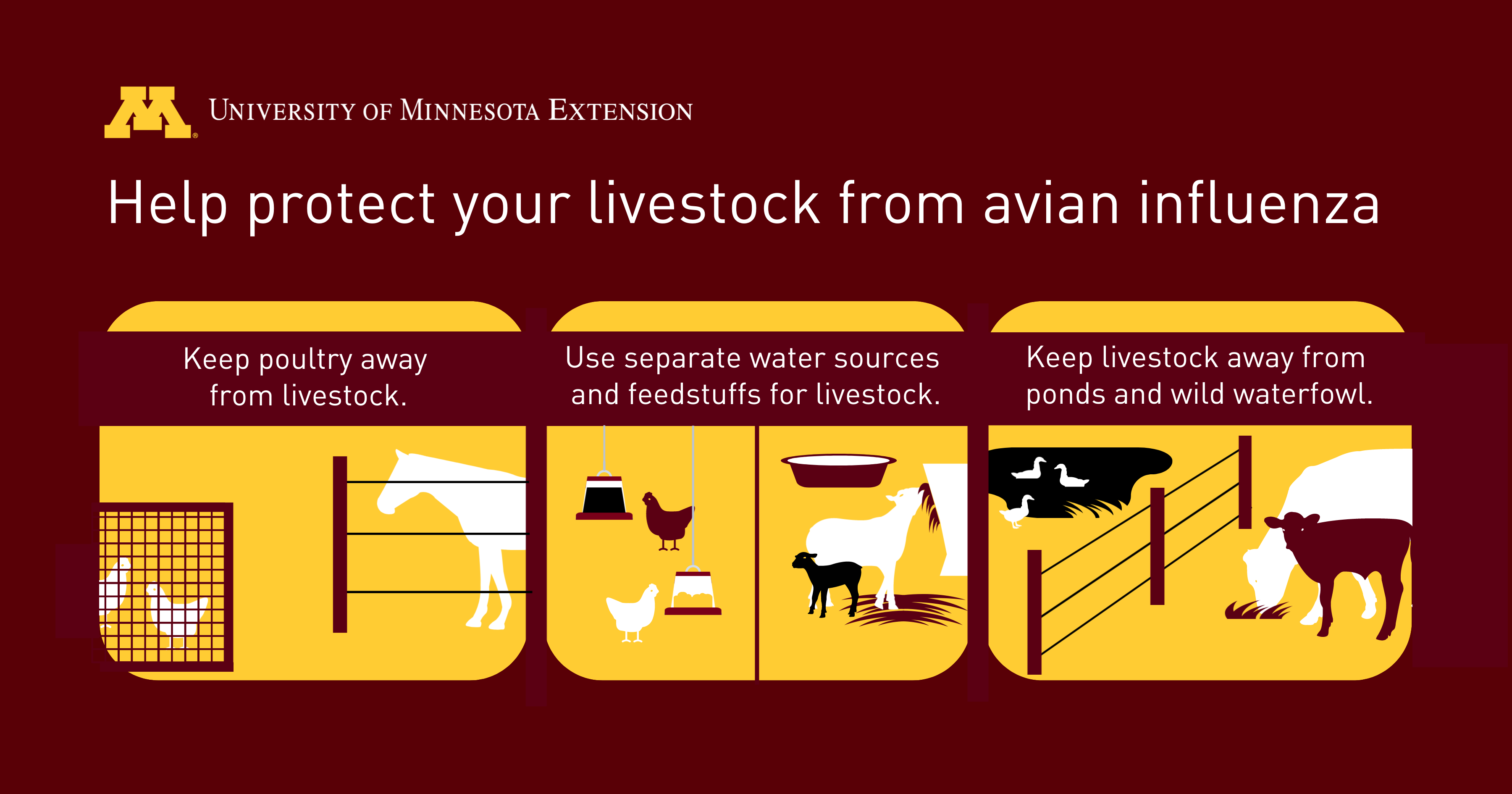
Avian influenza is harmful to poultry flocks, especially if it’s highly pathogenic. Always report any signs of disease to your state agency or veterinarian. Preventing disease is the best way to keep your flock healthy.
- Basics for organic and pastured poultry flocks
- Basics for urban and backyard flocks
- Basics for pigeon lofts
Highly pathogenic avian influenza videos
- (00:09:33)
- (00:03:06)
- (00:13:03)
- (00:06:18)
- (00:08:48)
- (00:02:40)
- (00:13:01)
- (00:05:16)
Biosecurity Entry Education Trailer (BEET) — BEET serves to educate and train people on how they can enhance poultry barn biosecurity.
Biosecurity for pigeon lofts — Biosecurity in your loft helps prevent disease in your loft.
Poultry biosecurity risks: identifying flows — Define system boundaries around barns and farmsteads and lines of separation to separate clean from dirty areas. Be aware of every flow that crosses system boundaries and lines of separation.
Poultry biosecurity basics — Learn about common biosecurity breaks, how to avoid biosecurity errors, and get materials and instructions for playing the “Risk and Reward” biosecurity game.
Writing a biosecurity plan using National Poultry Improvement Plan audit principles
- It is best practice to have, maintain, and use a site-specific operational biosecurity plan, regardless of annual production size.
- A site-specific biosecurity plan allows you to best fit your individual farm needs.
Planning for emergencies
- Operations Contingency Plan for Commercial Poultry Producers
- Contingency Plan for Commercial Pasture Poultry Production
- Contingency Plan for Urban Poultry Keepers
These forms will automatically download to your device. You will need a current version of Adobe Acrobat Reader DC to complete and save the form.
Download the appropriate PDF to outline essential livestock care if you or your managers experience illness, injury, or another emergency when you may need outside people to provide care.
Contingency plans cover essential care only. They are not comprehensive care plans.
- Contracts are an increasingly important aspect of agricultural production and marketing.
- Such contracts may take the form of leases, contracts for deed, production contracts or marketing contracts.
- Learn about the advantages, regulations and associated risks.
- Farms increasingly use both family and outside labor to complete agricultural work.
- Federal and state laws generally apply to farmers, but both include certain exemptions for farm operations
Reducing salmonella risk in table egg production
- Control rodents, insects and wild birds on your farm.
Properly wash and store eggs to prevent Salmonella contamination.
Maintain a robust, strict biosecurity program on your farm.
— A guide from the Minnesota Institute for Sustainable Agriculture for those interested in commercially raising, processing and marketing poultry.
See more business topics in the Farm Legal Series.
Diseases of small poultry flocks
- Causes, symptoms, prevention and treatment of diseases and parasites in small flocks.
- If you suspect disease in your flock, consult with a veterinarian.
- Preventing disease spread in small flocks (videos)
Managing biting gnats around poultry and livestock
Managing footpad dermatitis in turkeys
Preventing heat stress in poultry
(video, 2016: 02:37) — Birds can die for many reasons, and some loss is expected. But if the frequency or number of deaths increases, you may want to have the birds tested to discover the source of the problem. This video explains how and where you can submit poultry specimens for diagnostic testing in Minnesota and western Wisconsin.
The University of Minnesota Extension poultry team brings university research to the commercial poultry industry and small-scale producers, resulting in increased profits and improved poultry health. Our goal is to maintain high-quality, safe poultry production in Minnesota.
Standards for organic livestock and poultry — The United States Department of Agriculture published . The goal of clearer standards is to increase consistency in animal welfare practices.
Public health and safety
(PDF)
Common concerns with backyard or urban poultry keeping
Poultry at-home health kit
This list includes items to keep on hand for routine poultry health care and emergencies. Follow your veterinarian’s instructions if you are unsure how to use the items below.
- Identify a veterinary clinic that treats poultry and keep the phone number handy.
- Always keep children away from sick chickens and make sure to wash your hands before and after handling poultry.
Basics
- Veterinarian’s phone number.
- Personal Protective Equipment (PPE)
- Disposable gloves and booties for interacting with dirty or diseased birds.
- Cover-alls or barn/coop-specific clothing and footwear for daily use.
- Clean towels and rags for handling, cleaning, or restraining birds.
- Plastic container for soaking birds with pasty butt or egg-bound hens. Consider using this container to store your poultry-related first-aid items.
- Epsom salt for soaking egg-bound hens.
- Electrolytes and water-soluble vitamins to support hydration during heat or transportation stress or disease.
- Scale to monitor body weight.
- Thermometer. The average body temperature of a chicken is 106° F.
- A designated area to separate a sick or injured bird from healthy birds.
Wound care
- Antimicrobial wound care spray.
- Antibiotic ointment.
- Saline solution and a clean syringe for irrigation and flushing wounds.
- Antiseptic scrub (i.e., betadine, iodine or chlorhexidine) for disinfecting wounds and infections. Follow product directions.
- Vet wrap and gauze for bandaging wounds and injuries.
Cold weather care
- Petroleum jelly for combs and wattles to protect against frostbite damage.
Explore these pages to learn more about caring for chickens with mites or lice. client-patient relationship (VCPR).
Chickens
Caring for chickens in cold weather
(Video, 2019: 00:09:58)
(video, 2018: 00:02:25)
Raising chickens for eggs — How to best care for backyard chickens for egg production.
Raising layer chicks and pullets — Learn about space needs, cleaning, brooders, feed and health.
Raising chickens for meat — You can raise chickens for meat on a small scale, even in your backyard.
Raising chickens videos
ace (00:01:43)
ace (00:02:03)
eat (00:01:17)
Ducks, geese and wild fowl
- You can raise game birds for show, meat production or release.
- Unless you make a large initial investment, the market will be mostly local.
- Special considerations are necessary to raise these wild birds commercially.
Feeders and shelter
DIY mobile poultry hut — Get step-by-step instructions on how to build your own mobile poultry hut.
DIY poultry feeder — Making your own feeder can save money and allow you to feed your poultry with the right-sized feeder for your birds and facility.