

Quick facts
- Spotted wing drosophila (SWD) is a member of the “small fruit fly” or “vinegar fly” genus Drosophila.
- In Minnesota, SWD primarily attacks raspberries, blackberries (and other cane berries), blueberries, strawberries and wine grapes.
- Native to Asia, SWD is currently found in most of the primary fruit growing regions of the U.S.
How to tell SWD from other fruit flies
Adults
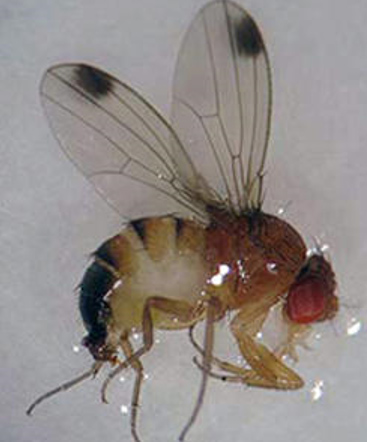
- Spotted wing drosophila (Drosophila Suzuki) is only 1/12 to 1/8 inch (2-3 mm) long.
- Yellowish-brown.
- Dark-colored bands on the abdomen.
- Prominent red eyes.
- They can be difficult to distinguish from other species of small fruit flies.
- Male SWD are relatively easy to identify as they have clear wings and a dark spot along the first vein near the tip of each wing.
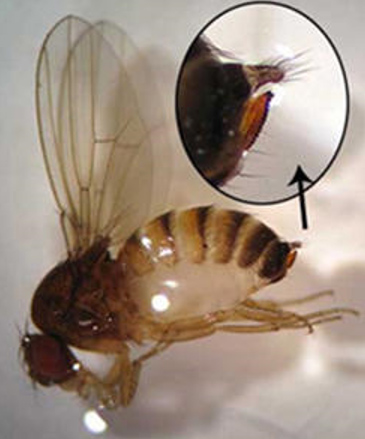
- Female SWD also have clear wings, but they do not have any spots.
- They can only be identified by their saw-like ovipositor, which has two rows of dark-colored teeth (the ovipositor is the structure used by the female fly to insert eggs into berries).
- High magnification is needed to see the ovipositor.
Larvae

- SWD maggots are white, cylindrical, and taper at one end.
- They do not have legs or a conspicuous head.
- This is a small insect, only reaching 1/8th inch long.
Biology
SWD first appear in late June or early July, and numbers increase rapidly in the middle of summer, with populations peaking in August.
- Adult flies insert eggs into soft fruit, where the larvae develop.
- Larvae leave the fruits to pupate and later emerge as adults.
- SWD can complete its life cycle in as little as seven days.
- Multiple generations of SWD can occur in a year, with populations building throughout the summer. The highest numbers are seen in August and September.
- SWD overwinters as an adult.
- Most SWD seem to migrate into Minnesota from the south, although there is evidence that some SWD can survive Minnesota winters.
Damage
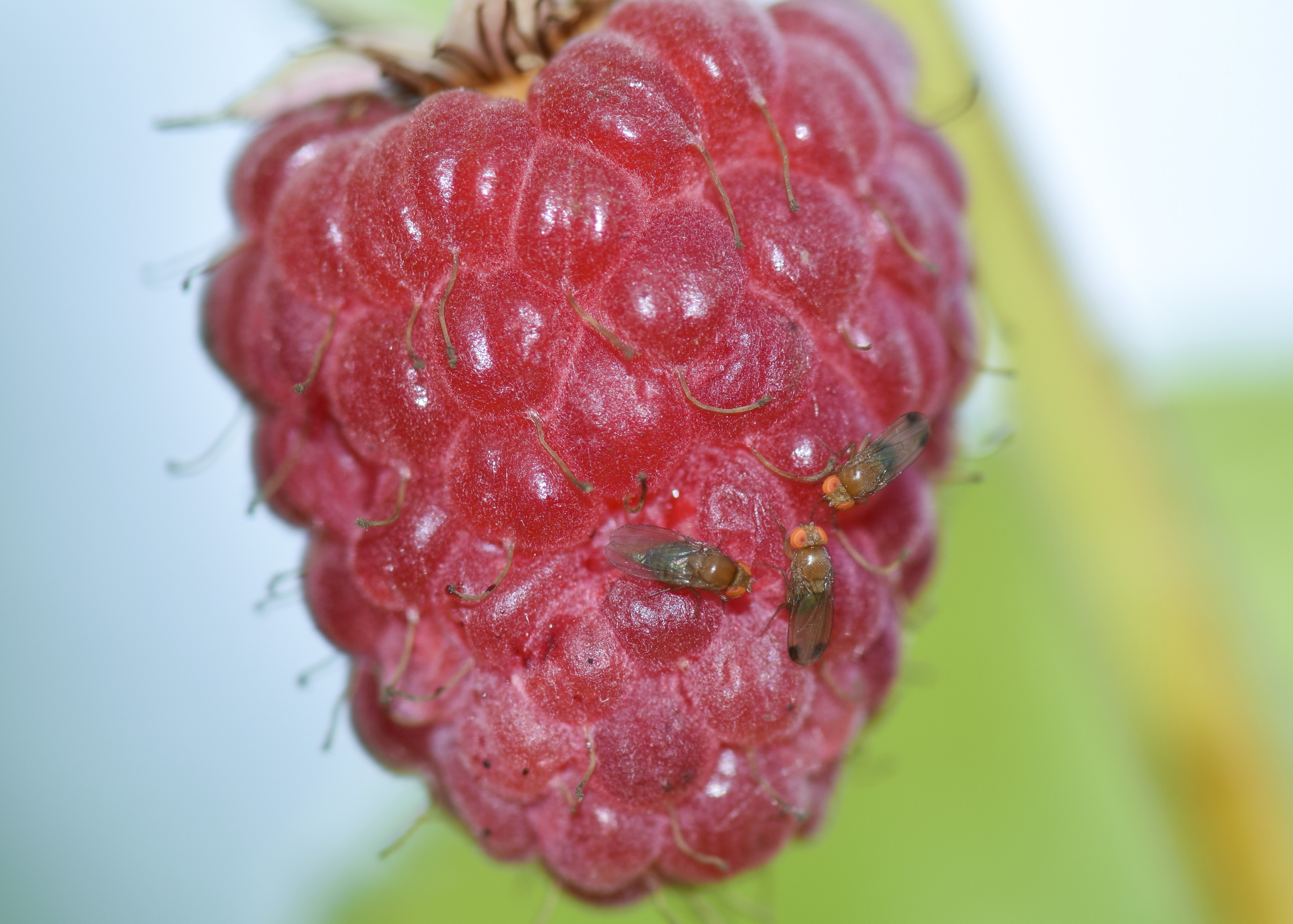
SWD larvae feed on healthy, intact, ripening fruits. In particular, SWD will feed on thin-skinned, soft fruits such as raspberries, blackberries, blueberries, strawberries, grapes, plums and cherries.
They do not attack healthy apples, pears or cherry tomatoes. However, if these fruits become damaged, they can successfully infest them. They do not appear to attack cranberries.
- SWD larvae feed within the fruits, causing brown, sunken areas.
- It is possible that larval feeding symptoms won’t show until after crops are harvested.
- During egg-laying, the female may introduce Acetobacter, a bacterium that causes the fruit to rot, and infested fruit often develops a fermented or sour smell.
- If berries are stored at room temperature, larvae can hatch after the fruit has been picked. Fruit that was normal may be soft and maggot-infested a day or two later.
- Mature larvae often crawl out of fruit stored on the counter.
- Feeding makes fruits susceptible to infestation by other insects, rot fungi, and bacteria.
- During minor infestations, infested fruit can be processed into wine or jelly.
- During severe infestations, the fruit is too rotten to be processed.
Managing SWD in home gardens
Start monitoring your garden for adult SWD as soon as you see fruit set, and continue through the end of harvest. This allows you to identify the start and end of fly activity.
The most critical time period to monitor is when fruit color first starts to develop until the crop is harvested.
Make your own SWD trap
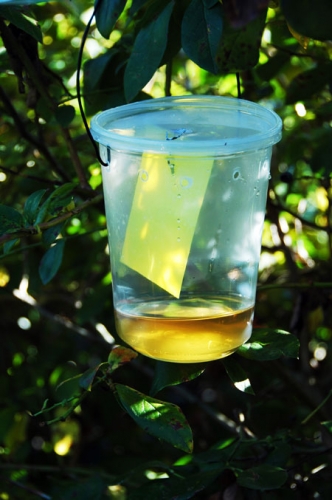
Adult SWD flies can be trapped using a plastic 32-ounce cup.
- Poke several 3/16-inch holes around the upper side of the cup (small holes let SWD in, but keep out larger insects).
- Leave a 3- to 4-inch section without holes to hold the bait.
- Pour one inch of apple cider vinegar into the trap as bait.
- Place a small yellow sticky card inside (purchase from a garden supply store). If you can’t get the sticky cards, add a drop of unscented dish soap to the vinegar to trap flies.
- Hang traps from branches in the shade near growing fruit, and begin monitoring before fruit begins to ripen.
- Replace the sticky card and apple cider vinegar bait at least once a week when checking for SWD.
- Dispose of the old apple cider vinegar away from the trap location.
- Checking traps more often can help detect adult SWD earlier, especially early in the growing season.
If you’d like to test fruit for the presence of maggots, there are several sampling methods you can use. See Sampling berries for spotted wing drosophila larvae (Michigan State University).
Sanitation
Sanitation is important for reducing local buildup of SWD populations.
- Frequently harvest crops to ensure ripe fruits are not in gardens for extended periods of time.
- Remove and destroy any old fruit that remains on stems or that has fallen to the ground.
- Once infested or fallen fruit has been collected, place it in a plastic bag and seal it tightly.
- Fruit in clear bags can be left outdoors, where the sun’s heat will kill any flies inside.
- Plastic bags can also be placed in the trash.
- Do not compost this material, as composting is unreliable for killing SWD.
- Do not bury infested material, as research shows that SWD can survive burial to depths of 18 inches.
If your fruit looks intact, but you still suspect an infestation, place it in your refrigerator. Chilling can help slow and even stop the development of larvae. Note that this fruit is safe to eat. There is no known risk to human health from eating SWD.
Exclusion

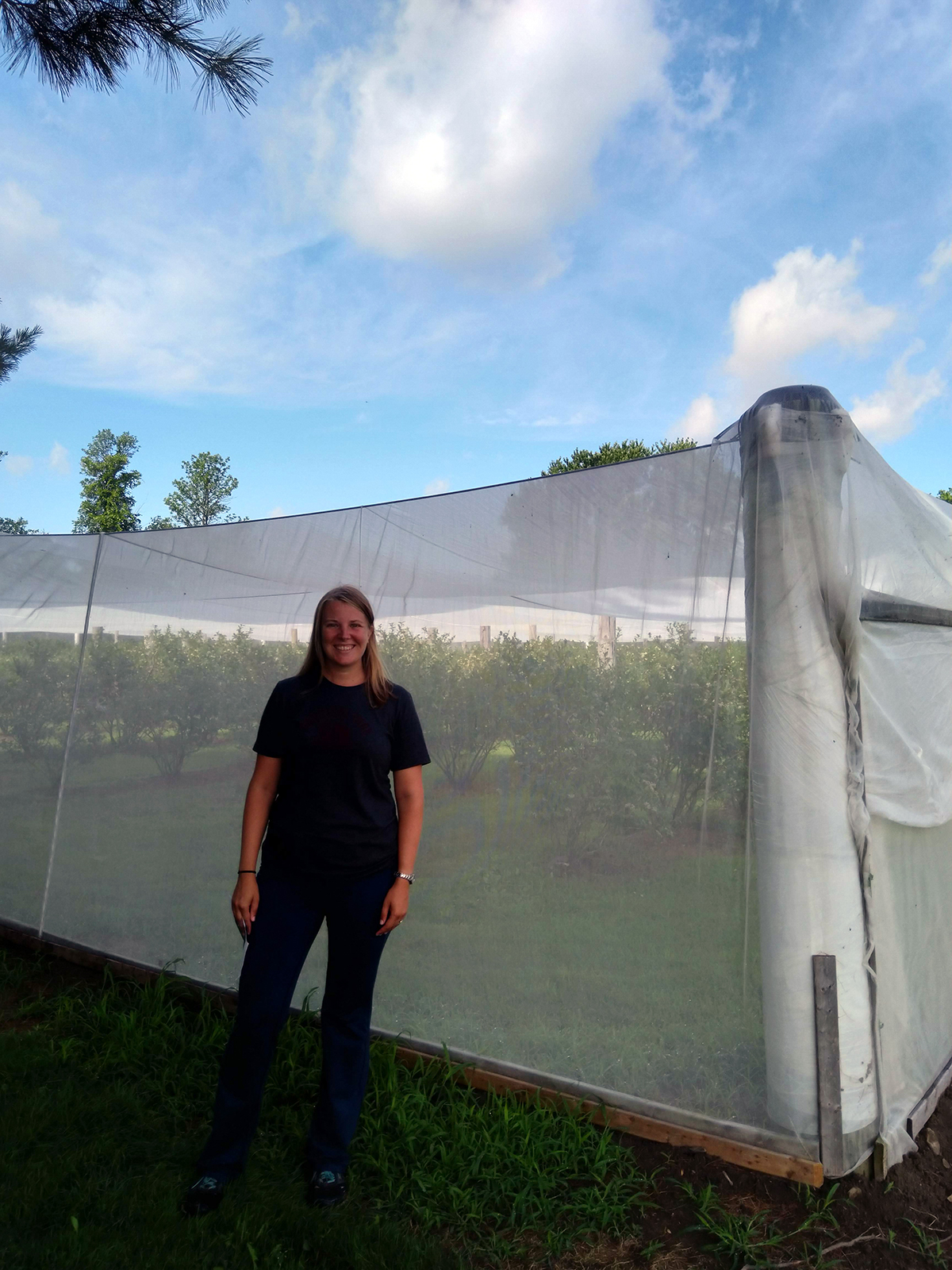
Another cultural control method for managing SWD is exclusion using netting or floating row covers.
- Netting can be used over a more permanent structure, such as a small high tunnel, or placed directly over the row like a floating row cover.
- The cover prevents SWD access to developing berries and can potentially reduce the infestation.
- One drawback is that the covering would have to be opened at each harvest, potentially allowing SWD access to the fruit.
- While netting can disrupt pollinator access to flowers, raspberries can still set fruit successfully since their flowers can self-pollinate, and wind can play a role in pollination.
- Use a fine mesh netting: 80-gram insect netting has been shown to provide good results.
- Coarser netting will allow SWD to pass through and infest fruit.
- Netting can also protect against birds and hail.
It is important to remember that SWD females can start laying eggs one day after adult emergence. This makes it very important to monitor to detect whether SWD is present and when they first appear. The sooner the flies are discovered, the quicker management decisions can be made.
SWD will complete multiple overlapping generations, so there will be continuous activity once the flies become active. Keep in mind that insecticides target adults before they lay eggs and will not control larvae already in the fruit.
Once fruit is infested, there is no effective control other than using sanitation to prevent SWD from emerging.
- Insecticides should be applied in the evening to avoid killing honeybees and other pollinators.
- Readily available insecticides that kill adult SWD include carbaryl, malathion, spinosad and pyrethrin.
- Spinosad and pyrethrin are approved for organic production.
- Insecticide resistance is a concern with this pest, and you should rotate classes of insecticides if possible.
CAUTION: Mention of a pesticide or use of a pesticide label is for educational purposes only. Always follow the pesticide label directions attached to the pesticide container you are using. Be sure that the plant you wish to treat is listed on the label of the pesticide you intend to use. And observe the number of days between pesticide application and when you can harvest your crop. Remember, the label is the law.
Managing SWD on farms
The following information is specific to fruit farms and those growing fruit for commercial sale or use.

Managing SWD is difficult because fruit is susceptible to infestation at first color through harvest. The most effective management plans integrate a mix of cultural, preventive, and chemical practices (organic or synthetic pesticides).
Currently, no economic threshold has been established for SWD, so a conservative approach is to use fly capture on your farm or regional SWD trap data as an indication of early activity, and to initiate protective measures if SWD is present and berries are at a susceptible stage.
If fruit is ripening or ripe and SWD flies are trapped, growers should:
- Implement cultural controls where possible, and
- Protect fruit until harvest using registered insecticides.
Adult SWD flies can be trapped using commercial or homemade traps.
- Commercial traps from Scentry (uses water + soap) and Trece (uses apple cider vinegar), both using a lure and drowning solution, are available from Great Lakes IPM.
- Traps should be checked 1-2 times per week for SWD flies - more often if fruit is harvestable, by looking at the yellow sticky trap (if used) and in the liquid drowning solution.
- Records should be kept for SWD captures to document the periods of fly activity, and the corresponding stage of fruit ripeness should be noted as well.
Make your own SWD trap
Adult SWD flies can be trapped using a plastic 32-ounce cup.
- Poke several 3/16-inch holes around the upper side of the cup (small holes let SWD in, but keep out larger insects).
- Leave a 3- to 4-inch section without holes to hold the bait.
- Pour one inch of apple cider vinegar into the trap as bait.
- Place a small yellow sticky card inside (purchase from a garden supply store). If you can’t get the sticky cards, add a drop of unscented dish soap to the vinegar to trap flies.
- Hang traps from branches in the shade near growing fruit and begin monitoring before the fruit begins to ripen.
- Replace the sticky card and apple cider vinegar bait at least once a week when checking for SWD.
- Dispose of the old apple cider vinegar away from the trap location.
- Checking traps more often can help detect adult SWD earlier, especially early in the growing season.
If you would like to test fruit for the presence of maggots, there are several sampling methods you can use. See Sampling berries for spotted wing drosophila larvae (Michigan State University).
Sanitation
Sanitation is important for reducing local buildup of SWD populations.
- Frequently harvest crops to ensure ripe fruits are not in gardens for extended periods of time.
- Remove and destroy any old fruit that remains on stems or that has fallen to the ground.
- Once infested or fallen fruit has been collected, place the berries in a plastic bag and seal it tightly.
- Fruit in clear bags can be left outdoors, where the sun’s heat will kill any flies inside.
- Plastic bags can also be placed in the trash.
- Do not compost this material, as composting is unreliable for killing SWD.
- Do not bury infested material, as research shows that SWD can survive burial to depths of 18 inches.
If your fruit looks intact but you still suspect an infestation, you can chill it to stop further SWD development. Refrigeration prior to sale is recommended. There is no known risk to human health following incidental consumption of SWD.
Physical exclusion and habitat disruption

High tunnels are typically used to extend the season, but they can also serve as a pest management tool by physically excluding insect pests.
In 2015, tunnels covered with plastic or fine mesh netting were evaluated as an alternative to insecticide application for protecting fall-bearing raspberries from SWD infestation in Minnesota. Berries in plastic-covered tunnels had low mean season-long levels of SWD infestation of only 2%, compared to netted tunnels at 35%, insecticide-treated open plots at 60%, and untreated open plots at 81% of berries infested.
Microclimate data suggest that temperature and humidity in plastic-covered tunnels were often above and below optimal levels, respectively, for SWD development, mating, and oviposition. These sub-optimal conditions may have limited overall population growth compared with the tunnel covered with netting.
Both exclusion and modification of micro-climate may be effective and complementary as pest management strategies for fall-bearing raspberry and may be viable alternatives to insecticide applications, particularly for small-acreage and organic production.
Properly applied, organic and synthetic insecticides can be effective, but insecticide applications must be coupled with timely harvests between sprays and with close adherence to the re-entry (REI) and pre-harvest (PHI) intervals for each insecticide.
Given the potential for rapid population growth of SWD (SWD females can start laying eggs one day after adult emergence), active management is needed through the end of harvest.
For raspberries, we recommend maintaining a 5-day spray interval (a 7-day interval is the recommended maximum), starting as soon as the first berry color change is evident and flies are present.
For each insecticide, use the maximum rate per acre, with high volume for maximum canopy coverage (e.g., 25-40 gallons water/ac), and, for example, use air-blast sprayers to improve coverage.
Alternating families of insecticides (see IRAC code) is also essential to minimize the risk of SWD developing insecticide resistance. Synthetic insecticides include spinetoram (Delegate), zeta-cypermethrin (Mustang Maxx), malathion, and fenpropathrin.
There are a few National Organic Program (NOP) compliant insecticides that provide good SWD control. Spinosad (e.g., Entrust) is currently considered the most effective organic pesticide option for SWD.
Pyrethrins have some efficacy against SWD. However, many farmers have expressed their disappointment with its performance. The Midwest Fruit Pest Management Guide rates its efficacy on SWD as “Poor” based on several research trials.
While neem oil can be used for SWD, its efficacy is also considered poor, and it is not recommended.
For updated insecticide control options, please refer to the annually revised Midwest Fruit Pest Management Guide.
Essential oil repellents (Ecotrol)
Researchers at the University of Minnesota have been testing certain essential oil mixtures as repellents against SWD. Tests are ongoing in both laboratory and on-farm settings.
Some farmers have also begun trying Ecotrol on their farms. While some results are promising, Ecotrol has shown inconsistent efficacy under field conditions. More replicated trials are needed regarding the timing of applications and application methods.
CAUTION: Mention of a pesticide or use of a pesticide label is for educational purposes only. Always follow the pesticide label directions attached to the pesticide container you are using. Be sure that the plant you wish to treat is listed on the label of the pesticide you intend to use. And observe the number of days between pesticide application and when you can harvest your crop. Remember, the label is the law.
Ebbenga, D. N., Burkness, E. C., Hutchison, W. D., & Rodriguez-Saona, C. (2019). Evaluation of Exclusion Netting for Spotted-Wing Drosophila (Diptera: Drosophilidae) Management in Minnesota Wine Grapes. Journal of economic entomology, 112(5), 2287-2294. https://doi.org/10.1093/jee/toz143
Reviewed in 2026