

Quick facts
- Metallic wood-boring beetles (Buprestid beetles) are common in forests and landscapes in Minnesota.
- Two common species in Minnesota:
- The bronze birch borer (Agrilus anxius) feeds on birch.
- The twolined chestnut borer (A. bilineatus) feeds on white and red oak.
- They prefer to feed and reproduce in stressed, dying trees
- Foliage at the top of the tree canopy starts to die back first and work its way down the tree.
- Raised ridges can be seen on the trunk and branches of infested trees.
- Keeping trees healthy helps to reduce their attractiveness to native borers.
- Insecticides can help protect valued trees.
How to identify bronze birch borer and twolined chestnut borer

Adults
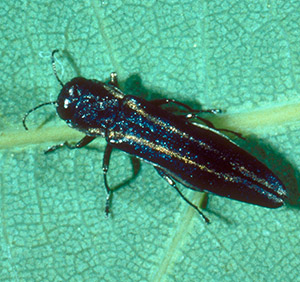
- 1/4 to 1/2 inch long, slender, dark colored beetles.
- Bronze birch borers are iridescent and bronze colored.
- Two-lined chestnut borers are bluish-black with two parallel yellow stripes running down their wing covers.
Larvae

- Up to one inch long when fully grown.
- Pale white.
- Flattened body and two pincer-like tails at the rear end.
- The head is mostly hidden, but the mandibles are easily seen.
Life cycle
- Beetles live through the winter as larvae under the bark of trees in pupal chambers.
- They pupate in spring.
- Adults start to emerge in early June in Minnesota when Vanhoutte spirea and black locust are in full bloom.
- They continue emerging until July.
- Adults live two to five weeks, feeding on leaves, mating, and laying eggs in branch or bark crevices.
- The eggs hatch, and small larvae chew through the bark to the phloem layer to feed.
- While feeding, the larvae create galleries that become packed with their frass (a mixture of borer feces and sawdust).
- Most larvae consume enough tissue through summer and fall to complete their life cycle in one season.
- In very cold climates or where the larval resources are limited in the tree, it may take two years to complete a generation.
Trees attacked by borers
Bronze birch borer
- Attacks most Asian and European species and varieties of white-barked birch.
- Native species of birch have evolved with the borers and are much more resistant when the trees are healthy.
- Native trees can be attacked if they become stressed and are declining.
Two-lined chestnut borers
- Attack native and introduced oaks that are stressed and declining.
- Native oaks in Minnesota:
- White oak (Quercus alba)
- Swamp white oak (Q. bicolor)
- Bur oak (Q. macrocarpa)
- Northern pin oak (Q. ellipsoides)
- Red oak (Q. rubra)
- Black oak (Q. veluntina)
- Chinkapin oak (Q. muehlenbergii)
Damage caused by bronze birch borer and twolined chestnut borer
Trees under stress are more susceptible to attacks by these beetles. Stressed trees are less able to get and move water and food (carbohydrates) to the canopy. This leads to a reduced ability to defend against borer larvae.
Stress factors
- Sustained drought.
- Prolonged defoliation.
- Poor planting sites, such as compacted soils; birch grown in open locations where roots are exposed to heat and drying.
- Physical damage to roots and trunks from construction damage or lawn mower injury.
- Construction practices, such as re-grading the landscape.
Adult beetles feeding on the leaves of trees do not affect tree health. But larvae create destructive galleries under the bark that disrupt the transport of water and nutrients.
Identifying infested trees is challenging
Look for these symptoms:
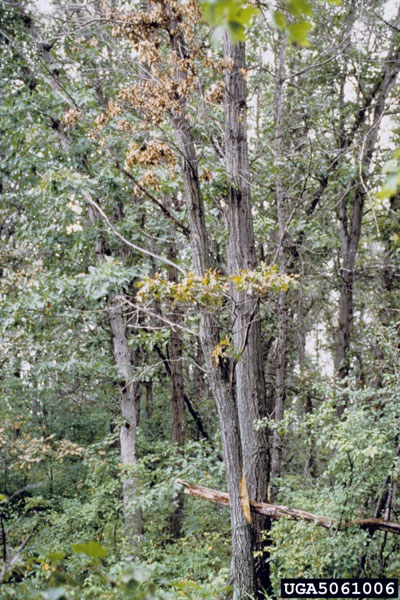
- Wilting or yellowing of leaves and dieback starting at the top of the tree.
- There can be other problems that can cause similar symptoms in the canopy so dieback is not automatically due to borers.
- As the tree continues to decline, dieback extends down into major branches and eventually into the main stem.
- Sawdust packed S-shaped galleries under the bark.
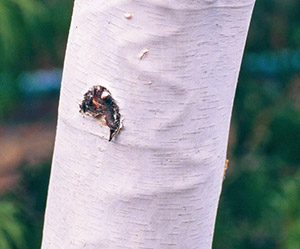
- Bronze birch borer galleries create raised ridges in the thin bark due to calluses forming over the galleries.
- Twolined chestnut borer galleries can only be seen when the bark is removed.
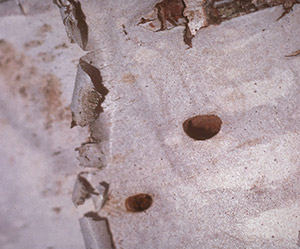
- 1/8-inch D-shaped exit holes on trunks and branches. They can be hard to see.
Symptoms of borer damage





How to protect your trees
Bronze birch borer
Native birch species are more resistant to borer attack as long as they are not stressed by drought, over-mature, or have some other health issue.
Resistant native species include:
- White barked birch
- Paper birch (B. papyrifera)
- Gray birch (B. populifolia)
- Non-white barked species
- Yellow birch (B. alleghaniensis)
- Sweet birch (B. lenta)
- River birch (B. nigra) seems to be immune
Most Asian and European varieties of white-barked birch are very susceptible to attack even when they are healthy.
Avoid planting highly susceptible white-barked birch species such as:
- European birch (Betula pendula)
- Asian birch (B. platyphylla)
- Himalayan birch (B. utilis)
- Japanese monarch birch (B. maximowicziana)
Twolined chestnut borer
Twolined chestnut borer attacks native and introduced oaks.
All North American oaks have some resistance, but can suffer damage when trees are stressed.
Trees that are stressed, from drought, defoliation or other causes, are more susceptible to damage.
To minimize stress:
- Add organic mulch to oaks and birch to improve their health.
- Mulch keeps soil temperatures cooler and slows the rate of moisture evaporation.
- It increases the water holding capacity of the soil and creates a better rooting system.
- Mulch is helpful for birch which has a shallower root system.
- Always keep trees well-watered.
- Avoid fertilizing stressed trees. Fertilizers increase water demand for the trees and can be injurious to them.
- If changes are being made to the landscape, make sure to protect the roots of trees.
- Root damage caused by soil compaction or root severing due to heavy equipment will stress trees.
- Remember that the roots can extend well beyond the canopy of the tree.
Treating trees with pesticides to kill borers is only effective if the tree is in the initial stages of decline and dieback.
Pesticides are not effective when more than 40 to 50 percent of the canopy has been killed by borers.
Systemic pesticides
- Imidacloprid is applied as a liquid drench to the soil around the trunk of the tree (professional applicators can also apply it as a soil injection or a trunk injection).
- Dinotefuron is applied as granules to the soil directly around the tree (professional applicators can also apply it as a bark spray, soil drench, or soil injection).
CAUTION: Apply these products to birch and oak trees only after flowering in the spring to reduce pesticide exposure to bees. Do not apply systemic pesticides to the soil when bee attractive flowers are planted next to trees.
Canopy sprays
Non-systemic control of borers is difficult because precise timing and coverage is necessary. Pesticide is effective if applied to the infested tree when the adult beetles are first active in early June.
Spray pesticide on the trunk and branches where the eggs are being laid. When the larvae hatch from the eggs, they will come in contact with the pesticide as they burrow through the bark.
Products containing permethrin, lambda cyhalothrin, and other pyrethroids are effective.
- Two applications are necessary.
- The first application should be applied as black locust trees bloom, and the second two to three weeks later.
- Homeowners can spray small trees themselves.
- Contact professional tree care companies for treatment of larger trees.
Professional services
Contact a professional when you are dealing with larger trees. Commercial tree care companies have experience in managing borers and in handling and applying pesticides. They have access to products and procedures that are unavailable to homeowners.
CAUTION: Mention of a pesticide or use of a pesticide label is for educational purposes only. Always follow the pesticide label directions attached to the pesticide container you are using. Be sure that the area you wish to treat is listed on the label of the pesticide you intend to use. Remember, the label is the law.
Reviewed in 2023