

Quick facts
Round leaf bittersweet (Celastrus orbiculatus - formerly known as Oriental bittersweet) is a Prohibited Control Noxious Weed in Minnesota. Prevent seed maturation and dispersal of plants into new areas. No transportation, propagation, or sale of these plants is allowed. Failure to comply may result in enforcement action by the county or local municipality.
Report round leaf bittersweet:
- Email [email protected], or
- Call 651-201-6684 or 1-888-545-6684

Round leaf bittersweet is a vine that strangles and smothers forest stands. It dominates tree canopies and reduces light and available moisture for other vegetation.
A large-scale mature infestation often contains dead trees covered by heavy, woody vines.
How to identify round leaf bittersweet
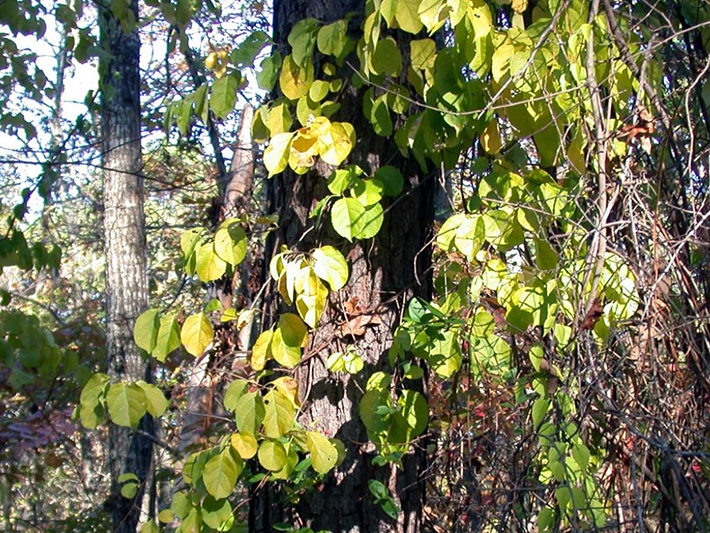
- A thick and woody deciduous vine that can grow up to 66 feet.
- Light brown to grayish.
Leaves
- Alternate green leaves turn yellow in the fall.
- They can be oblong or round, 2 to 5 inches long, and 1.4 to 2 inches wide.
- Leaves are variable and not a good identifier.
Flowers
- Separate male and female plants by flowers.
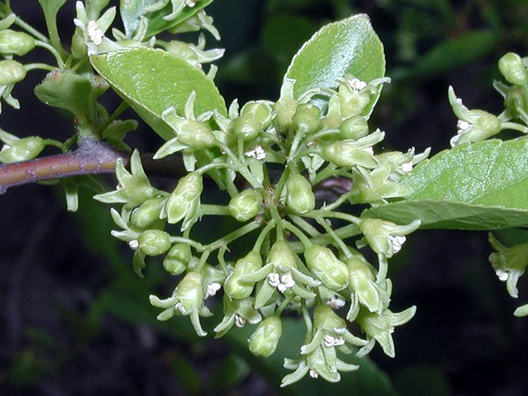
- Flowers are found in clusters of 2 to 7, with each flower having 5 petals.
- Flowers are the only way to identify male plants positively; males do not produce fruit.
Fruit and seeds

- Loose bunches of 3 to 7 yellowish, 3-parted capsules enclosing reddish berries are strung along the stem near the leaf axils.
- Berries have three segments containing 1 or 2 seeds each.
- Mature berries are red with yellow capsules in the fall and can persist all winter.
- Seeds can be carried by birds as they feed on berries.
Roots
- Vines can root where they touch the ground.
- Rhizomes can spread and send up new plants.
360-degree image of round leaf bittersweet
Use your cursor to move the image.
Reviewed in 2024