

Prune a tree to have well-spaced branches and a balanced appearance, while eliminating broken, diseased or dead branches.
General pruning guidelines
- Remove diseased, broken, or dead branches.
- Remove any downward-growing branches.
- If two limbs are crossed, entangled, or otherwise competing, remove one of them completely at its base.
- Remove any limbs along the trunk that are bigger in diameter than the trunk.
- Remove suckers coming up from the roots or low on the trunk.
- Remove vigorous vertical branches, called water sprouts.
- Make pruning cuts close to the branch collar at the base of the limb.
- For larger limbs, start the cut from the underside of the limb to avoid tearing the bark.
- Remove large limbs first, starting with the top of the tree.
- "Thinning" cuts remove entire branches at the branch collar and are usually the recommended type of cut.
- "Heading" cuts remove only part of a branch and encourage vegetation growth below the cut and are not as common.
Fruit trees should be pruned every year in late winter or early spring, preferably after the coldest weather has passed and before growth begins. Prune minimally, especially with young trees, as excessive pruning will delay or reduce fruiting and create too much leafy growth.
Once the first set of scaffold branches has been selected, choose a second set above it. Scaffold branches should be spaced about 12 inches apart. Always keep the conical form in mind when pruning.
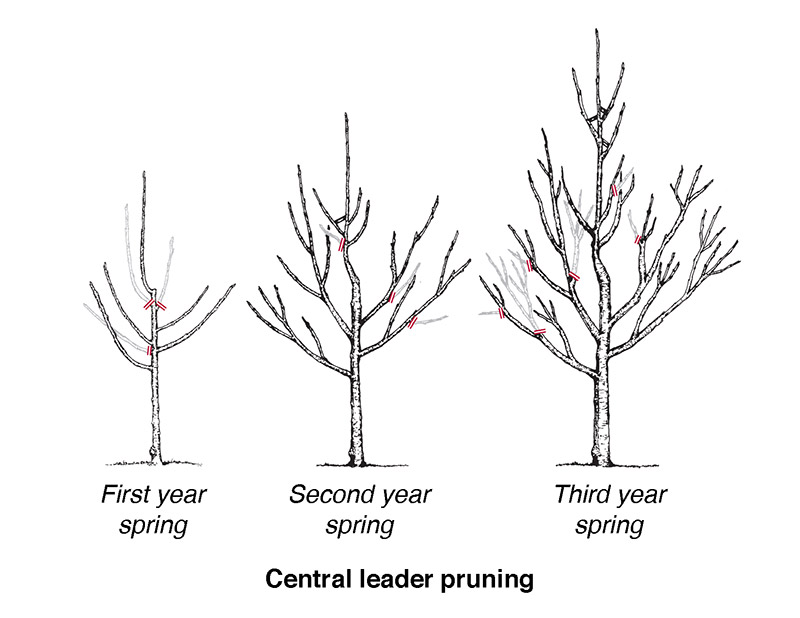
Central leader pruning
Many apple trees are pruned and trained to allow a central main stem, or leader, to be the foundation of the tree off of which side branches, or scaffolds grow. The tree ends up in a conical or pyramid form. This is called central leader pruning.
This is a simple pruning method that makes a compact, balanced, easily managed tree. The fruit has maximum access to sunlight and air circulation.
How to prune apple trees: A 3-part video series
- UMN Extension Apple Pruning Tips Part One (2018; 3:50)
- UMN Extension Apple Pruning Tips Part Two (2018; 3:34)
- UMN Extension Apple Pruning Tips Part Three (2018; 8:06)
Pruning to restore or renovate an old tree
Do you have an old, overgrown apple tree in your yard? Are the branches overlapping and going every which way? Don't lose hope. This tree is probably fine, it just needs a little work to get it back in shape and productive again.
Reclaiming a mature apple tree that has been neglected for several years can be a challenge, and will take a few years of pruning to make the tree productive again.
Here are a few guidelines for renovating a neglected tree:
- Decide which branch is or will be the leader.
- Decide which branches to save based on the branch position around the trunk.
- Prune out a few large branches in year one to open the tree up and increase light and airflow.
- Don't prune too much or the tree will put all its energy into making new branches and not fruit.
- During year two, decide where branches should remain and remove a few more.
- Follow general pruning guidelines to prune out branches that are diseased or broken.
Training young trees
As you prune your young tree to achieve a good form, you may also need to train it. Training primarily consists of bending young, vertically growing flexible branches into more horizontal positions, toward a 60-degree angle from the main stem. Some apple varieties produce strong vertical growth and need more training; others tend to produce branches that are naturally well-angled.
- Training branches at about a 60-degree angle from the main stem slows down the production of new leaves and branch growth and encourages fruiting.
- The more vertical a branch, the more vigorously it grows, and the less fruit it tends to produce.
- Branches with relatively wide crotch angles are also stronger and better able to support the weight of the crop.
- Branches that grow more vertically often break away from the tree under the weight of fruit.
- Don't train a branch to be truly horizontal or to grow downwards; it should still grow more or less upwards.
If a young branch is well placed but has a narrow branch angle, using a device called a "spreader" may help. The spreader can be as simple as a notched stick, or you can find one at a garden center. You wedge it between the branch and the trunk to create a wider angle.
- To train new branches less than six inches in length, use a wooden spring-type clothespin.
- Clip the clothespin onto the leader and position the flexible shoot between the other ends of the clothespin.
- Move the clothespin up or down the leader until you have the young shoot at the proper angle.
- Always go back and remove the spreaders at the end of the growing season.
For more information on growing apples in your yard, see Growing apples in the home garden.
For commercial growers: see the University of Minnesota fruit research pages on growing apples.
Reviewed in 2025