

Quick facts
- A trellis provides the support needed to train both permanent and semi-permanent grapevine parts.
- While three-dimensional trellises offer some added benefits for vigorous vines and fresh eating grapes, most wine grape growers use two-dimensional trellis designs.
- Two-dimensional systems simplify some vineyard management tasks, including winter pruning.

Constructing a reliable trellis is a key step to successful vineyard establishment. Trellises come in various designs, and there are multiple tools and supply options to choose from for construction and maintenance.
Why do grapes need to be trellised?
Trellises are the hardware onto which grapevines are trained. Left to their own devices, grapevines would grow bushy and become difficult to manage and harvest. A trellis provides the support needed to train both permanent and semi-permanent grapevine parts, such as a trunk and cordons, guide shoots, and uphold the crop weight of a fully ripened grapevine without collapsing.
Trellis designs can vary, but they are typically built in two or three dimensions. While three-dimensional trellises offer some added benefits for vigorous vines and fresh eating grapes, most wine grape growers use two-dimensional trellis designs. Two-dimensional systems also simplify some vineyard management tasks, including winter pruning. Overall, it can be helpful to remember that the trellis form determines its function.
Each trellis design specifies which training systems can be used. For example, a two-dimensional trellis can support bilateral cordon systems like Vertical Shoot Positioning (VSP), High Wire Cordon (HWC), Scott Henry (SH), or Fan training.
Modified Munson and Geneva Double Curtain are examples of training systems for three-dimensional trellis designs.
Parts of a trellis
Understanding the function of each trellis feature simplifies the initial planning process. The diagram below is a simplified version of a two-dimensional trellis with wires set up to train VSP grapevines.

1. End posts
End posts bear a lot of force from the tension exerted by the fruiting and catch wires, as well as the weight of the vines throughout the year. End posts can be installed into an augured hole or with an industrial post pounder, most typically to a depth of 2-3 feet.
The installation depth, post width, and angle will influence its sturdiness. The final post height should account for installation depth and the anticipated grapevine canopy height.
Materials
End posts are typically made of wood, but other materials, such as steel or reinforced concrete, are also available. The material a grower chooses for an end post depends on row length; longer rows require sturdier, stronger posts.
Soil type, management practices, and the cost or availability of materials also influence which materials are suitable. For example, growers who manage their vineyard organically would avoid using treated wood.
2. End post brace
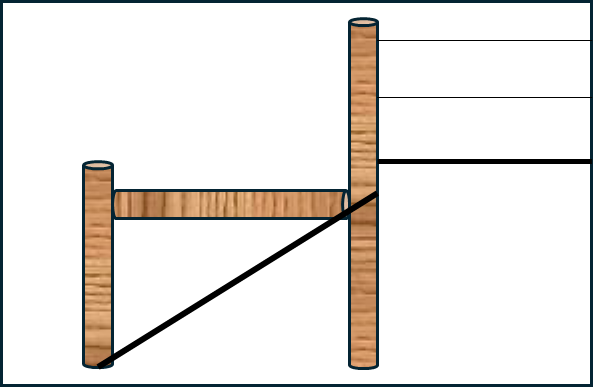
The end post brace refers to the reinforcement used to create counter-tension on the end post. This prevents the end posts from caving in at the ends due to the internal weight of the trellis and wire tension.
An anchor and brace wire is one approach to maintain counter-tension on the end post.
Materials:
Anchors can be made from wood (e.g., a tie-back post) or metal, such as an earth anchor. Earth anchors vary in helix diameter, and larger diameters are suitable for longer rows (e.g., a 6-inch helix supports a row up to 600 feet long).
Thicker wire or even a cable can be used in some circumstances to diagonally connect an anchoring feature to an end post.
Alternatives to using an anchor and brace wire include the H-brace or a slant brace; however, these designs require more wood and can be more costly. The H-Brace also takes up more end space, which can be disadvantageous for vineyard blocks with short space for turning a tractor between rows.
3. Line posts
Line posts, also known as “in-line” posts, are positioned at regular intervals within the trellis row and reduce the total weight load. Without line posts, a trellis row would need to be much shorter in length to prevent sagging and potential collapse.
Growers typically install one line post every 21 to 28 feet of the inner trellis row. This allows for 3-4 grapevines per panel, spaced 6-7 feet apart. Keep in mind that vine spacing should be determined by anticipated vigor, which is based on soil conditions and cultivar type.
Materials:
Line posts can be made of wood, metal, or reinforced concrete.
4. Fruiting wire
Fruiting wire is where the grapevine cordons, spurs, and fruit-bearing shoots exist, and it is the wire that bears the most weight.
Training wires should be installed through wooden end posts by guiding a wire into a drilled hole in an end post, along the trellis into the second end post, and securing it with a wirevise on both trellis end post outer sides.
For steel or other end post styles, the wires can be secured with a clip to maintain their position and then wrapped around and connected with a Gripple® connector or wire tensioner.
Materials:
The fruiting wire is usually a single galvanized wire between 12 and 10 gauge, which is thicker or lower gauge than the catch wires.
5. Training stakes
Training stakes are used to support the grapevine trunk as it establishes and should be as tall as the fruiting wire, or the anticipated vine height. The training stakes in the trellis diagram above would be appropriate for a VSP training system where the training wire is positioned at 3-4 feet, but it would need to be taller for HWC systems.
Stakes provide the added benefit of keeping trunks straight during training, allowing more energy within the vine to be directed toward fruit production.
Training stakes should be clipped to the training wire to keep them stable.
Materials:
Stakes can be made from wood, such as bamboo, or metal; however, metal stakes will last longer.
6. Support wires
Catch wires and single wires are used in vertical shoot training systems, such as VSP and Guyot, to guide shoots upward each year. Catch wires are double wires that are secured around the outer side of the end post and connected by a wire tensioner or Gripple® connector.
Catch wires allow shoots to be tucked, which can save time on shoot training.
Single wires require a method to attach shoots to the wire, which can be done with a Tapener® tool.
Domoto, P., 2002. Constructing a vineyard trellis (PDF). Presented at the Iowa Grape Growers Conference, January 26, 2002.
Reviewed in 2026