

Quick facts
- Grazing two or more livestock species on the same piece of land can produce more total pounds per acre while also improving the pasture ecosystem and composition.
- Using a diversity of grazing livestock species promotes pasture plant species diversity, resulting in increased nutrient cycling and productivity.
- Multiple livestock species can be grazed together or separately.
Maximizing forage and farm productivity
The goal of multi-species grazing is to graze two or more livestock species on the same piece of land, aiming to produce more total pounds per acre compared to single-species grazing, while also improving the pasture ecosystem and composition.
Livestock grazing preferences
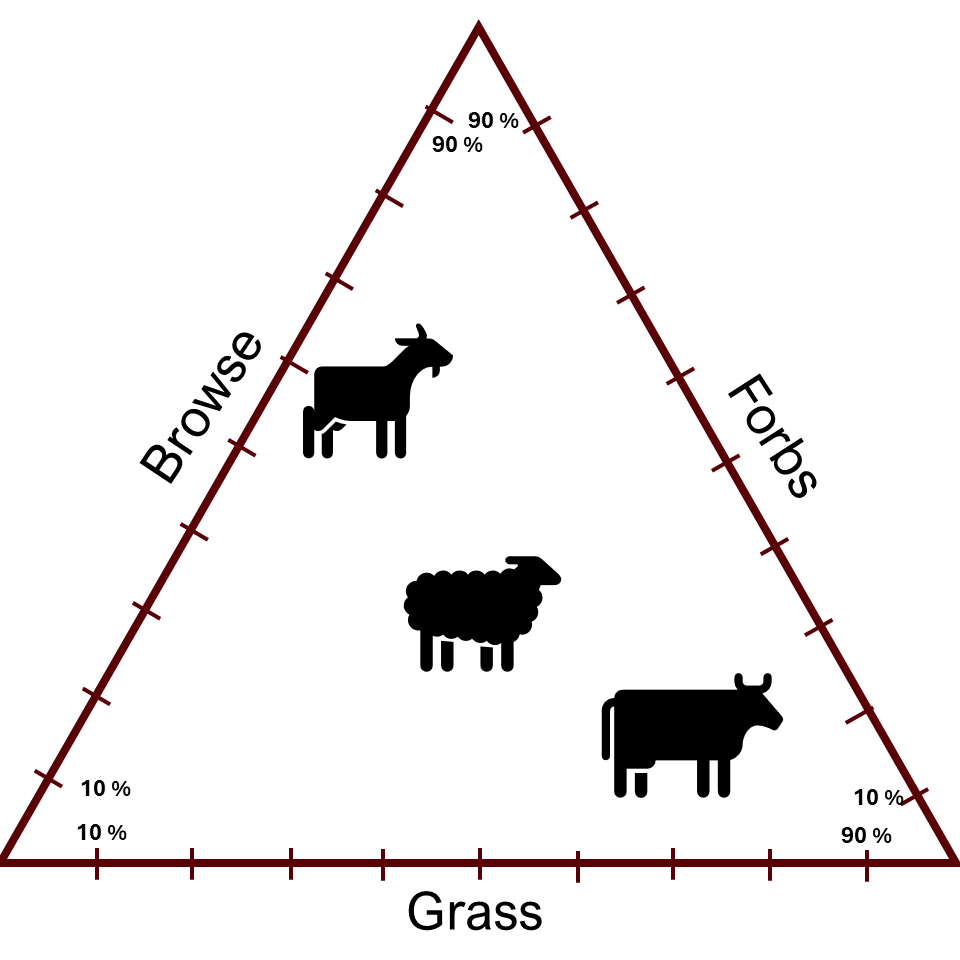
Each ruminant livestock species will select for different proportions of each common plant functional group (grasses, forbs and browse).
On average:
- Cattle select 70% grass, 15% forbs and 15% browse.
- Sheep select 50% grass, 30% forbs and 20% browse.
- Goats select 30% grass, 10% forbs and 60% browse.
- These proportions will vary within the livestock species and can be manipulated by management.
- Using a diversity of grazing livestock species promotes pasture plant species diversity, resulting in increased nutrient cycling and productivity.
Take stock of pasture plant species
To take advantage of multi-species grazing, evaluate the proportions of grasses, forbs, and browse currently in your pastures and on your farm site.
Determine which livestock species might be a suitable addition to your operation based on your pasture make-up and species preferences.
Benefits of multi-species grazing
These benefits are only realized when proper grazing, animal husbandry, and business management techniques are used.
Plants
- Forage quality and resilience increase, as may overall pasture forage crude protein and organic matter digestibility.
- Prevents pasture domination of just one plant group or species.
- Reduced need for weed control in pastures.
Livestock
- Weight gain increases per day per unit of area.
- Parasite control improves when cattle are grazed with small ruminants.
- Protection from predators improves when combining small ruminants with larger ruminants.
- Small ruminants should not be combined with all classes of cattle.
- Cows may attack lambs as they are born.
Farm
- Studies show that a 1:1 ratio of cattle to sheep can increase the net return per animal unit by 65%.
- You can diversify your income streams and mitigate risks.
- Inputs shared between enterprises lower the total cost of producing two or more products.
Livestock considerations

There is a lot to learn when raising a new livestock species, even for experienced livestock producers. Do your homework. For example, learn which plants are toxic to new livestock species. Cattle producers must learn about parasite control for small ruminants if they want to incorporate sheep and goats.
Cattle
- Sheep are more competitive when forage availability is low; cattle productivity will decline.
- If feeding sheep minerals to cattle, you may need to increase copper supplementation during the third trimester of gestation.
Sheep and goats
- Sheep are sensitive to copper. Do not feed cattle minerals with higher levels of copper to sheep.
- May need livestock guardian animals.
- They require more fencing infrastructure, especially for goats. You may need to cull sheep or goats that don’t stay inside the fence.
- Ensure sheep and goats can reach cattle waterers. Place rocks at the bottom of the waterer in case lambs or kids fall in, so they can easily get back out.
- Sheep and goats share parasites. If grazing sheep and goats together, there may be more parasite pressure on goats.
- Prevent all species from grazing too low to the ground (below 6 inches of forage height) to minimize parasite infection.
Grazing methods
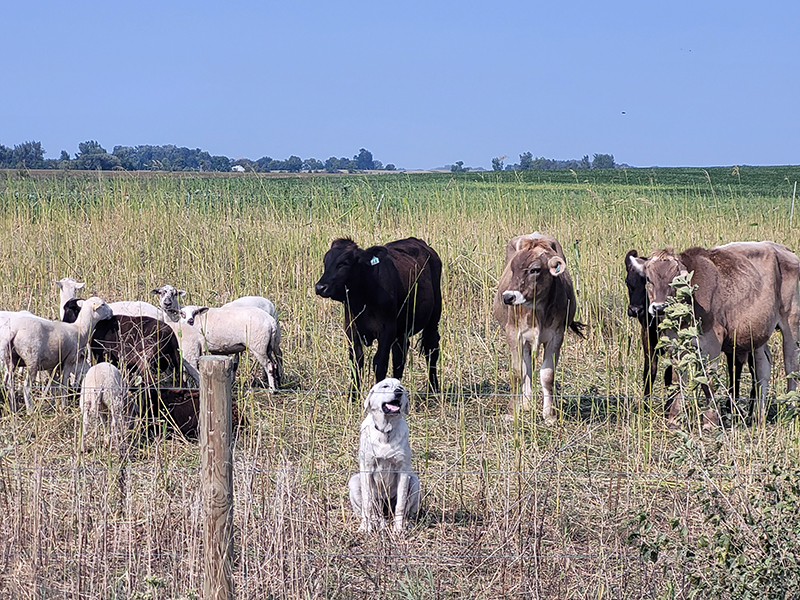
Grazing together
Multiple livestock species can be grazed together in a flerd (i.e., sheep and cattle bonded together). This will reduce the labor required for moving livestock to new paddocks. However, bonding cattle and small ruminants can be difficult.
- Start with the youngest, weaned livestock to attempt bonding.
- Closely monitor livestock that are bonding for any aggressive behaviors.
Grazing separately
Multiple livestock species can graze the same land in sequence, one after the other. Some producers graze sheep first, followed by cattle, chickens, and then pigs. This requires more labor to move multiple groups of livestock.
Keeping livestock species separate may reduce the transfer of disease between livestock species. It also allows for specialized management, such as nutrition and health protocols tailored to each species.

Evaluate your resource concerns, landscape, forage and labor availability to determine which livestock species to graze and how to graze them.
Anderson, D., et al. (2012). Managing livestock using animal behavior: Mixed-species stocking and flerds. Animal, 6, 1339–1349. https://doi.org/10.1017/S175173111200016X
Carlsson, B. Å., et al. (2024). Are cows pickier than goats? Linnaeus’s innovative large-scale feeding experiment. Biological Journal of the Linnean Society, 143(1), blae084. https://doi.org/10.1093/biolinnean/blae084
Dobson, R., et al. (2011). A multi-species model to assess the effect of refugia on worm control and anthelmintic resistance in sheep grazing systems. Australian Veterinary Journal, 89(6), 200–208. https://doi.org/10.1111/j.1751-0813.2011.00719.x
Hintze, K., et al. (2021). Economic Feasibility of Mixed-Species Grazing to Improve Rangeland Productivity. Animals: An Open Access Journal from MDPI, 11(5), 1226. https://doi.org/10.3390/ani11051226
Krueger, W. C., et al. (1978). Management Approaches to Reduce Livestock Losses from Poisonous Plants on Rangeland. Journal of Range Management, 31(5), 347–350. https://doi.org/10.2307/3897357
Martin, G., et al. (2020). Potential of multi-species livestock farming to improve the sustainability of livestock farms: A review. Agricultural Systems, 181, 102821. https://doi.org/10.1016/j.agsy.2020.102821
Mhuireach, G. Á., et al. (2022). One or many? Multi-species livestock grazing influences soil microbiome community structure and antibiotic resistance potential. Frontiers in Sustainable Food Systems, 6. https://doi.org/10.3389/fsufs.2022.926824
Multi-Species Grazing | Master Grazer. (n.d.). Retrieved May 16, 2024, from https://grazer.ca.uky.edu/multi-species-grazing
Multispecies Grazing: A Primer on Diversity – ATTRA – Sustainable Agriculture. (n.d.). Retrieved May 16, 2024, from https://attra.ncat.org/publication/multispecies-grazing-a-primer-on-diversity/
Qu, J., et al. (2016). The more the merrier? Multi-species grazing of small herbivores mediates plant community impacts. Biodiversity and Conservation, 25(11), 2055–2069. https://doi.org/10.1007/s10531-016-1178-7
Riggs, R. A., et al. (2015). Biomass and fire dynamics in a temperate forest-grassland mosaic: Integrating multi-species herbivory, climate, and fire with the FireBGCv2/GrazeBGC system. Ecological Modelling, 296, 57–78. https://doi.org/10.1016/j.ecolmodel.2014.10.013
Rowntree, J. E., et al. (2020). Ecosystem Impacts and Productive Capacity of a Multi-Species Pastured Livestock System. Frontiers in Sustainable Food Systems, 4. https://doi.org/10.3389/fsufs.2020.544984
Schanz, L., et al. (2022). Single- and multi-species groups: A descriptive study of cattle and broiler behaviour on pasture. Applied Animal Behaviour Science, 257, 105779. https://doi.org/10.1016/j.applanim.2022.105779
Targeted Grazing Handbook. (n.d.). Retrieved May 16, 2024, from https://www.webpages.uidaho.edu/rx-grazing/Handbook.htm
The Pros and Cons of Multi-Species Grazing with Greg Judy Part 1 of 3. (December 22, 2021). https://www.stockmangrassfarmer.digital/podcasts/the-stockman-grassfarmer-podcast/episodes/2147654644
Tohiran, K. A., et al. (2023). Multi-species rotational grazing of small ruminants regenerates undergrowth vegetation while controlling weeds in the oil palm silvopastoral system. Agricultural Systems, 210, 103720. https://doi.org/10.1016/j.agsy.2023.103720
Walker, J. Multispecies grazing: The ecological advantage. (1994). ResearchGate. Retrieved June 11, 2025, from https://www.researchgate.net/publication/284038172_Multispecies_grazing_The_ecological_advantage
Wang, L., et al. (2021). A scientific basis for promoting grassland ecosystem multifunctionality by diversifying grazing livestock: A review. Chinese Science Bulletin, 66(30), 3791–3798. https://doi.org/10.1360/TB-2021-0121
Reviewed in 2025