

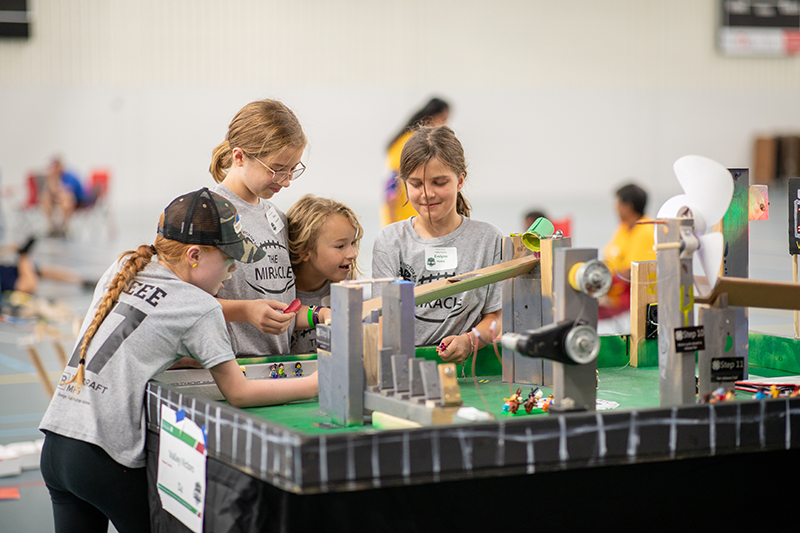
In the 4-H Engineering Design Challenge, youth develop critical thinking, creativity, innovation and problem-solving skills through engineering, as they have fun working with their team.
Teams of youth in grades 3 and up work to design and build a Rube Goldberg™–type machine that completes the two-part challenge: Win a carnival game every time and show the crowd you've won.
Two Minnesota 4-H volunteers are needed for each team. Minnesota 4-H staff support volunteer coaches every step of the way with curriculum, project ideas and learning activities. No expertise is required.
Watch the 4-H Engineering Design Challenge in action (YouTube).
2026 Engineering Design Challenge
Step Right Up: The 4-H Marvelous Midway Challenge
Step right up and join the 2026 Minnesota 4-H Engineering Design Challenge (EDC)! This exciting statewide event invites youth in grades 3 and up to work in teams to design and build a Rube Goldberg™–type machine that completes a two-part task: Win a carnival game every time and show the crowd you've won (e.g., make a sound, ring a bell, play a recording of a crowd cheering, raise a banner, lift up your prize stuffed animal in victory, etc.).
Teams and individuals exhibit their machine at their county fair with the opportunity to exhibit at the state fair.
How to join or form a team
Interested youth should contact their local Extension educator to find or form a team.
Once you have your team, complete the intent form by June 30.
For participants and coaches
Information and resources
- Reach out to Anja Johnson at [email protected] to request the EDC Handbook. The EDC Handbook provides all of the information needed to participate in the challenge.
Q: What does human intervention mean?
Once the first step in your machine, winning a carnival game every time, takes place, the machine should run all the way through the second step of showing the crowd you've won and continue to the end without anyone touching it.
However, sometimes the machine may fail to reach the last steps to accomplish the task. If a machine fails before it completes the task, it may be necessary for a person to start it again from the point where it failed. That is a human intervention.
Q: Can I enter a machine that has been previously built and posted online?
No. All entries must be new machines created for the current challenge year and theme.
Q: What is a desirable size for a machine?
Due to space constraints at the state fair, we encourage teams and individuals to think mini and keep their machine to tabletop dimensions to build a machine that is manageable and portable. We encourage a “table top” platform size of 3 ft wide (with height up to 3 ft.). The maximum allowed dimensions are 3’ x 3’ x 3.’ Machines will be on display in the 4-H building for the duration of the state fair.
Q: Should we build our machine on a platform, table, or the floor?
Individuals and teams will decide the best ways to ensure their machine is built on a stable surface or in a way that makes it easy to reset after each run. Some “best practices” have been to build a platform on wheels, use a sturdy table you bring, build a base so you can attach some of your machine parts to the base, or other methods to make it sturdy. Machines will be set up on a hard surface floor in the 4-H building at the state fair.
Q: What sources can we use for research?
Information gathering is a key step in the design process. Some of the information may be what you and your teammates already knew before you started to think about your machine. In that case, your source is your other teammates or maybe the class in school where you learned the information, or maybe a parent or relative or a 4-H volunteer who taught it to you.
But you probably won’t know everything before you start. The library, your teachers, the Internet, your family and friends are all good sources for helping you figure out how to solve a problem.
Q: Can a team be made up of youth of different ages and school grades?
Yes. Adult leaders should carefully consider the benefits and challenges of widely varying age/grade groups. Youth in different grades vary greatly, not only in their attention span and ability to stay on task, but also in the amount and type of planning they are capable of, the guidance and recognition they require, and the types of personal development they seek.
Q: Can youth from different counties be on the same team?
Yes. However, the team must be affiliated with a specific county’s 4-H program. If they exhibit their design at a county fair, it will be the fair of the county they’re affiliated with.
Q: Will our team be disqualified if we can’t complete the minimum number of steps?
No, your team will not be disqualified. A machine that meets the minimum number of steps has achieved the expected standard. A machine that does not meet the expected standard may result in a lower ribbon placing.
Resources for support
- The Engineering Design Process guides individuals and teams through the problem solving process as they create their machines. Youth will share how they used this process to complete the challenge task.
- Team coach/volunteer job description lists the roles and responsibilities of any adult who serves as a volunteer team coach.
- The Engineering Simple Machines lesson plan, developed by the Minnesota 4-H State STEM team. These lessons help volunteers and educators teach youth about the six simple machines and how to use them to design an Engineering Design Challenge machine.
Judging
In this interview, project engineer and challenge judge Teresa Burgess explains what she looks for when interviewing an individual or team.
Guidelines
Reach out to Anja Johnson at [email protected] to request the EDC Handbook. The EDC Handbook provides all of the information needed to participate in the challenge.
Evaluation
Judges use this feedback form during a conference judging experience.
Elements and ideas you can incorporate into your own machine
Helpful videos
- A Minnesota 4-H Engineering Design Challenge team in action -The Meeker County Koronis Eager Beavers demonstrate their contraption that puts toothpaste on a toothbrush and talk about what they learned while building it.
- View past EDC teams' machines for inspiration: 2025 4-H Engineering Design Challenge (YouTube)
Keeping a journal
Keeping a journal or engineering notebook is strongly recommended. This provides a way to record design ideas, work accomplished, problems encountered and solutions tried, materials needed, and any other aspects of designing and building your machine. Individuals or teams wishing to enter their machine for judging at county or state fairs are required to keep a journal or notebook.
Here are example journal questions to help guide your journaling. Print or make a copy of this document to complete.
Reach out to Anne Stevenson at [email protected] with any questions or to view examples of past journals.
Engineering Design Challenge experience at the state fair
Teams and individuals that have prepared a machine following the guidelines in the EDC Handbook can register to showcase their machine at the county fair. Full details on participation at the Minnesota State Fair are available in your county fair premium book or from your local 4-H educator.
2026 Minnesota 4-H Engineering Design Challenge will be exhibited at the Minnesota State Fair during the 4-H members scheduled general encampment.
Contacts
Looking for a team to join?
Reach out to your local Extension educator to find out if there is a team in your area.