

Quick facts
- Symptoms first appear when tomato fruit are at the green mature stage. Severely infected stems may crack or collapse.
- Bacteria survive in infected plant debris and soil.
- Use different cultural control strategies to manage the spread of the disease.
Pathogen
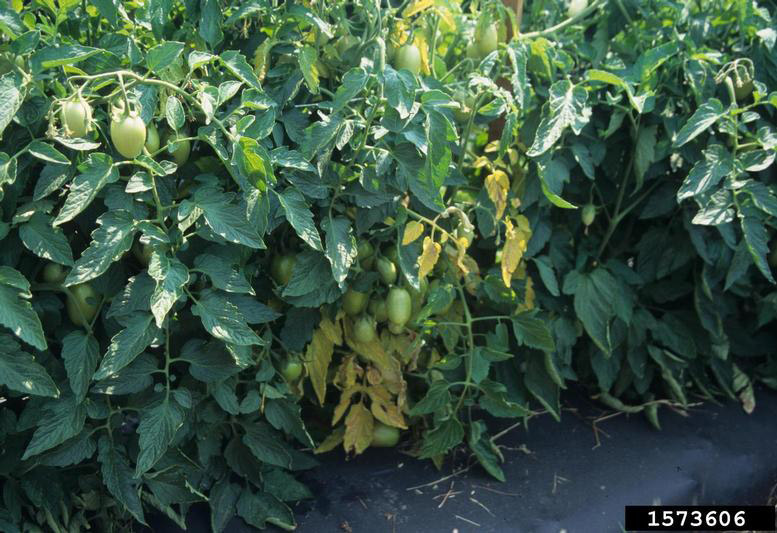
The bacteria Pseudomonas corrugata, P. viridiflava, Pseudomonas spp., and Pectobacterium carotovorum.
Host range
Tomato, pepper, and numerous vegetable and ornamental crops.
Identification
Signs and symptoms
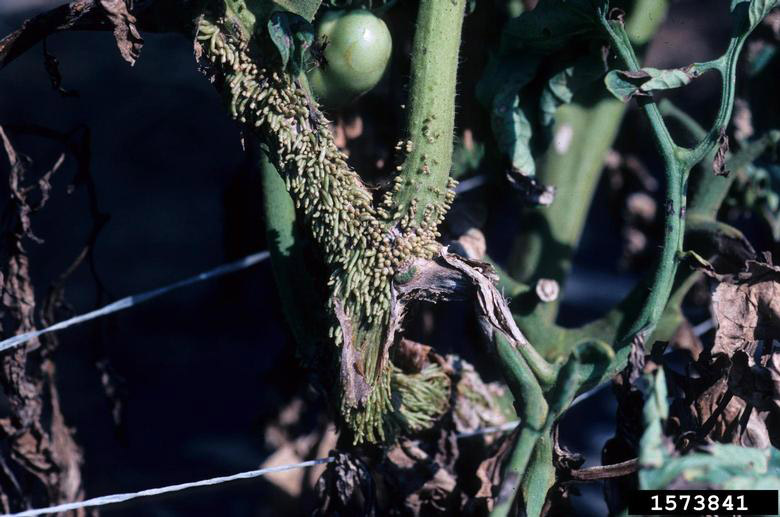
- Symptoms first appear when the tomato fruit is at the green mature stage.
- Leaves turn yellow, and lower leaves wilt.
- Dark brown to black lesions form on the stem.
- Many adventitious roots form along the stem.
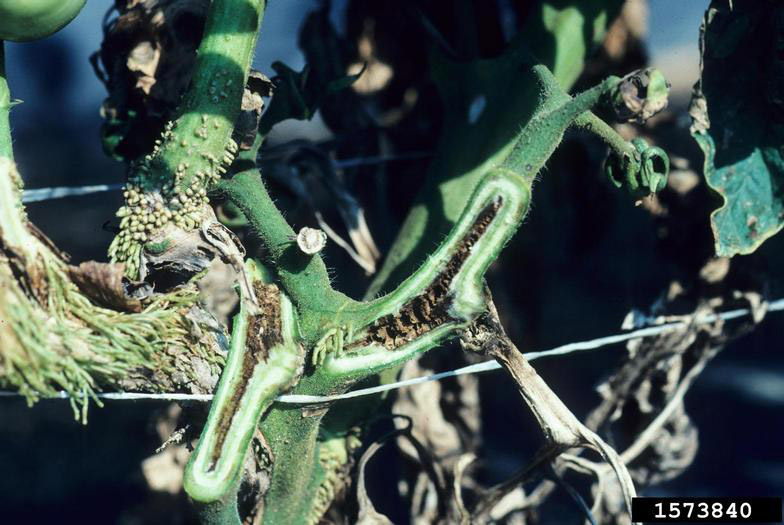
- If the stem is cut lengthwise, dark discoloration can be seen in the pith. Discoloration is darkest at the base of the plant but does not extend into the roots.
- The pith has pocket-like cavities.
- Severely infected stems may crack or collapse.
- Affected plants are scattered in a seemingly random pattern in the crop.
Environment
- Favors high humidity, low light and the large temperature difference between day and night.
- Favors high nitrogen and excess irrigation.
Biology and disease cycle
- Bacteria survive in infected plant debris and soil.
- May be brought in on infected seed or transplants.
- Spread on workers’ hands, pruning tools, and by splashing rain or irrigation.
- Bacteria need a wound or natural opening to start an infection.
Management
There are no tomato varieties resistant to pith necrosis. And there are no pesticides effective in managing pith necrosis.
These cultural controls can help manage the disease:
- Use a balanced fertility program based on a soil test. Avoid the use of excessive nitrogen.
- Reduce humidity by using vents, proper plant spacing, and staking and pruning plants. This is especially important on cloudy days.
- Do not work in plants when foliage is wet.
- Promptly bag and remove infected plants, including roots, to prevent spread.
- Use a commercial sanitizer to regularly clean pruning tools.
- Sterilize stakes, ties, trellises, etc., with 10% household bleach or commercial sanitizer.
Reviewed in 2016