

Quick facts
- Feeder design and access are the main factors affecting pig feed intake.
- If pigs don’t eat enough of their diet, their growth performance is at risk despite the diet’s nutrient content.
- Providing more feeder space can enable pigs to eat more effectively and reduce the number of lightweight pigs at market time.
- Finding poor-performing pigs early through daily observation and giving them extra care are also good practices.
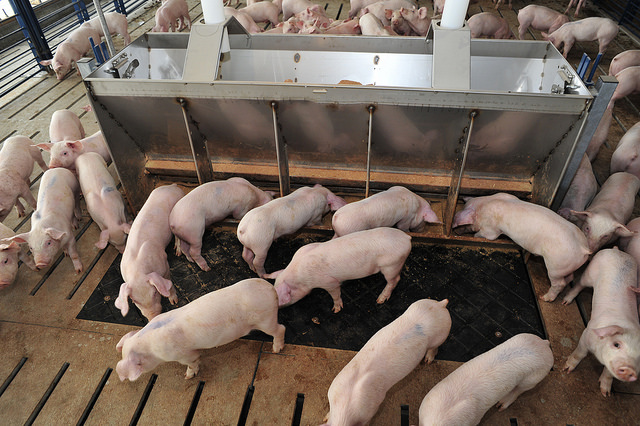
Pigs that grow significantly slower than their peers can cause concerns for animal well-being and reduce profit. In all-in-all-out systems, these pigs reach ideal slaughter weights slower than their peers. As a result, slow-growing pigs usually go to market at much lighter weights and return less income to pork producers.
Competing for feed affects slow-growing pigs
Research shows that social stress, such as competing for feed, can significantly impact pig growth. Due to their smaller size, it’s harder for slow-growing pigs to compete with pen mates for feed. This is especially true for pigs fed together and near each other, as is the case with most commercial feeders. As a result, growth performance in slow-growing pigs declines.
In this case, animal well-being becomes a concern because slow-growing pigs are often hungry. Sometimes they’ll only eat at night when there’s less competition at the feeder.
However, it is possible to improve the growth performance of slow-growing pigs. Some lightweight pigs can overcome slow growth and move to a heavier weight group.
More feeder space can improve the growth of slow-growing pigs
Researchers at the University of Minnesota West Central Experiment Station looked at the effects of standard (4 pigs per feeder) and ample (1.6 pigs per feeder) feeder space on pig growth performance. In the past, 4 to 11 pigs per feeder space has been recommended in commercial pork production when using a dry feeder with no head barriers between each feeding place.
Results from this study indicate that fast-growing and average-growing pigs exhibited similar growth performance in both feeder spaces. However, slow-growing pigs with ample feeder space exhibited an improved growth rate during the nursery phase compared to slow-growing pigs with standard feeder space.
Researchers also looked at a few risk factors for being lightweight at marketing, including:
- Birth weight
- Weaning weight (26 days of age)
- Nursery exit weight (51 days of age)
- Gender (gilts versus barrows)
- Litter size (greater than 14 versus less than 14 pigs born alive per litter)
- Dam parity (first parity versus greater than second parity)
Of these factors, the following are strongly related to pigs being more likely to be lightweight at marketing:
- Birth weight: Pigs less than 3 pounds
- Weaning weight: Pigs less than 14 pounds
- Nursery exit weight: Pigs less than 44 pounds
- Gender: Gilts are more likely to be lightweight at market time than barrows.
Litter size at birth and dam parity didn’t relate to the chance of being lightweight at marketing.
Reviewed in 2018