

Quick facts
- Alfalfa is susceptible to winter injury from low air temperatures (below 15 F), fluctuating air temperatures, and ice sheeting.
- Assess winter injury by examining crown and roots, stand density and stem density.
- Adjust harvest, control weeds and insects, and follow fertilizer recommendations when managing an injured stand that will be maintained.
- Options for winter-injured alfalfa stands include termination and planting corn, sorghum-sudangrass, and teff; or interseeding ryegrass and red clover.
Alfalfa is a perennial crop susceptible to injury from low air temperatures (below 15 F), fluctuating air temperatures, and ice sheeting. Winter injury may be first evident in no or very slow regrowth in the spring. Injured plants may have uneven regrowth and even appear yellow. Stand health can be assessed by observing plant health, plant density, and stem density.
Assessing winter injury
Assess plant health
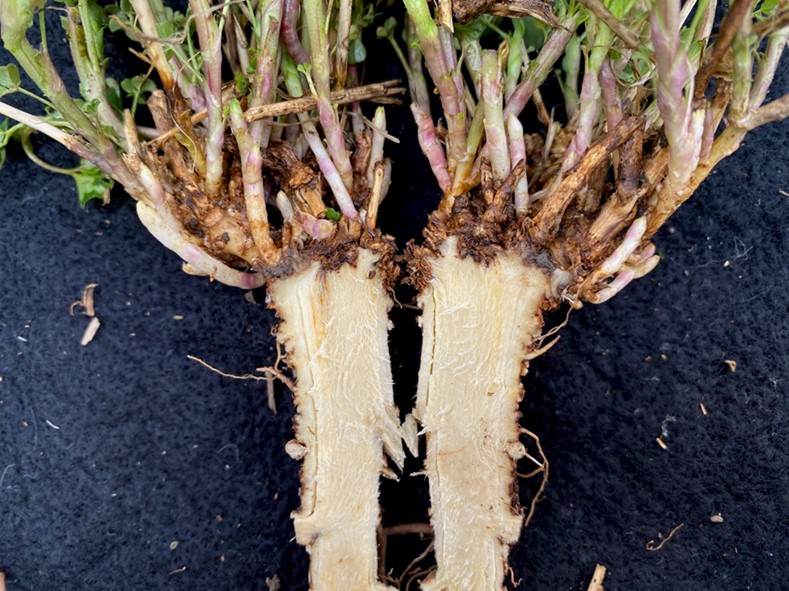
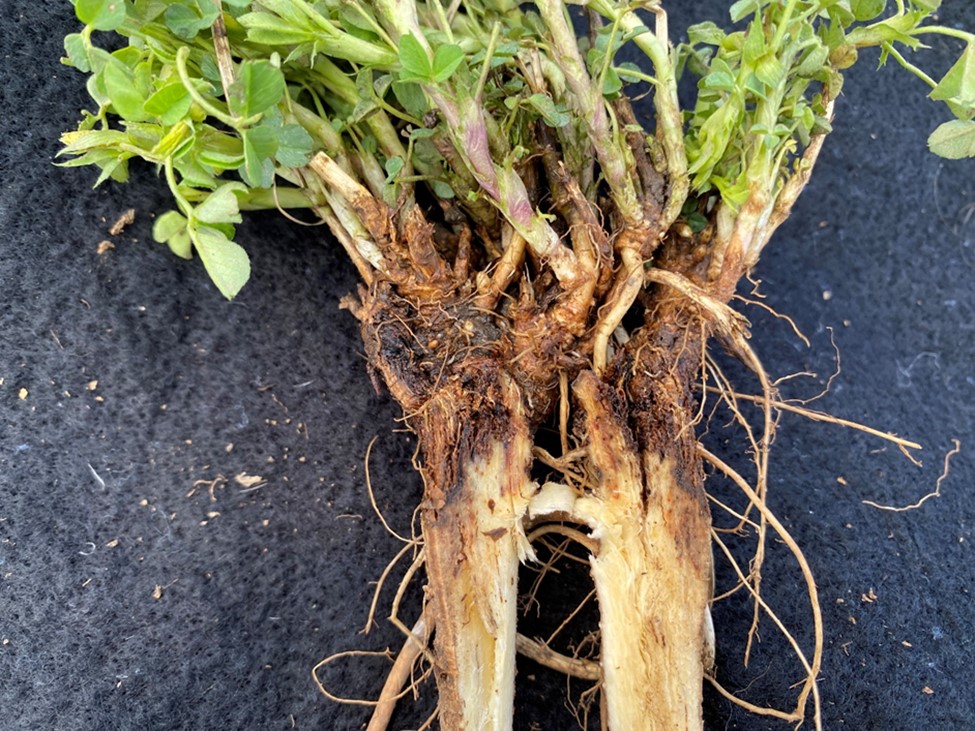
Assessing plant health will help to estimate the yield potential of a stand. Healthy plants have symmetrical crowns and white pithy roots, while injured plants typically have asymmetrical crowns with root and crown disease.
- Dig plants from 4 to 6 representative areas of a field to a 6-inch depth.
- Examine the plants for symmetry of the regrowth from the crown and the number of shoots present. The crown and root should also be examined.
- Look for the incidence of decay on the external surface.
- Then cut the root lengthwise and examine the crown and root for disease.
The University of Wisconsin's Alfalfa stand assessment: Is this stand good enough to keep? uses photos to rate alfalfa on a scale of 0 to 5.
Assess stand density/plant populations
Alfalfa stand density naturally declines with stand age. Stands that are one year old or less should have a high stand density. As alfalfa stands age, competition for resources, diseases, and crown injury due to winter and traffic reduce plant numbers. Decreases from 25 plants per square foot during the first year to 5-10 plants per square foot by the end of the second production year are common.
This reduction in plant density is compensated for by an increase in plant root and crown size and stems per plant. Injury to older crowns by traffic, disease, and winter conditions can reduce the number of stems and productivity of individual stems. A population of 4-5 healthy plants can result in productive stands, while lower populations will likely not be as productive.
Assess stem density
To further evaluate the potential productivity of an alfalfa stand, determine stem density by counting stems from 4 to 6 representative square foot areas within your field. Only count stems that are at least 6 inches tall.
Use these guidelines to determine if adequate stem numbers are present for a productive field:
- More than 55 stems: Density is not limiting to production.
- 40 to 55 stems: Some reduction has occurred, but adequate forage production is still likely.
- Less than 40 stems: Significant forage yield reduction. Consider stand termination.
Managing injured alfalfa stands
As you consider management options, remember that injured alfalfa stands can exhibit delayed regrowth, but may be capable of partially recovering. Be careful not to rush into alternative options if you can maintain the stand for acceptable production. If you plan to maintain the stand, consider the following management actions.
Allow alfalfa plants to mature before cutting
Delaying the first harvest until the alfalfa flowers will help the plants restore needed carbohydrates, redevelop damaged roots, and develop new crown buds to replace those killed during the winter.
Increase cutting height
Increasing cutting height to 4 to 6 inches will allow more sites for axillary bud development. In addition, increased cutting height will protect new shoots elongating from crown buds.
Control weeds and insect pests
When alfalfa stands are damaged and populations decrease, there is less competition for invading weeds such as dandelion. Herbicide applications to control weed competition will help the stand recover and also provide weed-free forage.
Stress caused by potato leafhopper stunting and alfalfa weevil defoliation can kill unhealthy, winter-injured plants. Scout for insect pest activity and treat when economic thresholds are reached. For more information, see Alfalfa insects: What to look for and how to scout.
Follow fertilizer recommendations
In addition to being generally stressed, injured plants can have damaged root systems. Soil test and apply needed fertilizer before the first cutting. Current recommendations can be found in Fertilizing alfalfa in Minnesota.
Reseeding options
Alfalfa stands that are thin or patchy will lack yield potential. There are several seeding options, depending on how many additional years are desired from the stand and by seed and equipment availability.
Seeding supplemental forages with a no-till drill in the affected areas is ideal, but conventional drills will often work if the ground is somewhat soft.
Terminate the stand and rotate to corn
Rotating to corn will allow the crop to use the alfalfa nitrogen (N) contribution in place of fertilizer N. Consider this option if stands are thin throughout the field and contain many weeds. For more information about terminating alfalfa and managing the two subsequent corn crops, see Managing the rotation from alfalfa to corn.
Terminate the stand and plant warm-season forages
Warm-season grasses, like teff, can be harvested for hay or grazed. Sorghum-sudangrass, another warm-season grass, can be harvested for silage or hay. Warm-season forage alternatives are described in Emergency forages: Warm-season grasses.
Interseed cool-season grasses
Rapidly growing, cool season grasses, like annual ryegrass or Italian ryegrass, can be interseeded into existing alfalfa stands at 5 to 10 pounds per acre.
True annual ryegrass goes to seed early in the summer and while it will regrow after harvest, it will not survive the winter. There are diploid types that are small-leafed and more prostrate than the tetraploid types that are larger-leafed with fewer tillers. Seeds of these two types are often mixed together and sold as blends.
Italian ryegrass is a biennial that won't form seed during the planting year but will go to seed the next spring instead. It has a more even yield distribution during the seeding year than the second year. Italian rye relies on snow cover for winter survival, but survival is not dependable.
Interseed red clover
Interseeding red clover at 6 to 10 pounds per acre in a mix with annual ryegrass is an option. Red clover has very good seedling vigor and can be harvested multiple times during the growing season. Mammoth or annual types behave as true annuals, while the medium types predominant in the marketplace are true perennials that persist for two or three years. Red clover forage is wetter than alfalfa so it requires a longer drying time — a potential drawback with this option.
Interseed with alfalfa
Alfalfa can be successfully seeded into fall-seeded alfalfa stands that are less than a year old at a rate of 10 pounds per acre. It should not be reseeded into older alfalfa stands due to the risk of autotoxicity. Autotoxicity occurs because mature alfalfa plants produce chemicals that kill alfalfa seedlings. For more information see Reducing autotoxicity in alfalfa.
Evaluate your winter injury risk
Our interactive decision tool can help you identify the factors that contribute to winter injury. Use this tool to calculate your risk on a field-by-field basis.
Reviewed in 2024