


Find crop-specific nutrient needs for Minnesota, including guidelines for nitrogen, phosphate, potash and other fertilizers, and strategies for ensuring crops get the nutrients they need.
Growing sugarbeet
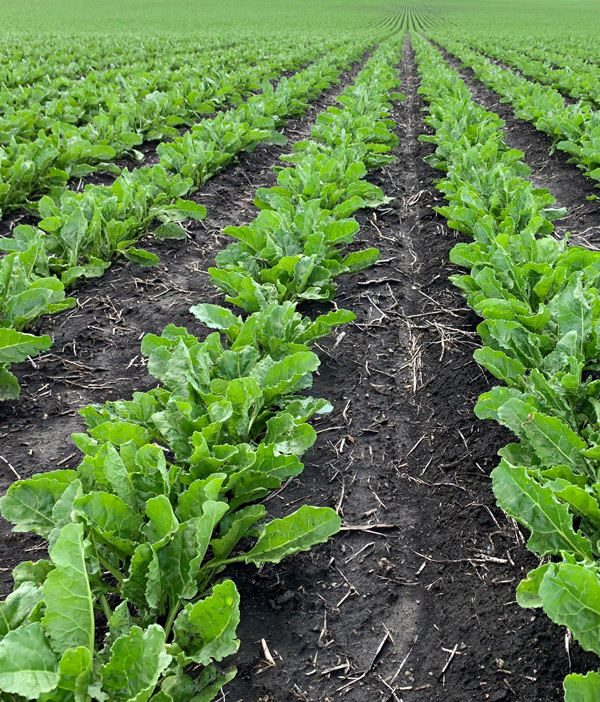
Sugarbeet has evolved through time from a labor-intensive agricultural crop to one that is highly mechanized and with steadily improving yield. The crop was first cultivated in Europe in the late 1700s.
Extension conducts applied research on sugarbeet production at University of Minnesota Research and Outreach Centers, at North Dakota State University, and on working farms around the state to solve the real-world problems facing farmers and ag professionals.
We work with
- Farmers
- Crop advisers
- Ag professionals
Guides and resources for sugarbeets production in Minnesota and North Dakota
|
- Sugarbeet fertilizer recommendations
- Sugarbeet production guide (PDF; North Dakota State University) – Fertilizing, row widths and plant populations, seeds, pest management.
The UMN Extension crops team can help you with disease diagnosis. Use the Digital Crop Doc to tell us more about your field situation and submit photos. A team member will contact you.
Insects
- Grasshopper management in Minnesota crops – Conditions that favor infestations, economically important species, how to scout for them, and treatment options.
Diseases
Leaf and crown diseases
Root diseases
Herbicide mode of action and sugarbeet injury symptoms
An in-depth look at eight herbicide families, their modes of action, factors that influence their effectiveness, and injury symptoms. This page includes information on herbicide and non-herbicide injury symptoms on sugarbeets.
- Application timing
- Herbicide selectivity
- Herbicide uptake and translocation
- Injury symptoms
The following webpages describe the characteristics of widely used herbicide families grouped by mode of action and the WSSA classification number (in parentheses).
- Growth regulators (SOAs 4 & 19)
- Amino acid synthesis inhibition (SOAs 2 & 9)
- Lipid synthesis inhibition (SOA 1)
- Seedling growth inhibition (SOAs 3, 8 & 15)
- Photosynthesis inhibition (SOAs 5, 6 & 7)
- Nitrogen metabolism inhibition (SOA 10)
- Pigment inhibition (SOAs 13 & 27)
- Cell membrane disruption (SOAs 14 & 22)

Soil and water
Soil health, irrigation and agricultural drainage resources for Minnesota.

NDSU sugarbeet production
University of Minnesota Extension collaborates with North Dakota State University Extension on sugarbeet research and on the sugarbeet production guide.
The Sugarbeet Report
This podcast features growing tips from NDSU and UMN Extension sugarbeet specialists and researchers.
The Integrated Pest Management podcast alerts growers, ag professionals, and educators to emerging pest concerns on Minnesota field crops, including corn, soybeans, small grains, and alfalfa. We also review recent pest trends and research updates.
Learn more about crop production
The University of Minnesota Extension crops team helps producers take control of their decisions to increase profitability and reduce economic and environmental risks. Our researchers and educators work in pest management, agricultural drainage and water management, soil management and health, climate and weather, and pesticide safety.
Page survey