

Quick facts
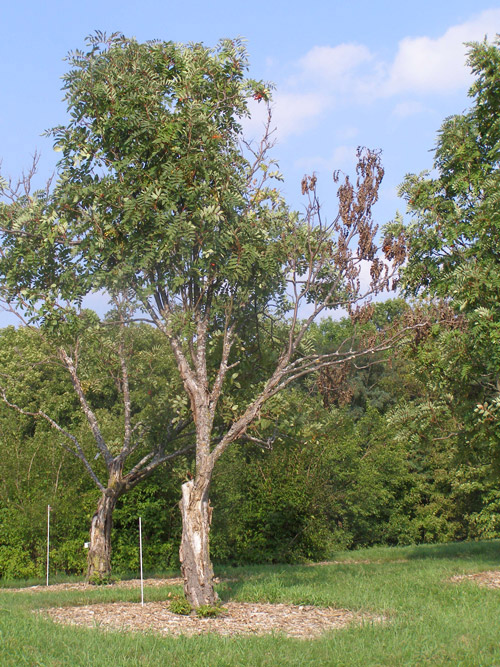
- In Minnesota, fire blight is most often seen on apple, crabapple, and mountain ash trees.
- Fire blight is a disease that can kill blossoms, but more commonly infects shoots and causes dieback of branches from cankers.
- Severe fire blight can cause trees to die, especially when young trees are infected.
- Young leaves and shoots wilt and bend downward, forming the shape of a hook.
- Trees with multiple infected shoots may appear scorched by fire.
- Homeowners can prevent issues with fire blight by planting resistant varieties.
- To manage fire blight, prune trees to remove infected branches before the disease kills the tree.
Plants affected by fire blight
Fire blight is caused by the bacterium Erwinia amylovora. This disease affects over 130 plant species in the Rosaceae family worldwide.
In Minnesota, fire blight is most often seen on apple and crabapple (Malus spp.) and mountain ash (Sorbus spp.).
The disease can also occur on raspberry (Rubus spp.), serviceberry (Amelanchier spp.), hawthorn (Crataegus spp.), and cotoneaster (Cotoneaster spp.).
How to identify fire blight
Flower symptoms
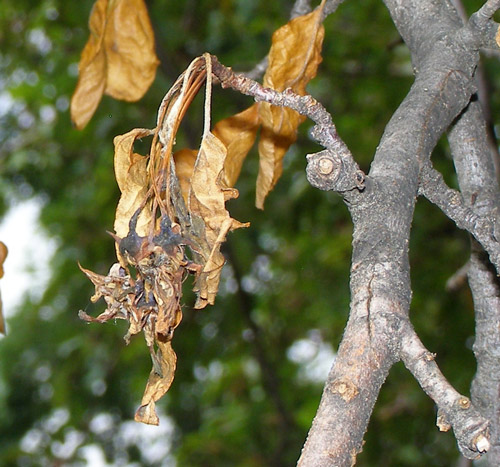
- Flowers and flower clusters appear water-soaked, then droop and shrivel, turning brown or black.
- Brown to black flowers remain attached through the growing season.
- Flower infections in Minnesota are less common than in other production regions because of the cool temperatures when trees and shrubs are blooming.
Leaf symptoms
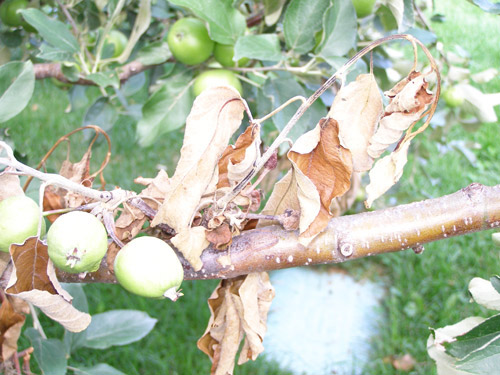
- Young leaves and shoots wilt and turn gray-green. These wilted shoots bend downward, forming the characteristic hook.
- Leaves and infected shoots turn brown or black. Trees with multiple infected shoots may appear scorched by fire.
- Brown leaves hang downward. Often, they cling to the blighted twig through the growing season and remain attached to the tree into winter.
Fruit symptoms
- Fruit turns dark and shrivels into a mummy.
- This shriveled fruit may cling to the branch for several months.

Bark symptoms
- Bark on branch or trunk cankers appear sunken, dark, and may be cracked or peeling.
- If the bark is peeled back, brown staining of the sapwood can be seen.
- Droplets of cream to light-yellow ooze are found along infected branches, shoots, or fruit during humid weather or after rain.
How fire blight survives and spreads
Because fire blight is caused by a bacterium, it enters the plant through natural openings like the stigma (top of female flower part), stomata, or wounds caused by hail, for example.
Fire blight causes the most damage when spring or summer weather is warm, humid, or rainy. Warm weather, above 65 F, combined with high humidity or a wetting event allows the bacteria to reproduce and spread.
Bacteria reproduction and spread
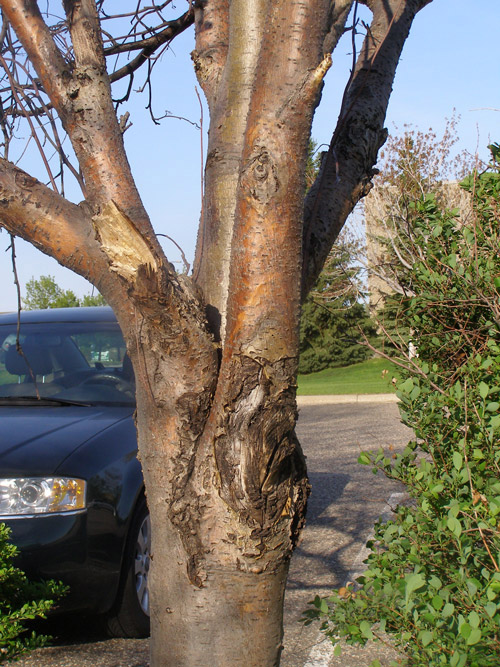
- The fire blight bacteria survive winter in cankers on the trunk or branches of infected trees.
- In spring, during warm, wet weather, bacteria begin to multiply. The bacteria seep out of the canker through natural openings or cracks as a sweet, sticky liquid known as bacterial ooze.
- Insects such as pollinators are attracted to this sweetness and carry the bacteria to wounds or flowers.
- Bacteria can also be moved by splashing water from rain, through irrigation, or on the hands and tools of gardeners.
- The fire blight bacteria will live and multiply on the surface of leaves, twigs, flowers and immature fruit for a few weeks without causing symptoms.
Entry and spread of infections
- Bacteria need a wound or a natural opening to infect the tree.
- Many infections start when bacteria growing on flowers reach a certain population and enter the flower through natural openings.
- Young shoots are infected through small wounds caused by insect feeding, wind whipping of branches, blowing sand or other damage.
- Once the bacteria have infected either blossoms or shoots, the bacteria can move into the branch through the vascular system of the tree. New branch cankers are formed by bacteria moving into branches in this way.
- In highly susceptible cultivars, the bacteria can move into the main trunk of the tree and even the roots. At this point, the tree will die.
How to manage fire blight
There are no known trees or shrubs in the Rosaceae family that are completely immune to fire blight. Some varieties can defend themselves by limiting or slowing the spread of the disease. This gives the gardener time to prune out the infected branches before the infection reaches the main trunk of the tree.
Varieties are often ranked by their ability to resist infection and slow the progression of disease. Since new varieties are brought to market each year, check with a reputable nursery about the disease resistance characteristics of new cultivars
Fire-blight-resistant trees that are hardy in Minnesota
Edible apple and crabapple (Malus spp.)
Most resistant
- Haralson
- Liberty
- Red Baron
- SnowSweet
- Chestnut crab
- Dolgo crab
Less resistant
- Cortland
- Keepsake
- McIntosh
- State Fair
- Sweet Sixteen
- Centennial crab
- Whitney crab
Somewhat resistant
- HoneycrispTM
- Zestar!TM
Least resistant
- Beacon
- Fireside
- Honeygold
- Paulared
- Wealthy
Ornamental crabapple (Malus spp.)
Most resistant
- Adams
- Adirondack
- Camelot
- Lancelot
- Tina
- Dolgo
- David
Less resistant
- Golden Raindrops
- Purple Prince
- Red Jade
- Spring Snow
- SugarTyme
Somewhat resistant
- Candymint
- Pink Princess
- Red Splendor
- Silverdrift
Least resistant
- Madonna
- Sinai Fire
- Snowdrift
Cotoneaster (Cotoneaster)
- Creeping cotoneaster (C. adpressus) has moderate resistance to fire blight.
Hawthorn (Crataegus)
- One European study tested 84 species of Crataegus for resistance to fire blight. Most were moderately susceptible.
- Downy Hawthorn (C. mollis) was one of the most resistant species tested.
Mountain ash (Sorbus)
- European mountain ash (S. aucuparia) was moderately resistant in some studies but very susceptible in others. This may be due to genetic variation within the species. More research is needed to learn about the resistance of this species to fire blight.
Twigs and branches infected with fire blight can be pruned out in order to prevent the infection from spreading to the main trunk.
- If possible, carefully remove infected shoots during the growing season by cutting at least 12 inches below the infection point.
- Larger branches can be pruned in late winter when the tree and bacteria are dormant, but this gives more time for the infection to spread during the growing season.
- Make the pruning cut through healthy wood at least 8 inches below the discolored bark of a canker.
- If the shoot is removed by cutting below it far enough that the pruning tool only touches healthy wood, it is not necessary to sterilize equipment between cuts.
- If only making a few cuts, or if the grower is not sure if they cut into healthy wood, it is ok to disinfect tools with a solution like rubbing alcohol or Lysol®.
- Remove infected cuttings from the growing site.
- If the infection reaches the main trunk, the disease likely cannot be cured, and the tree will eventually die. If this happens, it’s generally best to remove the entire tree along with the stump. This will eliminate one source of bacteria for the rest of the susceptible plants in the area.
- If fire blight is seriously damaging a cotoneaster hedge, cut the hedge to about six inches above the ground in late winter. If only a few stems are blighted, they can be removed as described above.
Heavy pruning and excess nitrogen fertilization stimulate excessive succulent growth of leaves and shoots. New growth and fast growth are very susceptible to fire blight infection. For best fertilization rates, submit a soil sample to the soil testing laboratory and follow the recommendations.
For proper apple pruning techniques, see Growing apples in the home garden.
Pesticides are usually not necessary to control fire blight in Minnesota. They should be used only if fire blight continues to be an annual problem and are more suitable for larger orchard settings. Note that most pesticides are ineffective against branch cankers.
For more up-to-date information about pesticides used to manage fire blight, refer to the Midwest Fruit Pest Management Guide.
CAUTION: Mention of a pesticide or use of a pesticide label is for educational purposes only. Always follow the pesticide label directions attached to the pesticide container you are using. Be sure that the area you wish to treat is listed on the label of the pesticide you intend to use. Remember, the label is the law.
Reviewed in 2026