

Quick facts
- The final apple tree height, width, and how long it takes to fruit depend primarily on its rootstock.
- Apple trees need at least 8 hours of sun per day during the growing season.
- Two varieties are required for successful pollination; one can be a crabapple.
- Apples grafted onto dwarf rootstocks will start bearing fruit 2 to 3 years after planting, while standard trees can take up to 8 years.
- Some varieties are more resistant to disease damage than others.
- Prune annually to keep apple trees healthy and improve tree structure and productivity.
Two trees can provide plenty of apples
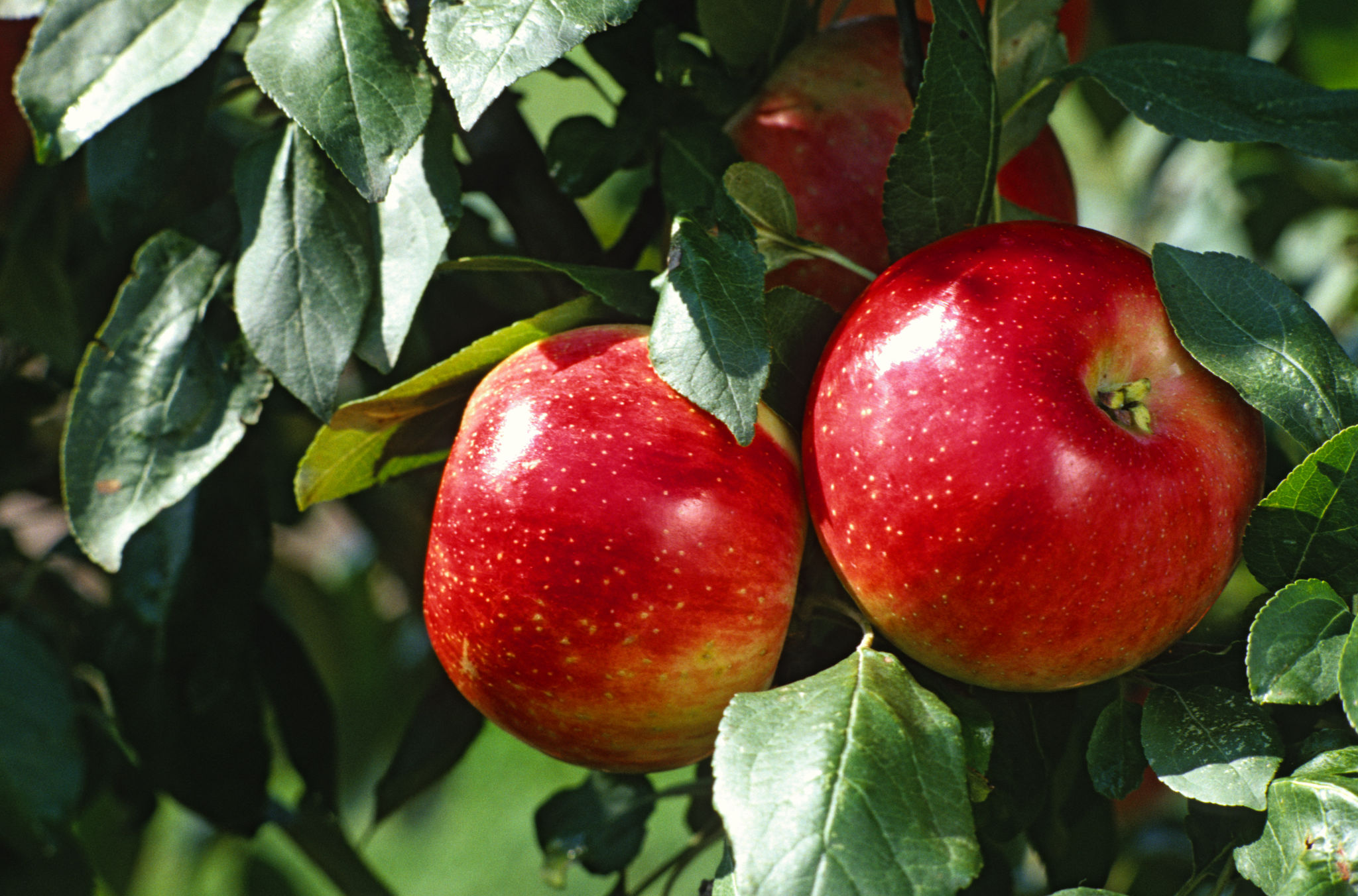
Insects pollinate apples, with bees and flies transferring pollen from the flowers of one apple tree to another. Two trees can bear enough fruit to enjoy and share.
Cross pollination
Apples require pollen from a different apple variety to grow fruit. If you only have room for one tree in your yard, there may be crabapples in your neighborhood to provide the pollen your tree needs.
Some apple trees are grafted onto dwarfing rootstocks, which only grow to be about 8-10 feet tall and can bear fruit as quickly as 2-3 years after planting. So even if you're short on space, you probably have space for two trees. Bear in mind other plants that might be shaded, or structures that could get in the way, based on the final size and location of your trees.
Care through the seasons
- March: For existing trees, prune before growth begins, after the coldest weather has passed, and avoid pruning during wet periods.
- April, May: Plant bare-root trees as soon as you can work the soil.
- If last year's growth was less than 12 inches, apply compost around the base of the tree.
- May, June: Plant potted trees after the threat of spring frost has passed.
- As flower buds begin to turn pink, watch for insect and disease symptoms.
- May through October: Water trees as you would any other tree in your yard, especially during dry periods.
- June, July: Thin fruit.
- Remove smallest apples to encourage larger fruit.
- Thin fruit so there is only one apple per cluster, and at least a fist-length distance between apples.
- For young trees and branches that are weighed down by excess fruit, you may want to remove more.
- August through October: Harvest.
- Taste fruit when it appears to be fully colored.
- If it’s too starchy, wait a few days and sample the fruit again.
- Very ripe fruit will have a yellow background.
- October, November: Rake up fallen leaves and fruit; mow, compost or discard.
- November: Apply tree wrap to prevent winter injury, or place a white tree guard that allows for airflow around the trunk.
- November through March: If wildlife pressure is high, put fencing or cages around trees.
Selecting plants
Pollination considerations
Before choosing an apple tree to plant, take a look around your neighborhood. A pollen source needs to be within about 100 feet of your apple tree to ensure pollen gets to it.
If you don't see any crabapples or other apple trees that close, your best bet is to plant two trees of different varieties.
Rootstock considerations
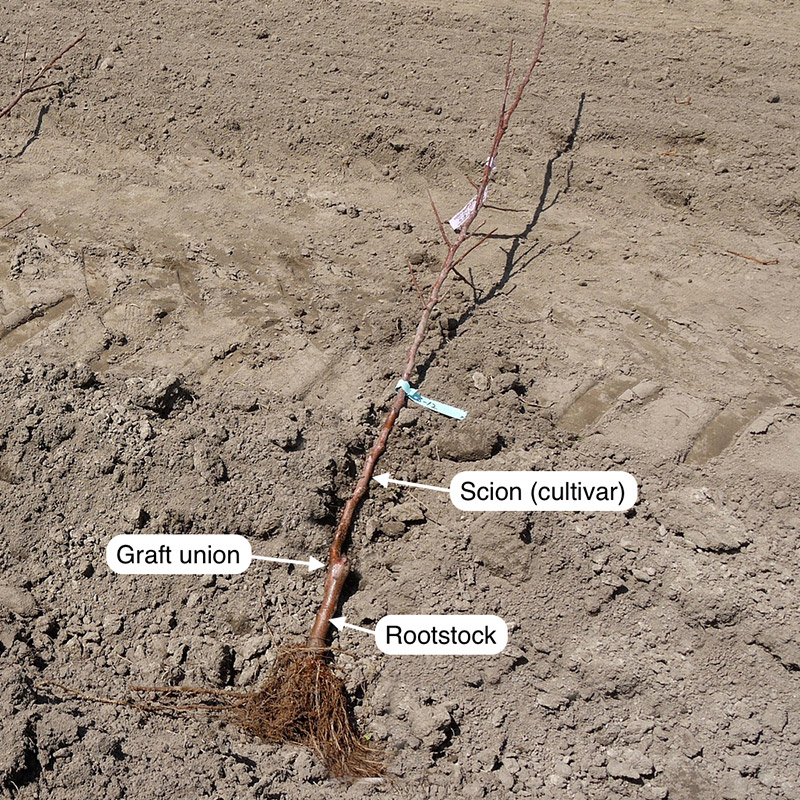
When purchasing an apple tree, you are actually selecting a plant made up of two genetically different trees grafted together: the scion and the rootstock.
- The scion is the top portion of the tree, including most of the trunk and the whole canopy, and produces the fruit desired (such as Honeycrisp or Haralson).
- The rootstock makes up part of the trunk (rootstock shank) and the tree’s roots. It plays a major role in determining the tree’s ultimate size and how long it will take to bear fruit.
The information below will help you choose a variety suitable to your climate and a rootstock for your growing site.
- If you have limited space, pay particular attention to the rootstock you choose for your apple trees.
- Whether the fruiting variety is grafted onto standard or dwarfing rootstock, the fruit size and quality will be the same.
- Local nurseries often label potted trees dwarfing, semi-dwarfing, and standard. These labels refer to the rootstock, which determines how tall your tree will grow.
- If you are interested in a specific rootstock, talk with your local nursery. They might be able to order a tree for you. Online nurseries will sometimes share more information about a specific rootstock.
- You can also order trees from a nursery that grafts each fruit variety on various rootstocks to get the combination you desire.
Seedling or standard rootstock
- Grow to 20 or more feet tall.
- Produce up to 10 bushels of fruit per tree.
- Can take up to 8 years to start producing fruit.
- The tree will have more time to put energy toward shoot growth.
- Pruning during establishment is advised to guide its shape.
Benefits
- More tolerant of wetter and drier soils.
- Better anchored than dwarf trees.
Drawbacks
- Long time to bear fruit.
- The height makes canopy management (pruning, fruit thinning) and pest management more difficult.
Dwarfing rootstock
- Grows to 8, 12, or 15 feet tall (40-80% shorter than standard).
- Produces 2-3 bushels of fruit per tree.
Benefits
- Simpler pruning, thinning, harvesting, and pest management due to contained size.
- Fast time to fruit-bearing.
- Easier to use in smaller landscape settings.
Drawbacks
- Can fall over more easily due to a smaller root system and may need staking to support the tree.
- Fruit can overly weigh down branches if tree structure and fruit load are not managed properly.
Common rootstock for Minnesota
Seedling
A seedling rootstock is grown from an apple seed, often McIntosh or another common, hardy variety. Although you won't know exactly what you’re getting with a seedling rootstock (every single seed is a genetically different individual), hardiness, anchorage, and adaptability to different soil types are generally excellent.
Malling series
The Malling series originated in England and has a long history of use since the early 1900s. Below are some Malling rootstocks available, ranging from semi-dwarfing to dwarfing.
- MM.111: This rootstock, termed ‘semi-dwarfing’ or ‘semi-standard,’ produces a tree about 80% of the height of a standard tree. In many areas of Minnesota, this can work out to roughly a 14- to 18-foot tree. It is a well-anchored rootstock that can withstand drier soil conditions and is moderately hardy, making it an excellent choice especially for southwestern parts of the state. Trees grafted onto MM.111 are prone to burrknots and tolerant of fire blight.
- M.9 (also: EMLA 9 – virus-free): This rootstock performs well under many conditions and produces a dwarf tree (45-50% the height of a standard tree). It produces fruit very early in the life of the tree. M.9 has poor anchorage due to brittle roots and a high fruit-to-wood ratio, which means it requires staking for the life of the tree. M.9 is very susceptible to fire blight. It produces moderate amounts of root suckers and burrknots.
- M.26 (also: EMLA 26 – virus-free): This dwarfing rootstock produces a tree 8-10 feet high (55-60% of standard tree). Trees planted on M.26 generally require staking for the first few years of growth or, on windy sites, for the life of the tree. M.26 is reliably hardy, but is especially susceptible to fire blight. Fruit is produced very early in the tree’s life, sometimes within three years from planting.
Geneva series
Geneva rootstocks originate from the Cornell University rootstock breeding program, developed in the mid-1900s. Some of these rootstocks are resistant to diseases and insect pests. They also have a wide range of dwarfing effects.
- G.11 is a dwarfing rootstock that can be seen as equivalent to M.9. It has some resistance to fire blight and crown rot.
- G.41 is a dwarfing rootstock that is also similar in size to M.9 and has some resistance to fire blight, Phytophthora, and replant disease; it is also described as being more suitable for soils with a higher pH.
- G.935 is closer in size to M.26 listed above with some resistance to fire blight and crown rot.
Budagovsky series
The Budagovsky series was developed in Russia and is known for its winter hardiness.
B.9 is a highly dwarfing rootstock and the most common rootstock grown in Minnesota. They are more dwarfing than M.9, G.11, and G.41 and should be supported. B.9 is susceptible to fire blight, but very resistant to crown rot. If left to grow on their own, B.9 trees are easily identified by their pink-colored flowers.
Apple varieties for home orchards and gardens
| Variety | Hardiness (zone 4 to zone 3) | Avg harvest | Best use | Description |
|---|---|---|---|---|
| Chestnut (1949) | Excellent to very good | Early-mid Sept. | Fresh eating, sauce | Large crab apple, russet skin. Rich, intense, nutty flavor. Fruit stores for 4 to 5 weeks. Moderately resistant to apple scab and fireblight. |
| Cortland | Good to fair | Late Sept.-early Oct. | Fresh eating, cooking, salad | Medium size. Sweet to tart. Slow to turn brown when cut. Susceptible to apple scab and fireblight. |
| Freedom | Good to fair | Sept. | Fresh eating, cooking | Crisp, juicy, sweet. Immune to apple scab, moderately resistant to fireblight. |
| Frostbite™ (2008) | Excellent to very good | Late Sept.-mid Oct. | Fresh eating, cider | Small. Intensely sweet, firm and juicy. Extremely cold hardy. Stores 3-4 months. Good for areas too cold to grow anything else. Some resistance to apple scab and fireblight. |
| Haralson (1922) | Very good to good | Late Sept.-early Oct. | Fresh eating, cooking. Great for pie. | Medium size, striped red. Great for pie. Stores 4-5 months. Some resistance to apple scab and fireblight. |
| Honeycrisp (1991) | Very good to good | Late Sept. | Best for fresh eating. Good for cooking. | Medium-large. Extremely juicy and crisp. Slow to turn brown when cut. Stores well for 7+ months. Some resistance to apple scab and fireblight. |
| Honeygold (1970) | Good to fair | Early Oct. | Excellent for fresh eating. Good for cooking. | Medium size, golden to yellow-green. Crisp, juicy, sweet. Stores 2-3 months. Susceptible to apple scab and fireblight. |
| Liberty | Good to fair | Early Oct. | Fresh eating, cooking | Medium size. Well-balanced flavor similar to McIntosh, but firmer. Immune to apple scab and resistant to fireblight. |
| Regent (1964) | Good to fair | Early-mid Oct. | Fresh eating, cooking | Red striped. Crisp and juicy, well-balanced flavor. Stores 4-5 months. Susceptible to apple scab and fireblight. |
| SnowSweet® (2006) | Good to fair | Mid Oct. | Fresh eating, cooking, salad | Large, bronze-red, blush fruit. Low-acid, sweet flavor. Slow to brown when cut. Stores up to 2 months. Moderately susceptible to apple scab and fireblight. |
| Sweet Sixteen (1977) | Very good to good | Mid-late Sept. | Fresh eating | Medium to large, stripes and solid wash of rosy red. Crisp, juicy, very sweet, spicy, cherry candy flavor. Stores 5-8 weeks. Some resistance to apple scab and fireblight. |
| Triumph (2021) | Very good in Zone 4, not recommended for Zone 3 | Late September | Best for fresh eating. Good for cooking. | Attractive fruit with pleasantly tart and well-balanced flavor and good storage life. Excellent tolerance to apple scab. |
| Wealthy | Good to fair | Early Sept. | Fresh eating, cooking | Medium size, slightly acidic. Resistant to apple scab and fireblight. Doesn't store as long as others. |
| William's Pride | Good to fair | Mid Aug. | Fresh eating, cooking | Medium size, slightly acidic. Resistant to apple scab and fireblight. Doesn't store as long as others. |
| Zestar!® (1999) | Good to fair | Late Aug.-early Sept. | Fresh eating, cooking | Large, crunchy, juicy red fruit. Balanced sweet-tart flavor. Stores 6-8 weeks. Susceptible to apple scab. Some resistance to fireblight. |
University of Minnesota varieties are in bold and include their release date.
Planting and caring for young trees
Learn how to choose a location, prepare for planting and space trees.
Find a sunny location
Apple trees require full sun, so choose a spot where the sun shines directly on the tree for at least 8 hours each day. Pruning is one way to bring more sunlight into the canopy by removing branches from dense areas. Sunlight is important for photosynthesis and helps the tree to produce more fruiting buds and spurs.
Test your soil
Apple trees can grow in most soils as long as there is no standing water and the soil pH is between 6 and 7.
- Have your soil tested to determine pH and soil organic matter levels.
- Soil pH should be between 6 and 7.
- Soils with higher organic matter levels will release more nitrogen each year and may require less fertilizer.
- Apple trees can grow in most soils as long as there is no standing water.
- Avoid planting in areas where water stands for several hours after a rain.
Spacing
How much space do you need for apple trees? A good rule of thumb for a garden fruit tree is to provide at least as much horizontal space as the anticipated height of the tree. So, if your tree will grow up to 8 feet high, make sure there is at least 8 feet between it and the next tree, building, or plants that you want to stay in full sun.
Planting trees too close together will increase shading and reduce the number and quality of the fruit coming from your tree. It is very difficult to correct poor spacing with pruning.
Tree spacing
- Standard trees: 20-25 feet
- Semi-dwarf trees: 12-15 feet
- Dwarf trees: 6-10 feet
Dig a hole
- Dig a hole for each tree that is no deeper than the root ball, and about twice as wide.
- When you dig the soil out of the hole, pile it on a tarp or piece of plywood so it's easier to get it back in the hole.
- You may mix in up to one-third by volume compost, peat moss (to lower soil pH), or other organic matter.
- Most of what goes back in the planting hole should be the soil you took out of the hole.
- Do not add fertilizer to the hole. This can harm the tree by causing root burn.
Look at the roots
- If you purchased bare-root trees, closely examine the root system and remove encircling roots or J-shaped roots that could eventually strangle the trunk.
- For trees in containers, inspect the root systems for encircling woody roots.
- If woody roots are wrapped around in a circle, straighten them or make several cuts through the root ball prior to planting.
- This helps the plant produce a stronger root system and prevents the formation of girdling roots that eventually weaken and potentially harm the tree.
Put the tree in the hole
- Position each tree so that the graft union is about 4 inches above the soil line. The graft union is a swelling where the variety meets the rootstock.
- If the graft union is placed close to or below the soil line, the variety (scion) will root, causing trees to grow to full size and delaying the fruit-bearing age.
- Spread the roots of bare-root trees, making sure none are bent.
- Have someone help you get the tree standing up straight.
- Begin adding the soil, tamping to remove air pockets as you go.
- After the hole is filled, tamp gently and water thoroughly to remove remaining air pockets.
- The soil may settle an inch or two. If this happens, add more soil. Check the graft union within the next few days after planting to make sure it hasn’t sunk.
Watch Planting apple trees video courtesy of Jon Clements, University of Massachusetts (2006; 00:3:47)
How to keep your apple trees healthy and productive
From watering to weeding to thinning fruit, caring for your apple trees throughout the year will help your plants produce plenty of apples to harvest. See our guidance for pruning apple trees.
Watering
Throughout the life of the tree, you should water its root zone thoroughly during the growing season whenever there is a dry spell. Ideally, the tree should receive one inch of water from rainfall or irrigation every week from May through October.
Support
It’s a good idea to stake the tree for the first few years.
- Either a single wooden or metal stake will work.
- A stake should be about the height of the tree after being pounded two feet into the ground and positioned 4-10 inches from the trunk, closer to the edge of the planting hole.
- Use a wide piece of non-abrasive material to fasten the tree loosely to the stake. Avoid narrow fastenings such as wire or twine, as they may cut into the bark.
- Watch for branches that may grow along the stake; this can sometimes damage the branch or leave a large impression.
Use tree guards to protect the trunk of your tree
Planting is a good time to install a tree guard.
- Tree guards are usually made of plastic and are available at most nurseries and online. Look for guards that allow for good airflow and are white.
- Tree guards protect your tree from winter injury and bark chewing by small mammals, such as voles (aka meadow mice) and rabbits.
- White guards also reflect sunlight from the trunk, which helps prevent the trunk from heating up on a cold, sunny winter day.
- If the bark temperature gets above freezing, water in the conductive tissue under the bark becomes liquid and begins to flow through the cells.
- When the sun goes down or behind a cloud, the liquid water suddenly freezes, damaging the cells and sometimes killing all the tissue on one side of the trunk. This is called sunscald.
Once the tree has rough and flaky mature bark, the risk of winter sun and chewing animals usually decreases, and the guard can be removed. If moisture is a concern, guards can be removed during the growing season.
Fertilizer and mulch
Once established, an apple tree planted on a favorable site, in properly prepared soil, should thrive with minimal fertilization.
- Nutrient applications should be based on the needs of the soil on site.
- Most sites do not need phosphorus, but can benefit from nitrogen fertilization by using plant-based compost (low in phosphorus) and other organic sources of fertilizer like blood meal.
- Sites that have high organic matter may require very little soil nutrient additives for a number of years.
- The branches of non-bearing young apple trees will normally grow 12 to 18 inches per year while the branches of bearing apple trees will grow 8 to 12 inches in a season.
- Excessive growth can be a sign of more than enough soil nitrogen.
Weeding
- For the first three to five years, grass and weeds should be removed from about a 3-foot radius around the tree.
- Grasses can deplete soil moisture rapidly and will reduce tree growth.
- Applying a few inches of mulch around the base of the tree will help prevent some weeds, but hand weeding may still be needed.
- Keep the mulch at least three inches away from the trunk to prevent rodent damage and fungal growth, and avoid creating a mulch volcano.
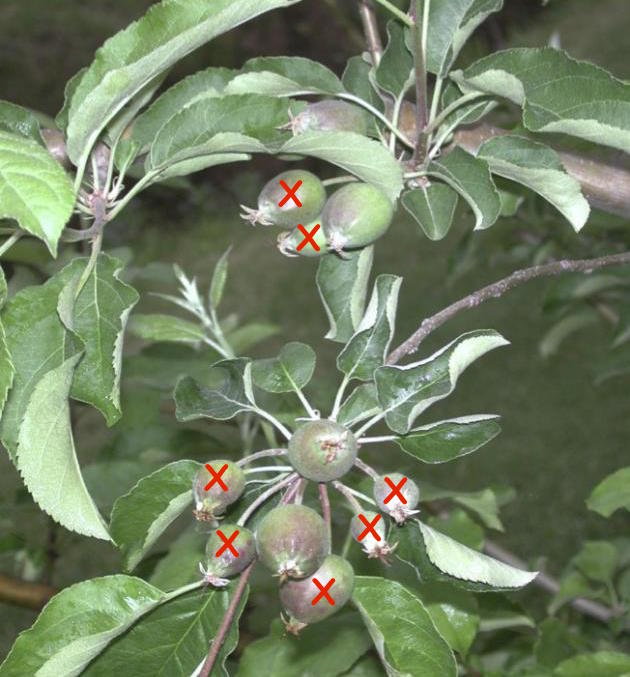
An apple tree will provide an abundant crop if conditions are favorable when the tree is in bloom.
Some of the fruit will naturally drop off the tree in mid-June, but the tree may keep more fruit than it can support.
Too heavy crops can cause biennial bearing, when a heavy crop of small, green apples is followed by little or no crop the next year. It can also overly bend branches and lead to less energy reserves for overwintering.
- Thinning fruit off the trees by hand will minimize biennial bearing and promote larger, higher quality fruit.
- Thin when fruit is about marble size, in late June or early July, after some of the fruit has already dropped naturally.
- Leave one fruit per flower cluster (or two for larger crab varieties) and thin fruits to 4 to 6 inches (fist width) between fruit on any branch.
- Younger-bearing trees may require thinning more fruit to keep the tree in balance.
- Thinning improves the quality of the apples you'll harvest in the fall.
- You'll be more likely to get fruit every year.
Video
- (2016; 5:13)
Know when to pick

The color of an apple is only one indicator of its ripeness. Sweetness is an indicator of maturity and harvest readiness along with fruit size and color. There is a popular idea that some later apple varieties need a frost to sweeten them before picking. However, apples will ripen and sweeten up without a frost.
How to tell if an apple is ripe
- For red apples, look for a change in the background color, the part of the skin not covered with red.
- When the background color (also called ground color) begins to change from green to greenish-yellow, the apple is starting to ripen.
- Other than Honeygold, all other apples we recommend should have a green-turning-to-yellow background color when fully ripened.
- Pick a few apples that seem ripe and taste them to be sure they are at the ripeness you prefer.
- As apples ripen, starch in the flesh is converted to sugar. An unripe apple will be starchy and leave a sticky film on your teeth.
- A ripe apple may still be tart, but it should have developed aromatic flavors.
- You may need to pick the fruit from the same tree several times over a week or two to get all the fruit at the right stage of maturity.
- Check the UMN Minnesota Hardy website to see when your apple variety typically ripens.
How to pick an apple
- Gently take the fruit in the palm of your hand, then lift and twist in a single motion.
- Or use one hand to hold the short, thick fruiting spur that bore the apple, and the other hand to lift and twist the fruit.
- Avoid pulling or yanking the fruit, as you could pull off the spur and take next year’s flower buds.
Apples last the longest at standard refrigerator temperatures, about 33°F to 38°F, with about 85 percent humidity. Although garages, basements and root cellars may provide adequate storage conditions, the best place to store apples at home is usually the refrigerator.
- Apples that are less ripe when picked will store longer than apples that are very ripe.
- Warmer temperatures always shorten the storage life of apples.
- Apples stored near 33°F may last much longer than apples stored at room temperature.
- High humidity helps reduce the shriveling of apples in storage.
- If the storage environment is low in humidity, as most refrigerators are, the fruit should be stored in a perforated plastic bag or a loosely covered container.
- Although apples are lovely displayed in a fruit bowl, such conditions will dramatically reduce their usable life.
A “hard freeze” is defined as four straight hours of 28°F.
While 32°F is the freezing temperature for water, it is not the freezing temperature for most fruits. Fruits such as apples, grapes, and strawberries are high in sugar. The sugar in the fruit’s juice reduces the temperature at which the fruit freezes.
- Apples start freezing at around 28-28.5°F, but they should be okay provided the temperature doesn’t fall much below 28.
- The longer apples are exposed to temperatures below 28 degrees, the higher the chance that they will get damaged.
- Frozen apples should not be picked until the fruit thaws out, as the frozen fruit will bruise and be unusable.
- After a freeze, leave the apples on the tree and wait until midday when they have thawed out.
- Late fruiting apples like the University of Minnesota’s SnowSweet® and Haralson are more at risk of freezing because they are more likely to still be on the trees when a freeze hits.
A brief dip below 28 degrees may just weaken the apples enough to decrease their shelf life. Several nights below 28 degrees are more likely to soften the skin and flesh of the apple, making the fruit unusable.
At 22°F, the fruit will freeze hard, and cells will break down, making the fruit soft. If only a brief freeze happens and the fruit is still firm, use the fruit soon, as it may not store well.
Reviewed in 2026