


Tune in to our WCCO Radio “Smart Gardens” show on Saturdays, 8-9 a.m., for answers to your lawn and garden questions. Dial in to AM 830 on your radio or ask your smart speaker.
Or listen to Smart Gardens podcasts whenever you have the time.
Mystery of the month
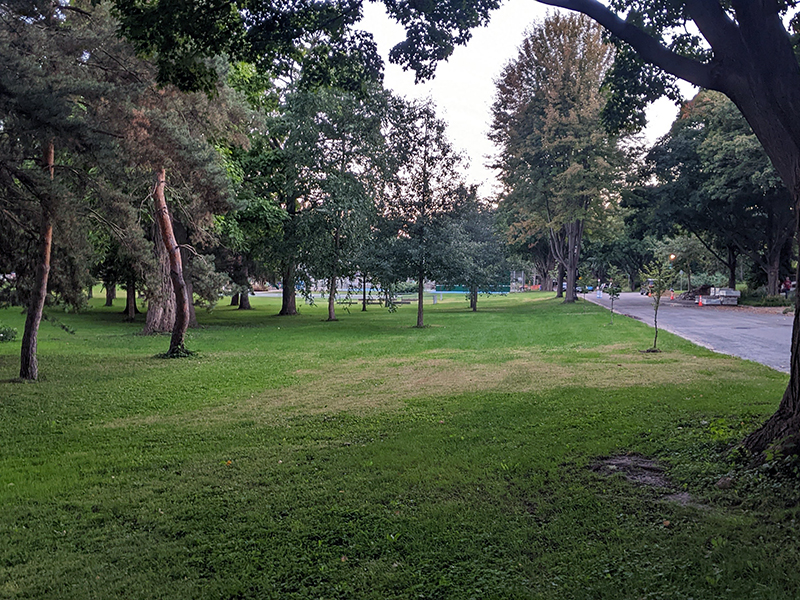
Why is a distinct area of lawn in this park turning brown? The brown areas appear only in full sun or on the south side of shade trees, while the surrounding grass stays green.
The answer is at the bottom of this article.
Pests and diseases
Remove diseased plant debris from your yard and garden.
For instance, if your lilacs had signs of disease and dropped their leaves, rake them up and place them in yard waste bins or bags or take them to a commercial composting facility that accepts diseased plant material.
The Minnesota Pollution Control Agency has a nifty compost facility locator, so you can find the facility closest to you.
If there isn’t a convenient location near you, bury the material away from the plants. Avoid putting diseased plant material in a home compost pile, as they do not get hot enough for long enough to effectively control disease.
Just a reminder: it has been illegal to put yard waste in the regular trash since 1992 for the entire state.
Trees and shrubs
Flag, mark, or prune branches or plants that need to be removed.
Over the growing season, you may have noticed dead branches or branches that could be pruned. October can be a great time to mark or remove branches or entire plants.
Use flagging tape or paint to indicate which branches or plants you intend to prune when it is more appropriate or convenient.
Avoid major pruning on spring-flowering trees and shrubs, because you will remove the flower buds that will bloom next year.
Flowers and other garden plants
Preserve any flowers or produce you can this month. As temperatures drop, it’s a good time to can, dehydrate, and otherwise preserve anything you want to store for the coming winter.
If you have extra produce you don't plan to eat or preserve, consider donating it to your local food shelf. Only whole, fresh produce can be donated; food shelves do not accept home-jarred or preserved foods.
The Food Group has an interactive map with information on hundreds of food shelves in Minnesota, so you can connect with the food shelves in your area.
Houseplants
Give seasonal indoor plants, like small mums used as decoration, the correct growing environment to thrive.
Annual mums benefit from 8 hours of light. Put them in a south- or west-facing window if you can.
Don’t let the pots get too dry before watering. If the soil gets too dry, it can cause blooms to fade faster.
Whenever possible, keep the leaves dry and only water the soil. Water should come out of the drainage holes on the bottom of the container. If you have the container in a decorative pot or on a tray, empty any pooled water. Mums are quite susceptible to root rot when left in standing water.
Regularly deadhead, or remove spent flowers.
Lawn
You are hopefully seeing your lawn greening up with the return of rain and cooler temperatures this fall. You can fertilize these areas to thicken thin stands or where annual weeds have encroached. With limited growing weather remaining, use more soluble or quick-release nitrogen sources like urea or ammonium sulfate, which will be immediately available to the plants.
If parts of your lawn have not greened up yet, they probably died and will likely need to be reseeded. It is too late for a fall seeding, and slightly too early for dormant seeding, which you can do when soil temperatures are below 40F.
Other tasks
Start cleaning used containers, trays, plant stands, labels, etc. before you need to turn the water off outside. Cleaning now will save you loads of time come next spring.
Remove as much dirt and debris as you can, then sanitize with alcohol, bleach, or alkyl dimethyl benzyl ammonium saccharinate (products that include Lysol®).
For more detailed information on ideal dilutions for the chemicals listed, read how to clean and disinfect gardening tools and containers.
Solution to the mystery of the month

The brown areas are crabgrass that is turning brown because it is a summer annual and is dying. This photo was taken on September 23.
Crabgrass does not tolerate shade and does not encroach where light is limited. Notice the greener grass around the base of the trees.
Using a taller mowing height (more than 3 inches) shades out the soil surface and reduces crabgrass.
Read more about managing crabgrass in home lawns.
Learn more about yard and garden
Need help? Ask a Master Gardener about plant diseases, insects, and other yard and garden issues.
The University of Minnesota Extension yard and garden team educates the public on landscape design and plant selection, integrated pest management, and gardening best practices for beautiful, bountiful, environmentally sustainable gardens.
Permission is granted to news media to republish our news articles with credit to University of Minnesota Extension. Images also may be republished. Check for specific photographer credits or limited use restrictions in the photo title.