

Agritourism farmer perspectives

An Extension team and the Minnesota Farmers Union interviewed four agritourism farm owners in 2024. The team invited agritourism business owners to tell their stories about starting and managing agritourism businesses.
An impressive part of their stories included the ways in which they gave back to their communities.
Collaboration with other farms, local organizations, and business cooperatives is key to success as an agritourism business. As farmers told their stories, the benefits of the relationships they’d built were clear. They increased profits by sharing resources and lowering overhead. These relationships also helped market the agritourism experiences and increased the knowledge and information owners brought to their business decisions.
In business, social capital refers to the value derived from relationships and connections. Agritourism clearly leverages social capital daily, to the benefit of their business as well as the community. Farm owners are creating spaces where community members can connect with each other and agriculture can connect to the community.
From our interviews with four businesses, we saw five ways farmers gave back to their communities.
1. Generating local economic ripples
With seasonal business models and tucked-away locations, it can be tricky to understand whether the local economy is impacted by agritourism operations. DeeDee LeMier, an Extension community economics educator, conducted an analysis using innovative mobile data tools to explore these connections. Mobile data makes it possible to understand where visitors come from and what businesses they visit on their way to and from the farm visit.
Findings from an analysis of two of the four featured farms show that agritourism is a recreational activity for both local and regional audiences and can draw visitors from even further away. While these are just two sample illustrations, they point to agritourism being a valuable economic asset for communities.
In tourism, a visitor from outside a 50-mile radius is defined as a “tourist” rather than a local or regional visitor. Using mobile data, Extension took a look at who visited Pike’s Corn Maze and the Kavan Christmas Tree Farm to understand whether these agritourism sites attracted tourist dollars to their communities.
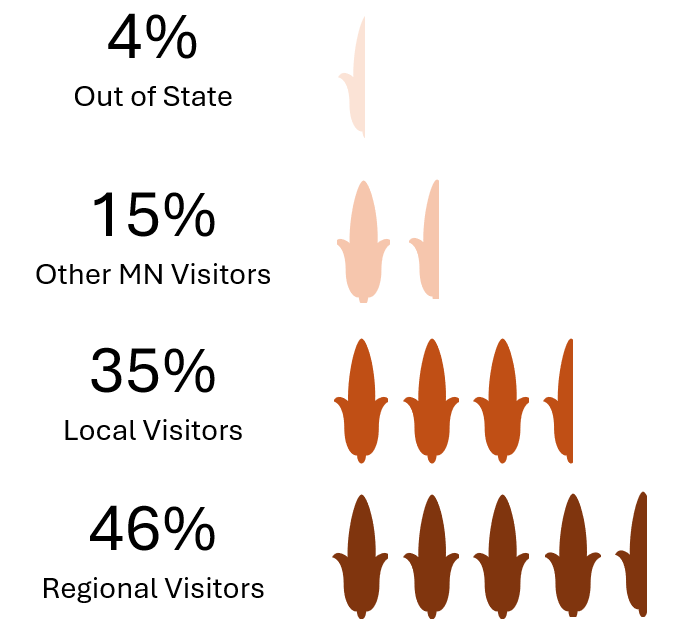
Pike’s Corn Maze (Figure 1) serves as a great example for this data. Due to crop rotations, their corn maze was most recently available in 2022. Of their visitors in 2022, 35% were local, with a Park Rapids home zip code. An additional 46% of their visitors were from the approximate 50-mile radius around the farm. An additional 15% of visitors were from other areas of Minnesota and 4% were from out of state. The heavy concentration of local and regional visitors illustrates the appeal of the attraction to the region.
Who visits Pike's Corn Maze
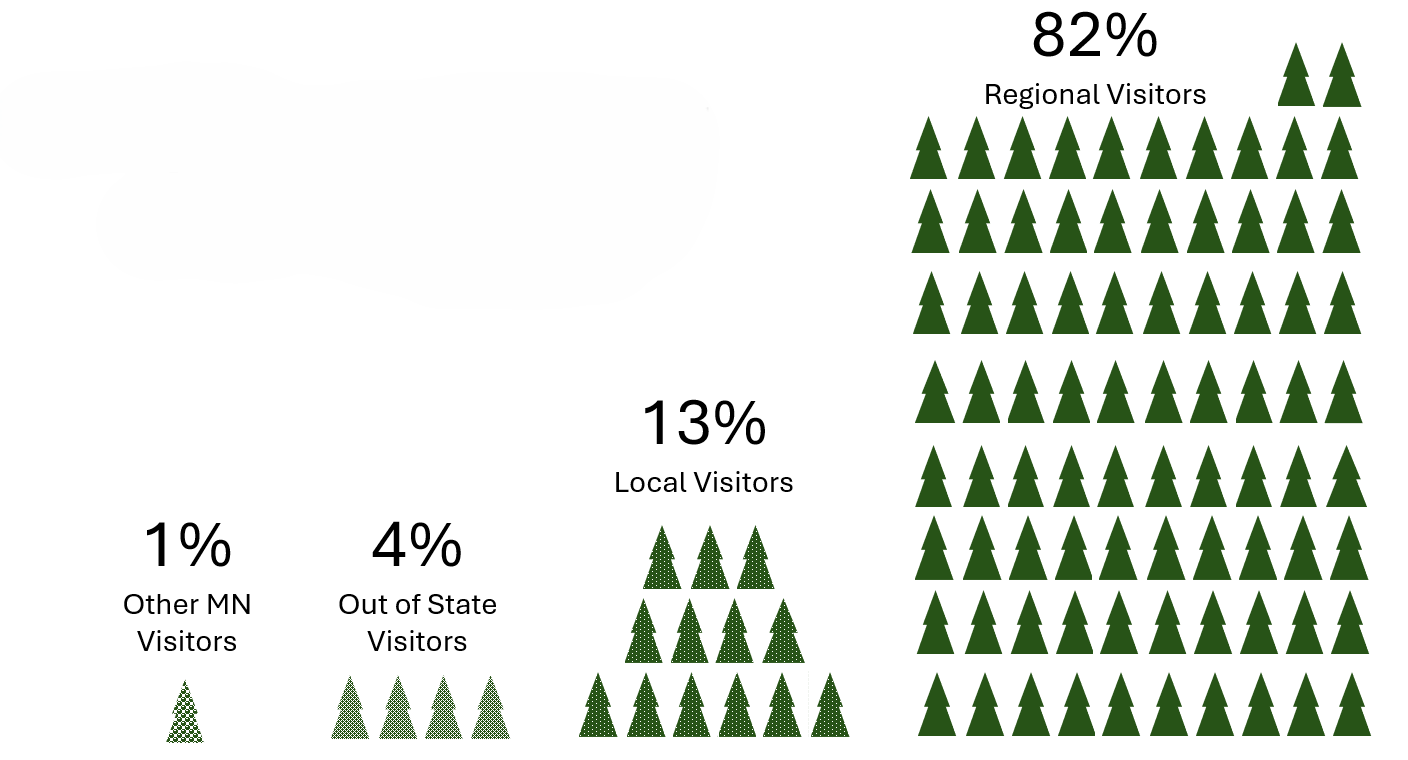
An analysis of visitors to the Kavan Tree Farm (Figure 2) in 2024 revealed similar patterns of heavy visitor traffic from local and regional visitors. Their location in the Twin Cities Metro Area made their local zip code area geographically smaller, and 13% of their visitors were local. Defining regional visitors as the population within a 50-mile radius, 82% of Kavan’s visitors came from the region. While regional visitors made up the bulk of their visits, an additional 4% of visitors came from further than 50 miles away in Minnesota; 1% came from out of state.
This location was noted as being valuable to their visitors as well. “The community doesn’t have to drive an hour or two,” said Steve.
Kavan Tree Farm visitor home location
Further examination of mobile data shows that agritourism visitors spent money at local businesses before and after farm visits. The visitor journey graphics below show how the agritourism businesses are connected to spending at gas stations and convenience stores, fast food and quick service restaurants, superstores and other retail sites. These connections might be increased through some joint marketing, signage, flyers, or other collaborative ventures among local businesses and agritourism experiences.
Visitor journey: Pike's Corn Maze
Destination address (coming to and from): Dovetail Road, Park Estates, MN 56470

Visitor journey: Kavan Christmas Tree Farm
Destination address (coming to and from): Ash Street, North Oaks, MN 5538

2. Commitment to youth and community education
Children’s books are rife with stories about cows, roosters, horses, and trees. But actual experiences with the places where crops are grown and animals are raised are more rare. At the heart of the origin story of several of our agritourism business owners is a passion for teaching kids, parents, and others what’s behind the food they eat and the places they are grown.
Les Schwartz of Rockwood Maple Farm in Wadena taught at a technical college for 24 years. He brings his passion for teaching to his agritourism enterprise.
“I’d done some farm-to-school experiences when I started producing maple syrup, which led to having groups of students come to the farm to see how maple syrup is made. It snowballed from there. Most kids — and some adults — don’t know where maple syrup comes from. The teacher in me likes to see the light bulb go on when people understand how it’s made. I want to give people a better understanding of where stuff comes from. Most of them realize afterwards, ‘Oh, that’s a lot more work than I thought, whether it’s maple syrup, corn, or vegetables.’”
Rockwood Maple Farm also brings 10th-grade biology students from a neighboring town every year to the sugar shack and tap trees. He calls this partnership a main business success. “I tap about 400 trees a year. Thirty students can tap it in like an hour. For me to do most of the tapping myself takes a long time. They’ve been doing it for 14-15 years, and the kids look forward to it and always ask, ‘When are we going to Les’s Sugar Shack?’ They are well-behaved and know they are on private property, so I’ve never had any problems.”
The venture out to Les’s Sugar Shack addresses some important biology lessons. “While out, they learn how to identify trees. We send them out with groups and every group has an adult with them. They collect maple sap and get an understanding of the process of making maple syrup. The high school paper usually does a story on it, and it gets the community excited about the maple industry and maple season.”
Debbie Yennie, owner of First Fruit Blueberry Farm, had a lot to learn when she acquired her blueberry farm in 2011. It had been sitting dormant for more than 10 years and had frozen two years earlier. Both the previous owners and experts thought the plants didn’t stand a chance, but Debbie consulted with a “fruit guru” at Central Lakes College and, together, they coaxed the plants back to life.
Now, Debbie seizes the opportunity to share what she’s learned with others. “I try to educate them about growing fruit and blueberries, and what we're doing to try to bring those blueberry plants back,” she says. Her outreach goes beyond on-the-farm events. She also provides cooking classes and is invited to schools to talk about farming.
One of her favorite topics is sharing her optimism that youth can be part of agriculture someday. “I'm really excited about telling kids it is possible. If these kids truly have a heart for agricultural businesses they can get into it. It's not a closed door,” she says.
Debbie is hopeful her impact on youth will get them involved in community gardening and farm-to-table possibilities. “These kids are going to grow up. And they're going to tell their grandchildren how they picked blueberries and earned money picking blueberries. I'm always telling them, ‘Maybe someday you'll be a blueberry farmer. You're gonna have a big garden that you're gonna make a community garden; farming even to have a restaurant.’”
At Pike’s Corn Maze, the local FFA (Future Farmers of America) chapter helps harvest pumpkins yearly; the FFA also helps with the planting. From this, the Pikes typically hire some children to help. The Pike’s also donate pumpkins to the children who helped to thank them for their labor.
In addition, a big event for the farm is when kindergarteners from the local partnering schools visit the farm. Each of them is given a small pumpkin as they leave to get back on the bus, which is a highlight for the youth. The event is provided at no cost to the school or the youth, though it is known to attract families to visit the corn maze later — a “win-win” for the community.
3. Creating positive outdoor experiences to those who need them most.
First Fruit Blueberry Farm created a Senior Citizens Day that has become an annual event. The farm opens up exclusively for senior citizens and people in assisted living.
“We get people from memory care. We get people in wheelchairs, walkers, and of course, we're still outside. These elderly people pick containers full of fruit, free blueberries, and then they also get to enjoy blueberry brownies, blueberry lemonade — you know, the whole bit. It's usually a four to five hour event. It's my favorite day of the whole year. I love it,” Debbie said.
Debbie hopes to increase access for other groups as well. Park Rapids has a very active Developmental Achievement Center that develops active community partnerships on behalf of local residents who have physical and mental disabilities. “I'm hoping to do a day for them also, so that they don't feel intimidated.”
4. Generating charitable funding for local causes.
Kaven Family Christmas Tree Farm has a vision of creating a relationship with its community. They work to earn the trust of the entire community and to be seen as an asset. “We want to create a nice community atmosphere,” says Steve. “So we’re committed to donating 5% of sales proceeds to local schools and food shelves. Hopefully, that will be meaningful. This year, we picked two elementary schools, and we donated, I think $4,700 to them. So it’s kind of fun to be part of the community and give back. And then also you hear feedback from the community.”
Debbie Yennie at First Fruit Blueberry Farm regularly invites groups for fundraisers. They have supported mission work, Dakota Smiles, and fundraisers for families facing hard times.
5. Helping farms create and maintain family connections to agriculture.
Research has shown that small family farms make an outsized contribution to local economies. Agritourism is helping to sustain family farms, making them viable for the next generation.
Pike’s Corn Maze works alongside an organic farm that is managed by the Pikes’ son, Nate. Nate started the corn maze but saw an opportunity for greater success when his father purchased land just a few miles outside of Park Rapids. As Nate got busier with his own farming, his parents invested their time and energy in taking over the agritourism part of the farm.
The businesses are naturally entwined. The corn maze experience is marketed at crop stands where the organic farm sells fruits and vegetables, and customers meld the two enterprises, frequently confusing the two businesses when they write checks.
Resource sharing among the businesses increases profitability. Straw bales are “lent” to the corn maze during its five to six weeks of operation. The corn bin where kids enjoy jumping into seeds comes from the organic farm, and the agritourism efforts share equipment with the organic farm.
Nate’s farm is on the site of the dairy farm where Jay farmed with his dad for 15 years. Together, these efforts provide a full-time living for Nate, supplemental income for the Pikes, and a family farm with special places for all of the generations to explore and enjoy.
First Fruit Blueberry Farm. In 2022, Debbie was honored to have her small farm nominated for farm family of the year in Wadena County. The nomination recognized her community connections and contributions, as well as her restoration of the blueberry plants. This recognition of an agritourism business as a “farm family” recognizes that agritourism is part of the landscape of modern farming and its contributions. “I'm just a little tiny farm. Why would I be a farm family? And they said because of my community outreach. And it was recognized, and I thought it was the greatest thing ever,” she says.
As noted above, Debbie has a passion for teaching youth that agriculture is a career opportunity, regardless of whether they currently have a family farm of their own.
The Kavan Christmas Tree Farm was an investment the Kavans made in their family life. “We wanted something that the kids could help with …” says Steve. The land they purchased that eventually became the tree farm was not viable for housing or industrial development, nor was it ideal for crops. Steve wanted to create the kind of experiences he had as a child, when both of his grandparents managed animal farms. “I would get shipped out to one of them to help out. It was difficult labor. I got paid hardly anything,” he says. He recognized the value of that hard labor as he compared it to his office job. “I kind of wanted to show that to my kids.”
The development of agritourism on this small amount of land creates a value to the community, both as a local farm experience and an economic asset.
University of Minnesota Extension’s Tourism Center helped create resources based on interviews with four agritourism businesses as part of a statewide work team. Learn more about agritourism farmer perspectives and available resources.
Reviewed in 2025