

Forage legumes vary in terms of their life cycle, the amount of nitrogen they can fix, how well they can adapt to challenging conditions and their susceptibility to insect damage and diseases.
By understanding the characteristics of forage legumes, you can better identify, use and manage them on your farm.
Life cycles
Annual, biennial and perennial describe the time required for legumes to complete their life cycles:
Annual (e.g., soybean): Germinates from seed, flowers, sets seed and dies within one growing season.
Perennial (e.g., alfalfa and kura clover): Live for three or more years once established, and have the potential to set seed each year.
Biennial (e.g., sweetclover): An intermediate group of legumes that lives for two years. They grow vegetatively the first year, and flower and die in the second year.
Benefits of perennials
Of the three legume life cycle types, perennials are considered to be the most valuable for the environment.
Perennials provide continuous ground cover, recycling of nutrients and long-term carbon storage. Plus, they eliminate the need for annual reseeding and associated field activities, saving producers time and money.
Nitrogen fixation
Many important food plants like corn, wheat, and oats require nitrogen fertilization for growth and yield. In contrast, properly managed forage legumes are nitrogen self-sufficient.
Legumes grow vigorously without the nitrogen fertilizers required by grasses. They achieve this self-sufficiency through biological nitrogen fixation.
Legumes convert otherwise unusable atmospheric nitrogen (N2, which is 78 percent of the earth’s atmospheric gases by volume) into ammonia and ultimately into nutritionally valuable plant protein.
The role of rhizobia bacteria
This is possible through symbiotic nitrogen fixation, a partnership between the legume plant and the rhizobia bacteria that convert nitrogen. In exchange, the legume plant supplies the bacteria with the nutrients and energy they require to grow and function.
Rhizobia are present in the soil or supplied in inoculum with the seed. They infect plant root hairs and stimulate the development of tumor-like nodules on the roots.
Nodule shapes vary. They can be elongated lobes, as in alfalfa and clover roots, or round, as in birdsfoot trefoil roots. Lobed nodules will overwinter and fix nitrogen for more than one growing season, while round nodules die and reform on roots each year.
Legume-specific needs
A specific Rhizobium is required for a legume species. For example, bacteria-infecting and nodulating kura clover will not effectively nodulate alfalfa. Upon dissection, active regions of nodules will contain a pink pigment, leghemoglobin, that’s indicative of active nitrogen fixation.
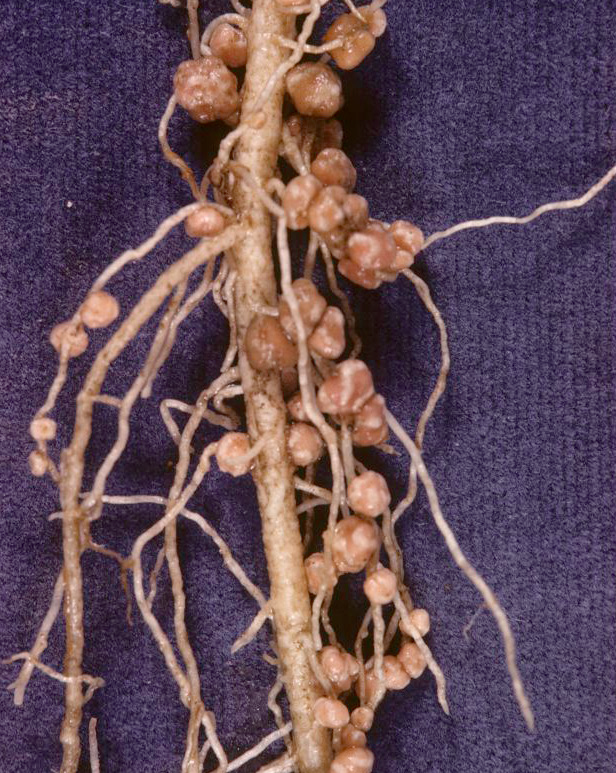
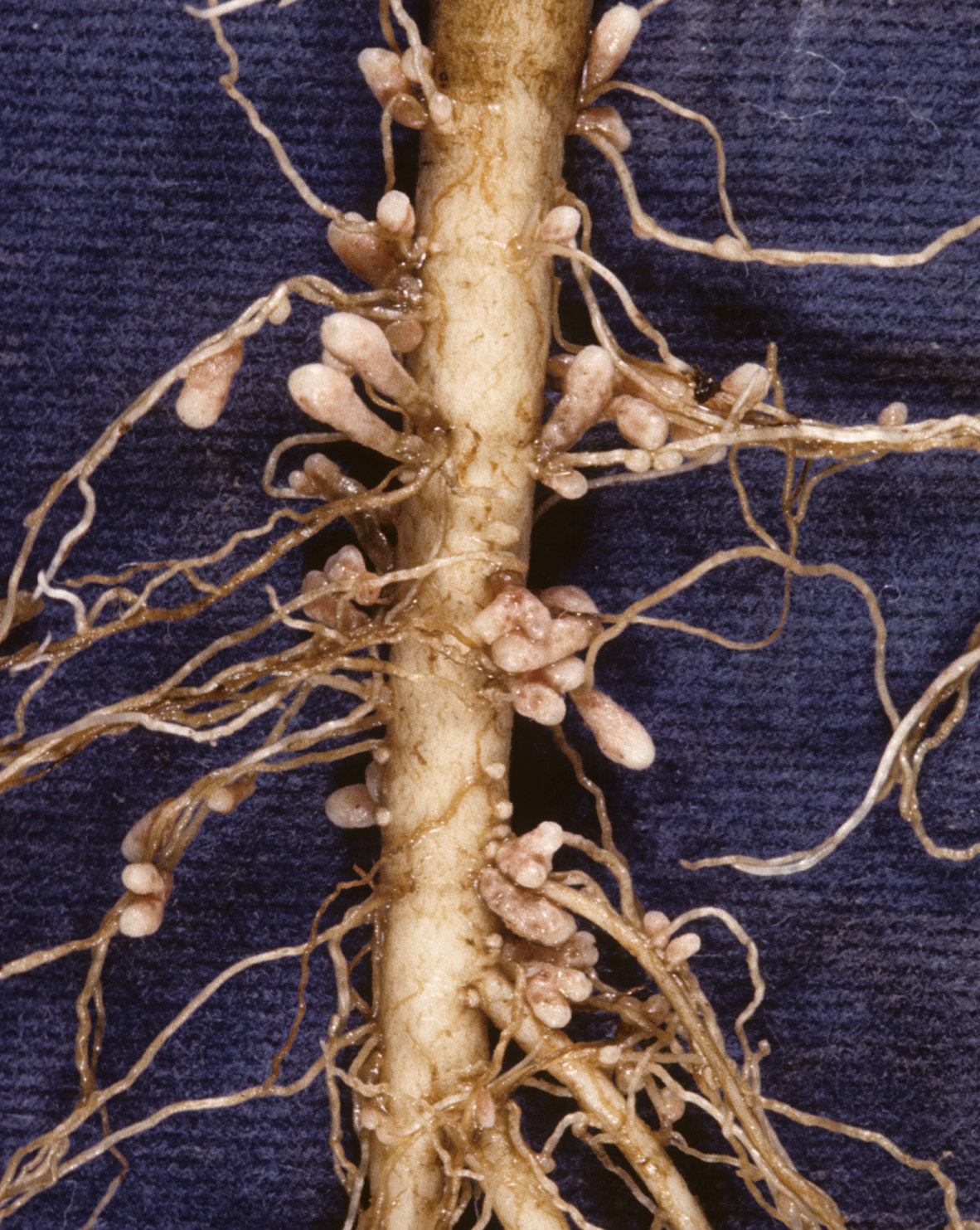
Nitrogen fixation by healthy plants causes legume foliage and protein-rich seed. In addition to requiring no synthetic or organic nitrogen fertilizer for growth, protein- and nitrogen-rich legume plants can be plowed under to supply nitrogen to subsequent crops in rotations.
Green manure
When producers use legumes to provide nitrogen for subsequent crops, the legumes are often referred to as a “green manure” crop. On many Midwestern farms that rotate crops, a green manure crop, such as a productive alfalfa stand three or more years old, can usually meet the nitrogen requirements of a subsequent corn crop.
When managing a legume like alfalfa, red clover or sweetclover as a green manure crop for plow-down, the amount of fixed nitrogen contributed to the soil depends on how much nitrogen-rich forage was incorporated.
Alfalfa herbage typically contains 3 to 3.5 percent nitrogen, depending on maturity, whereas roots contain only about 2.5 percent nitrogen. That’s why green manure systems usually allow a significant amount of herbage to accumulate in the fall before incorporation.
Nitrogen transfers to grasses
Nitrogen fixed by legumes also helps grasses growing in a mixture with them.
The nitrogen transferred represents, on average, about half of a grass’s needs. However, this ranges from 20% to 80%. This can be greatly influenced by soil nitrogen status, structural composition, precipitation patterns, and legume composition of the stand.
Legume nitrogen is transferred by:
Root exudation.
Decomposition of decaying leaves, roots and nodules.
Mycorrhizal fungi growing in association with grass roots.
Grasses can also take up nitrogen excreted in the urine or feces of livestock that have grazed legumes.
Legumes vary in the amount of atmospheric nitrogen they can fix.
This variation is partly due to the relative effectiveness of the symbiosis between plants and the bacteria. Efforts are underway to select bacteria that are more effective at nitrogen fixation.
By legume: Amount of nitrogen fixed
A given legume species' fixation range can be due to variations in soil and environmental conditions. For example, nitrogen fixation is likely to be lower in a legume grown in soil naturally high in nitrogen because legumes fix less atmospheric nitrogen when soil nitrogen is available.
Quantities of nitrogen fixed by various legumes
| Legume | Nitrogen fixed (pounds per acre per year) |
|---|---|
| Alfalfa | 70-200 lbs. |
| Birdsfoot trefoil | 44-150 lbs. |
| Crownvetch | 98 lbs. |
| Cicer milkvetch | 140 lbs. |
| Crimson clover | 57 lbs. |
| Hairy vetch | 99 lbs. |
| Kura clover | 17-158 lbs. |
| Lentil | 149-168 lbs. |
| Red clover | 60-200 lbs. |
| Soybean | 20-200 lbs. |
| Sub clover | 52-163 lbs. |
| Sweetclover | 120 lbs. |
| White clover | 115-180 lbs. |
Sources: Heichel (1987), Date & Brockwell (1978) and Sequin, et al. (2000).
Adaptability and susceptibility
Forage legumes differ in how well they adapt to soil and climatic conditions and in their susceptibility to insect damage and disease.
As a result, various legumes have characteristics that often suit them best for specific uses. This is why being able to identify, use, and manage the perennial forage legumes commonly grown in the Upper Midwest can be valuable to a livestock producer.
Characteristics of forage legumes
| Legume | Heat/drought tolerance | Wet tolerance | Winter injury tolerance | Frequent cutting/ grazing tolerance | Soil salinity tolerance | Soil acidity tolerance | Soil alkalinity tolerance | Seedling vigor | Ruminant bloat inducing |
|---|---|---|---|---|---|---|---|---|---|
| Alfalfa | Excellent | Poor | Good | Fair | Fair | Poor | Fair | Good | Yes |
| Alsike clover | Poor | Excellent | Poor | Poor | Fair | Good | Good | Good | Yes |
| Birdsfoot trefoil | Fair | Excellent | Fair | Good | Fair | Good | Good | Poor | No |
| Cicer milkvetch | Good | Fair | Excellent | Fair | Fair | Fair | Excellent | Poor | No |
| Crownvetch | Good | Poor | Fair | Poor | Fair | Good | Poor | Poor | No |
| Kura clover | Good | Good | Excellent | Excellent | Fair | Fair | Fair | Poor | Yes |
| Red clover | Fair | Fair | Fair | Fair | Fair | Good | Poor | Excellent | Yes |
| Sweetclover | Excellent | Poor | Excellent | Poor | Good | Poor | Excellent | Good | Yes |
| White clover | Poor | Good | Fair | Excellent | Fair | Good | Poor | Good | Yes |
Key: 1 = infrequent problem, 2 = occasional problem, and 3 = frequent problem.
Relative importance of insect and disease pests of forage legumes
| Legume | Potato leaf hopper | Plant bugs | Leaf feeders | Leaf feeders Crown and root feeders | Damping off | Crown and root rots | Vascular wilts | Foliar disease | Viruses | Nematodes |
|---|---|---|---|---|---|---|---|---|---|---|
| Alfalfa | 3 | 2 | 2 | 2 | 2 | 3 | 3 | 2 | 1 | 2 |
| Alsike clover | 2 | 1 | 1 | 3 | 2 | 3 | 1 | 2 | 3 | 2 |
| Birdsfoot trefoil | 1 | 2 | 1 | 2 | 2 | 3 | 1 | 2 | 1 | 2 |
| Cicer milkvetch | 1 | 1 | 1 | 1 | 1 | 1 | 1 | 1 | 1 | 1 |
| Crownvetch | 1 | 1 | 1 | 1 | 1 | 2 | 1 | 2 | 1 | 1 |
| Kura clover | 3 | 1 | 1 | 2 | 2 | 1 | 1 | 2 | 2 | 3 |
| Red clover | 1 | 1 | 1 | 3 | 2 | 3 | 1 | 3 | 2 | 2 |
| Sweetclover | 1 | 1 | 2 | 3 | 2 | 3 | 1 | 1 | 2 | 1 |
| White clover | 2 | 1 | 1 | 2 | 2 | 3 | 1 | 2 | 3 | 3 |
Date, R.A., & Brockwell, J. (1978). Rhizobium strain competitions and host interactions for nodulation. In J.R. Wilson (Ed.), Plant relations in pastures. East Melbourne, Australia: Commonwealth Scientific and Industrial Research Organization.
Heichel, G.H. (1987). Legume nitrogen: Symbiotic fixation and recovery by subsequent crops. In Z.R. Helsel (Ed.), Energy in plant nutrition and pest control (pp. 63-80). Amsterdam, The Netherlands: Elsevier Science Pub.
Sequin, P., Russelle, M.P., Sheaffer, C.C., Elke, N.J., & Graham, P.H. (2000). Dinitrogen fixation in kura clover and birdsfoot trefoil. Agronomy Journal, 92, 1216-1220.
Reviewed in 2023