

Identification of seedcorn maggot (Delia platura)
Adults
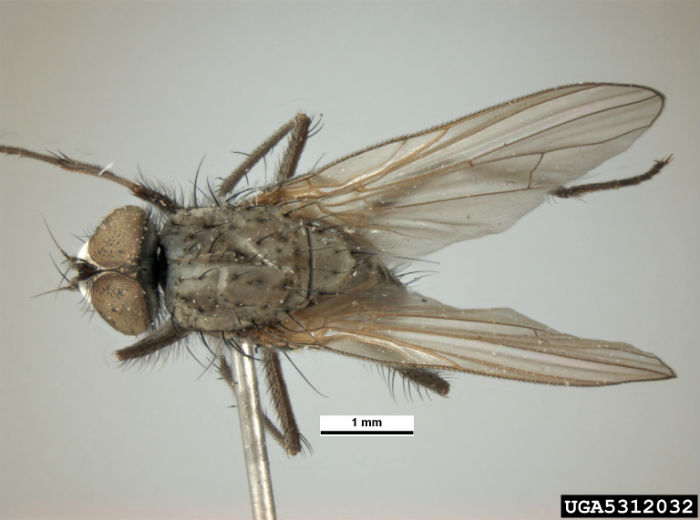
- The fly has a grayish–brown body.
- About 1/5-inch long.
- Wings overlap when at rest.
- Often mistaken for a small housefly.
Eggs
Eggs are elongated and white and not usually seen.
Larvae
- Larvae are white with a brown head.
- Less than 1/4-inch long.
Pupae
- Pupae are brown.
- Cylindrically shaped.
- Less than 1/4-inch long.
Biology
- Seedcorn maggots overwinter as pupae in the soil.
- In the early spring, adult flies emerge and mate.
- Female flies lay eggs in cracks in the soil or under soil clods.
- Disturbed soil with decaying organic matter, such as manure or green plant material (cover crop or weeds), is highly attractive to female flies for egg-laying.
- Eggs can hatch within 2 to 4 days.
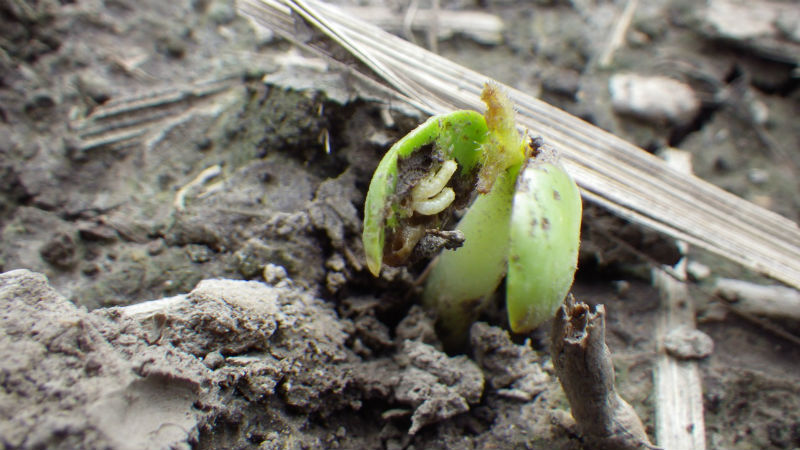
- Maggots move to and feed on seed and germinating plants.
- Fully developed larvae pupate in the soil, about three to six inches deep.
- Flies emerge 12 to 14 days later.
- There are four to five generations per year.
Crop impacts
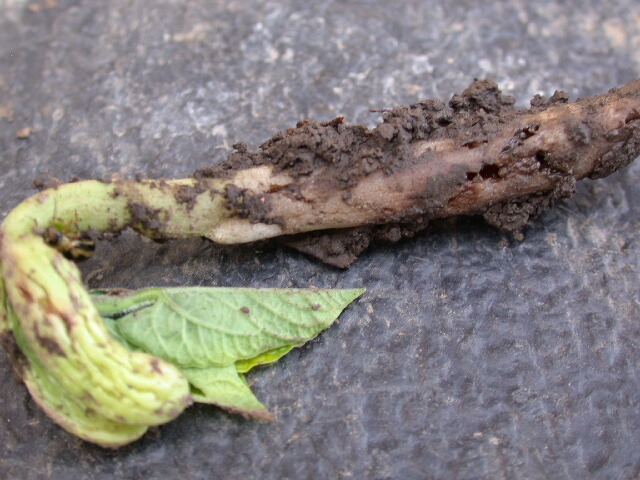
- Seedcorn maggot feeding destroys the seed and can cause stand loss.
- Maggots also feed on developing cotyledons, which can destroy the growing tips, resulting in "snakehead" plants.
- These then may die or become "Y–plants," where branching develops at surviving nodes.
- Yield from "Y–plants" may be reduced if competing with neighboring healthy plants.
- Seedcorn maggot feeding can also lead to secondary infections by fungi and can cause damping off.
Management
There are no rescue treatments for seedcorn maggot.
Once seedcorn maggot injury is noticed, it is too late to use any control methods. All management decisions need to be made before planting and should be based on the risk of economic infestation.
Risk for economic infestation by seedcorn maggot is greater in:
- Fields with a history of infestation by this pest.
- Fields with fresh organic matter, such as animal manure or green plant material (cover crops, weeds, etc.), that has been recently incorporated into soil.
- Cool, wet soils that delay emergence and increase the time that the seed and emerging plants are susceptible to attack by soil pests.
Cultural control
- Delay planting until soil temperatures promote rapid seed germination.
- Avoid planting at least two weeks after incorporating fresh organic materials into soil.
- Degree-day models can guide decisions about adjusting planting date to avoid periods with high larval abundance. Seedcorn maggot development is estimated using a base temperature of 39°F (3.9°C) for degree-day calculation.
- Avoid planting during peak fly emergence, which occurs for the first three generations when 354, 1080, and 1800 degree days have accumulated, respectively.
- To calculate degree days for your area, visit the UW Extension degree day site.
Chemical control
- Rescue treatments are not available for this pest.
- Consider preventative use of seed-applied or in-furrow insecticides for fields with high risk for economic infestation by seedcorn maggot.
- Follow instructions on the insecticide label.
Estimation of stand loss and replant decisions
Inspect fields for stand loss during seedling growth stages.
Soybean is a resilient crop and able to tolerate relatively high levels of stand loss. However, when significant stand loss occurs, replanting may be required. Consider this option carefully. Information is available on how to estimate plant stand and guide replant decisions in soybean. This emphasizes the importance of knowing the field history, previous infestations, and current degree days.
CAUTION: Mention of a pesticide or use of a pesticide label is for educational purposes only. Always follow the pesticide label directions attached to the pesticide container you are using. Be sure that the area you wish to treat is listed on the label of the pesticide you intend to use. Remember, the label is the law.
Reviewed in 2026