

The purpose of tillage

For centuries, farmers have recognized the benefits of tilling soil to promote crop growth. The primary goal of tillage is to create a good seedbed.
Historically, tillage was essential for killing weeds, preventing competition for water, nutrients, and sunlight, and protecting seeds from predators. Tillage also warms and dries the soil in spring, breaks down crop residue, and incorporates fertilizers or manure into the soil.
Farming practices have evolved significantly due to advancements in science and technology. Understanding modern tillage methods and equipment is crucial for making informed decisions on best management practices.
Best practices for tillage management
Adapting to a new tillage system requires patience and fine-tuning to match soil conditions, crop rotations, and operational capacity. Farmers should prioritize cost-effective production while maintaining soil health and long-term productivity.
- Time tillage wisely: If possible, wait until spring to till fields, especially those with soybean residue.
- Fall tillage considerations: When necessary, use contour tillage and maintain 40-50% corn residue and 60-70% soybean residue to reduce erosion and improve moisture retention.
- Residue management:
- Spread crop residue evenly with the combine.
- Consider cover crops after low-residue or early-season crops.
- Tillage adjustments for reduced soil disturbance:
- Reduce the number of tillage passes.
- Shallow tillage is preferable: set chisels and disks at a shallower depth to minimize soil disruption.
- Use straight points or sweeps on chisel plows instead of twisted points.
- Erosion and compaction prevention:
- Avoid tilling when soil is wet to prevent compaction.
- Minimize tillage operations on slopes to reduce runoff and erosion.
By implementing these practices, farmers can improve soil structure, conserve water, reduce costs, and maintain or increase yields. Reducing tillage not only benefits soil health but can also lead to significant savings in fuel, labor, and equipment maintenance.
Tillage challenges
Tillage can be useful, but it also comes with serious challenges that affect soil health, productivity, and farm costs.
Intensive tillage methods, like moldboard plowing, chisel plowing and disking, can break apart soil structure, leading to:
- More erosion: Loose soil particles are easily washed away by water or blown away by wind.
- Loss of organic matter: Disturbing the soil speeds up the breakdown of organic matter, reducing soil fertility.
- Compaction issues: Repeated tillage at the same depth creates compacted layers (tillage pans), restricting root growth and water movement.
- Higher costs: Aggressive tillage requires more fuel and time, and wears down equipment faster.

Soil structure is the way soil particles (sand, silt, clay, and organic matter) clump into aggregates. These aggregates create pores that allow roots to grow, water to drain, and air to circulate.
Microbes, fungi, and plant roots help bind soil particles together, strengthening soil structure over time.
Tillage destroys these aggregates, loosens soil, and increases oxygen levels, speeding up the breakdown of organic matter. This weakens soil structure, making it more prone to erosion and compaction.

Soil erosion happens naturally, but excessive tillage accelerates soil loss. Topsoil is the most nutrient-rich and productive layer and can be carried away by wind, water, and even tillage itself.
- Water erosion: Raindrops break up soil particles, and runoff washes them away. Crop residue helps slow this process, allowing water to soak in.
- Wind erosion: Dry, loose soil is easily lifted and blown away, especially in open fields with little plant cover.
- Tillage erosion: In addition to loosening soil particles, putting them at risk for wind and water erosion, tillage can move more soil than wind and water combined. Studies have found that moldboard plowing alone can shift 27 tons of soil per acre per year, making fields less productive over time.
Soil organic matter (SOM) is essential for storing and releasing nutrients, building and maintaining soil structure, and improving moisture retention. It consists largely of carbon, which cycles between the soil and the atmosphere.
Tillage speeds up this cycle by exposing organic matter to oxygen, releasing more carbon dioxide (CO₂) into the air instead of letting it build soil health.
Over time, tillage lowers soil organic matter levels, reducing fertility and crop productivity and increasing the risk of erosion.
Types of tillage disturbance
Different tillage implements affect the soil in distinct ways, influencing soil structure, residue management, and erosion risks. Generally, the deeper they penetrate, the greater their impact on soil structure.
Base your selection of the appropriate tillage method on soil conditions, crops grown, soil texture, residue management goals, and erosion concerns.

Disks chop, flip, and mix crop residue while loosening the topsoil. However, they can create a compacted layer just below the tilled zone, restricting root growth and water infiltration.
While effective at breaking up soil clods, disks significantly damage soil structure by cutting and shearing the soil against its natural fracture lines.
They also bury a large portion of surface residue, reducing its protective benefits and leaving the soil more vulnerable to wind and water erosion.
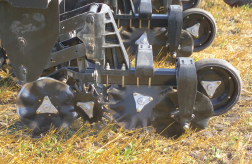
Coulters slice through residue with minimal soil disturbance, preserving much of the surface residue.
Commonly used in vertical tillage and some strip-till systems, they are less disruptive to soil structure than other implements.

Points and shanks vary in their impact on soil structure.
Shallow, narrow, and straight points cause less soil disturbance and leave more surface residue than deep, twisted, or wide shanks and points. Commonly used in field cultivators, chisel plows, and deep rippers, these tools help break up subsoil compaction.
Unlike disks, which cut and shear the soil, shanks lift and separate it along natural fracture lines, preserving more soil aggregates and reducing structural damage.
Residue levels and yield

Crop residue management plays a crucial role in soil conservation and farm profitability. While farmers in drier regions benefit from moisture retention by leaving residue on the soil surface, those in wetter, cooler climates worry about slower crop growth due to cooler, wetter soils in spring.
Research from the University of Minnesota and North Dakota State University shows that reduced tillage systems maintain more residue cover, reduce soil erosion, and lower tillage costs, all without significantly impacting crop yields.
Studies in Minnesota and North Dakota comparing different tillage systems, including strip till, vertical till, chisel plow, and disk rip, found no consistent yield differences for corn or soybeans across multiple years and soil types.
Since 2004, research has shown that soybean yields were unaffected by tillage more than 76% of the time. When differences did occur, strip till often provided an advantage over chisel plow. For corn, strip till outperformed chisel plow and no-till in 44% of trials, while aggressive tillage (i.e., chisel plow) led to yield improvements in only about 12% of cases.
Overall, these studies confirm that farmers can maintain yields, improve soil health, and reduce costs by adopting less aggressive tillage while effectively managing residue levels.
More from Extension
DeJong-Hughes, Jodi; Daigh, Aaron. (2021). Upper Midwest Tillage Guide. Retrieved from the University Digital Conservancy: https://hdl.handle.net/11299/263302
Reviewed in 2026