

Quick facts
- Plant rhubarb in well-drained soil.
- Different varieties have varying levels of sourness and fibrousness.
- Only the long stalks are edible.
- Rhubarb plants are very large. A single plant usually provides enough for any family.
- A giant rhubarb plant can be a strong competitor against weeds.
- Wait until the second season before harvesting.
- Wait until the third season if you started from seed.
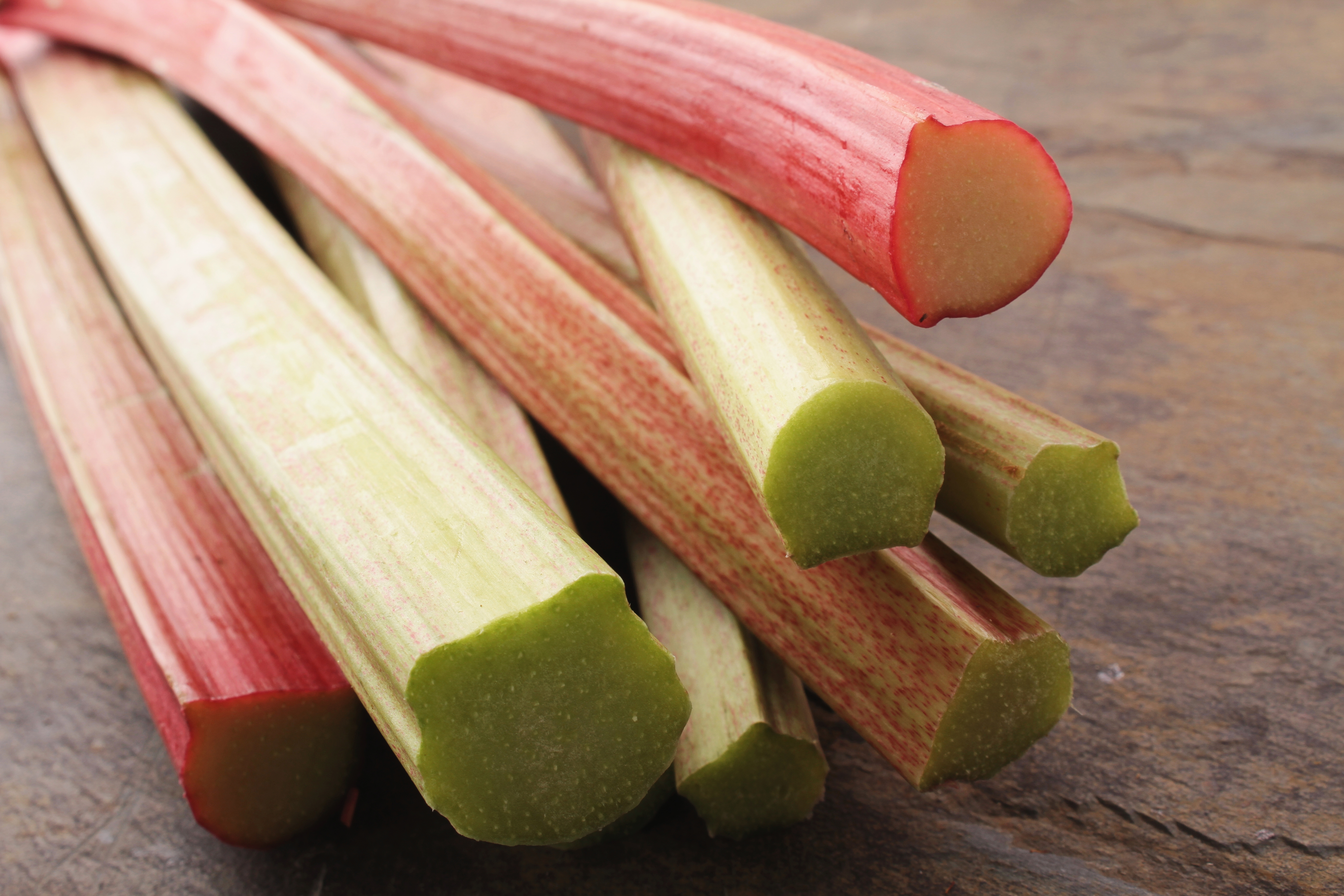
Rhubarb (Rheum rhabarbarum) is a perennial vegetable hardy enough for Minnesota gardens. It is in the buckwheat family, has a sour flavor and is among the first crops ready for harvest in spring.
Rhubarb is also a "pie-plant" because you can cook, sweeten and use the chopped stalks as a pie filling, usually with strawberries.
You can also incorporate it into breads and cakes, sweet and use it as a sauce, or cook with sugar, strain and drink it as a refreshing juice.
Few people can eat much rhubarb as a raw vegetable. While juicy and crisp, it is very sour.
Selecting plants
Buying rhubarb plants
Gardeners often acquire rhubarb plants from another gardener who is dividing a large plant. Although there is a possibility of receiving a plant infected with a virus, chances are good that the plant is healthy and vigorous, since it is large enough to need dividing.
You can also purchase plants at garden centers and from mail-order catalogs. Nursery-grown plants will be virus-free.
Catalogs also sell rhubarb seed. The reddest varieties are not available as seed, only as plants.
Choosing rhubarb varieties
- Different varieties have varying levels of sourness and fibrousness.
- Varieties also vary in color from almost pure green to almost pure red. Usually the skin is more or less red, while the flesh color varies from pale to darker green.
- Color does not cause any specific flavors. Redder varieties are desirable for pies, because the color of the filling is more attractive than the grayish color of cooked green varieties.
- Plant stature and vigor also vary among varieties. In general, greener varieties are more vigorous and have longer stalks than red varieties.
- Rhubarb leaves are toxic. Do not eat them.
- Only the long, thick leaf petioles, the "stalks," are edible. The stalks contain high levels of oxalic acid, which can tie up calcium and make it unavailable in the body.
- Eating an occasional dish containing rhubarb does not pose a serious nutritional threat.
- People with gout, kidney disorders and rheumatoid arthritis may want to avoid foods high in oxalic acid and should consult with their physicians about consuming these foods.
Planting and growing rhubarb
The environment, plant diseases, insects and wildlife can cause changes in physical appearance and plant health. To address what you’re seeing, it is important to make a correct diagnosis.
You can find help identifying common pest problems by using Ask a Master Gardener to share pictures and get advice, or by sending a sample to the .
Soil testing and fertilizer
- Rhubarb likes well-drained soil.
- Loamy soils are better for rhubarb growth than sandy soils. They are more water-retentive and can provide more nutrients to the plant.
- Soil pH is not important. Any garden soil in Minnesota, whether acidic, neutral or basic ("alkaline"), can support a good crop of rhubarb.
- Garden soil tests, because they are usually from parts of the garden with annual plantings, will not provide information about the rhubarb plant's needs.
- The rhubarb plant is a "heavy feeder." The plant must take in large amounts of nutrients from the soil to produce its large stalks and leaves.
- Make it an annual practice to supplement the soil with either a balanced commercial fertilizer or rich compost, or both. The addition of manure or compost can add micronutrients and organic matter to soil.
- Note whether growth is vigorous or weak, and adjust the next spring's fertilizer application accordingly.
- Continuous use of high phosphorus fertilizer such as 10-10-10 or 15-30-15, or high rates of manure or manure compost results in phosphorus buildup in the soil.
- Some runoff may occur with phosphate fertilizer. It can then become a major pollution concern in our lakes, rivers and streams.
- High levels of phosphorus support over-production of algae, which causes a significant reduction in water quality.
- If your soil tests high in phosphorus, use a low-phosphorus (such as 32-3-10, 27-3-3, or 25-3-12) or no-phosphorus (such as 30-0-10 or 24-0-15) fertilizer.
Rhubarb plants are very large. A single plant usually provides enough for any family. Give each plant a three-foot-by-three-foot area in the garden.
For most gardeners, it is most convenient to position rhubarb at the edge of the garden. It should be in a spot that receives all-day sun. Rhubarb is hardy in USDA Zone 4, and worth trying in Zone 3.
Starting seeds indoors and transplanting
- Start seed indoors six weeks before the last frost date for your area. Cover the seed lightly, keep moist and supply bottom heat to improve germination and seedling health.
- It may be two or three weeks before seedlings emerge.
- Harden plants off for at least a week before planting out in the garden.
- Prepare the soil by tilling or forking to a depth of at least two feet, to allow the new plants to root easily.
- Add plenty of garden and kitchen compost or composted manure to increase organic matter, improve drainage and supply nutrients.
- It is best to prepare the soil and let it settle for a few days before planting, so that newly set plants do not end up too deep.
- Plant seedlings, divisions from a neighbor's garden and plants bought in pots at garden centers at the same depth they are growing in the pot. Plant bare-root plants bought through the mail with the crown of the plant just level with the soil.
- Water well after planting.
Watering
Proper watering will help rhubarb grow. Soak the soil thoroughly when watering, to a depth of at least one inch each week during the growing season.
Controlling weeds
- A giant rhubarb plant can be a strong competitor against weeds.
- While the plant is establishing itself during the first year or two, keep weeds controlled by hoeing or hand pulling. Frequent, shallow cultivation will kill weeds before they become a problem.
- Be careful not to damage the plants when cultivating. Keep your tool away from the plant itself.
- Continue watering and weeding all summer long, even after harvest. The plants can live 15 or more years with good care.
Dividing
The rhubarb plant will produce the next year's buds at the outer edges of its crown. With each passing year, the plant will become slightly wider. The center may not produce any new stalks. Like many perennial plants, rhubarb can benefit from division every few years.
As new growth is starting very early in the season, use a clean, sharp shovel to cut the plant in half or in thirds. Move the divisions to newly prepared planting sites, or give them away. You can also dig up the entire plant and divide it using a sharp knife.
Because rhubarb takes so many nutrients from the soil, move the plant to a new site every so often. Rotate another crop into the former rhubarb patch.
- Rhubarb is one of the first crops of the year. Wait until the second season before harvesting. Wait until the third season if you started from seed.
- Begin picking stalks as soon as they have reached their full length. Depending on the variety, they may be only 12 inches long, or as long as two feet.
- To pick rhubarb, hold the stalk firmly, pull and twist.
- Do not use a knife to cut the stalks from the plant. The knife can carry diseases from plant to plant, and the remaining stalk can be a point of entry for other pests.
- Immediately upon harvesting, use a knife to trim the leaves from the stalks and discard. They are toxic, and leaving them on can speed wilting of the stalks.
- The harvest season for rhubarb lasts until the end of June. Until then, pick as many stalks as you wish. After harvest, allow the plant to keep all of its leaves to build its reserves of energy for the next year.
- A common myth is that the entire plant becomes toxic later in the summer. This is not true.
- If you pull a few stalks on one occasion later in summer to prepare a special dish, you will not harm plant health and vigor. The stalks may be tougher than spring-harvested rhubarb.
- When a seed stalk emerges from the plant, cut it off as soon as you notice it. If the plant flowers and sets seed, it will have used up energy unnecessarily.
- Rhubarb is common in dishes with strawberries, but the season for strawberries and the season for rhubarb only overlap in June. Some gardeners freeze rhubarb for a few weeks until the main harvest of strawberries starts.
Insects
- Insect pests are generally not a problem on rhubarb.
- Rhubarb curculio is a dark-colored, snouted beetle about one-half to three-fourths of an inch long. It can bore holes into the crown and stalks.
- Stalk borers may cause similar problems as rhubarb curculio. Control them by removing nearby grassy weeds and curly dock, a weed that is the normal host for rhubarb curculio.
Diseases
- Planting rhubarb in a sunny, well-drained site is important to avoid infection by soil-dwelling pathogens.
- In a wet year or a poorly drained site, root-rotting fungi can invade the plant. Start over in a new spot if this happens.
- There are two rhubarb leaf spot diseases that are common in Minnesota: Ascochyta rhei and Ramularia rhei. Manage them through selective harvesting of infected stalks combined with removing and destroying all leaves after the first hard frost in the fall.
- Viruses occasionally infect rhubarb, causing abnormal growth, loss of vigor or unusual leaf coloration. If a rhubarb plant has a virus, it is best to remove it from the garden and start over.
Reviewed in 2026