

Quick facts
- Healthy trees have a better chance of surviving storm damage.
- Natural tree imperfections can make them prone to damage.
- Cuts or wounds on trees can make them more vulnerable to insects and diseases.
- Homeowners can care for and repair minor damage, but hire a tree care professional to take care of more severe problems.

In the upper Midwest, wind and ice storms are common and often cause tremendous damage to individual trees and urban forests.
Storms can cause weakly attached branches to break away and tear trees apart. Trees with stem girdling roots or inadequate root systems may blow over or break off at the ground line.
Regardless of the circumstances, these effects can cause personal and property damage.
The key to preventing tree damage is to correct potential problems before storms strike.
City foresters and tree care professionals can help you solve tree care problems.
What causes tree weakness?
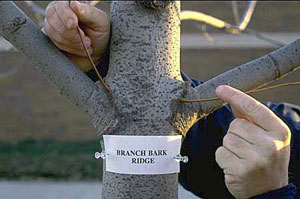
Trees may suffer from several natural form imperfections that lead to damage under storm conditions.
Inclusion of bark at branch unions is a common weak point in trees. Branch unions should have a rough, protruding branch bark ridge where the branches meet. Without this proper union, branches or leaders tend to separate during storms.
Trees may also have co-dominant leaders. This occurs when a tree has two or more branches or stems that are trying to become the center point of the tree.
Co-dominant leaders typically exhibit inclusion at their unions. Proper pruning at planting and throughout a tree’s life can correct tree form problems.
Tree decay
Decay is the natural degradation of tree stem, branch and root tissue.

- Decayed tissue is very weak and is the most common contributor to tree failure.
- The location and extent of decay within a tree make a difference in a tree’s potential for failure.
- Decay located within a single branch is not always a critical situation since weak branches can easily be removed.
- Decay located within the main part of the trunk can be seriously dangerous.
- Wounds from lawnmowers and grass trimmers can cause areas of decay in trees.
- Cars, snowplows, staples, and any stacked materials that wound stems and branches can cause long-term damage in a short time.
Staking equipment that is not properly installed or is left attached to the tree too long will damage stem tissue and encourage decay.
- Never attach staking wires or ropes to tree stems.
- Use wide, padding materials around the tree stem and connect these materials to the tree wires or ropes. Strips of carpeting, old belts or inner tubes work well.
- Regularly inspect and adjust staking or guying materials on a tree for increased stem growth. Don’t wait more than a year between adjustments.
Stem girdling roots
Stem girdling roots are roots at or below the soil surface that wholly or partially encircle the trunk of the tree. Over time, they begin to stress the health of the tree, including the root system. The girdling roots eventually cause compression of the lower trunk, creating a weak point that is often the point of failure in high wind storms.
Many stem girdling root problems can be prevented by root pruning pot-bound trees before planting and planting all trees at the correct depth: the first branch roots just below the soil surface.
Trees that are native to floodplain areas (elms, maples, etc.) tend to form “stem” roots where they are buried by floodplain material. These trees commonly form encircling roots when planted in cities, particularly when they are planted too deeply.
Common site problems that may contribute to tree failure
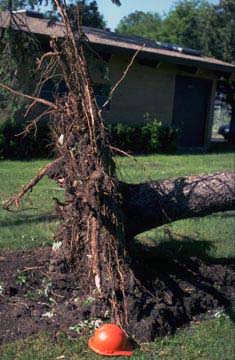
- Shallow soils.
- Compacted clay soils.
- Saturated soils.
- Confined rooting areas.
- Inappropriate species for the location (such as large trees in small boulevard strips).
Most site problems are directly or indirectly related to a lack of oxygen reaching the tree’s roots. When oxygen is lacking, root systems suffer and trees become unstable.
It is essential to understand your site’s situation, including soil types and root volume, before selecting and planting trees.
Preventing tree loss from storm damage
The conditions of the planting site are as important as the plant. Consider the soil type and drainage, as well as the availability of water and sunlight, exposure to drying winds, and other relevant factors. Matching the plant’s needs to the site enhances its performance and longevity.
The location of the planting site in relation to other trees and objects, such as buildings and fences, will affect temperature and moisture conditions. The amount of protection provided by individual microclimates can affect plant hardiness.
Planting too deep may be the most common planting mistake that leads to tree failure. The first set of roots should be just below the soil surface.
Take a tree inventory
By keeping track of the trees on your property and their condition, preventing storm damage is much easier.
- Create a list of key trees and key problems.
- Key trees are those that are most important to the property.
- Key problems are those that are most likely to damage or weaken those key trees.
- Check key trees regularly.
- When minor damage occurs, correction (such as pruning or wound painting on oaks during oak wilt season) may prevent damage from spreading throughout the tree.
- If extensive damage has occurred, take immediate corrective action to prevent further damage.
How to determine strength within a branch or stem:
- For every 3 inches of branch or stem diameter, solid wood should comprise at least 1 to 1.5 inches.
- Less than 1 to 1.5 inches of solid wood can indicate a branch or stem that is more likely to fail during a storm.
Keep trees healthy
Healthy trees have a much better chance of surviving storm damage. When trees are stressed, they become more susceptible to problems such as decay and damage from diseases or insects. These can weaken trees, making them more susceptible to damage from high winds and flooding.
- Avoid mechanical damage, including wounds from lawnmowers, grass trimmers and poor pruning.
- Don’t pile mulch against the stem, as this can lead to stem girdling roots and other unhealthy root systems.
- Avoid overwatering the soil around trees as this can encourage shallow root systems, stem girdling roots and unstable trees.
- Be careful when using staking equipment. Wires that are too tight around stems can girdle and weaken stems.
Learn how to correctly prune trees or hire a tree care professional to prune them. Poor pruning practices can encourage decay or the formation of weak branches.
- Done correctly, pruning wounds should close over naturally, keeping decay from starting and expanding in the wound area.
- A general rule for pruning wounds: the smaller, the better.
- Don’t flush cut or prune too close to the lead branch or trunk.
- Don’t leave long stubs.
- Don’t “top” or strip bark when pruning.
When mulching:
- Apply a 3-6 inch layer of coarse mulch, spread to form a 4-6 foot diameter circle around the tree.
- Keep the mulch material from direct contact with the tree trunk.
- Mulching, planting trees in landscaped beds, and even staking can give trees the necessary protection from mechanical injury.
Treating tree damage after a storm
Before attempting to treat any major damage yourself, consider hiring a professional tree care specialist. Except for pruning small branches and straightening slightly leaning small trees, it’s best to consult an arborist.
Corrective pruning
- Small branches that have been damaged extensively should be removed to the next branch, but never cut off the branch collar.
- Storm damage that leaves a large tear where a limb came down should be pruned smooth by removing jagged and protruding wood.
- Do not remove large, heavy limbs with a single cut. If a branch is too heavy to support with one hand, a three-cut method should be used.
- Use proper pruning techniques to safely remove broken branches.
Straightening, staking and guying
For minor uprooting of smaller trees (shorter than 25 feet), straightening and guying are both options if correction takes place immediately after damage has occurred.
- When staking an uprooted tree, be sure that the roots remain covered and moist.
- Stakes should be placed evenly around the tree and attached securely without pulling on the tree.
- Thin rope or wire should not be used against the trunk of the tree.
Wound repair
- Remove torn bark to reduce entry sites for diseases and insects or for aesthetic purposes.
- Split, cracked and torn branches should be removed to points of no damage.
- Don’t remove bark from areas beyond the damage already present.
- When pruning branches or repairing wounds, it is usually unnecessary to paint the wounds.
- The exception is during oak wilt season (April through July).
- During this period, wounds made on oaks should be painted immediately with a latex paint or shellac to deter insects carrying the oak wilt disease fungus.
Cabling and bracing
- Cabling and bracing are most effective as preventative measures and provide extra support for weakly attached branches or stems.
- Cabling and bracing are frequently used following storm damage.
- Only trained professionals should perform these installations.
- Most tree care companies will provide this service.
When to hire a tree care professional
Possibly the most important question to address when evaluating storm damage is whether to hire a tree care professional or an arborist to do the work. You need a professional if:
- You need a chainsaw or ladder to do the pruning.
- There are downed and potentially energized power lines in the area of the tree.
- You don’t know if the tree is worth saving.
In any situation where there is a potential for personal or property damage (such as broken limbs hanging high in a tree or unsupported branches over sidewalks), it is crucial to immediately contact your city’s forestry department or a reputable tree care company to remove the potential danger.
Find a list of certified arborists in Minnesota through the Minnesota Society of Arboriculture.
Contact your city forester or county Extension office for more information on branch or tree removal from boulevards and public spaces.
We can help
Discover additional resources for caring for your trees and shrubs with the help of these Extension materials.
Reviewed in 2026