

When the growing season winds down, it’s time for growers to prepare for corn harvest and start thinking about next year.
Combine adjustment
Volunteer corn in soybean fields serves as a reminder to adjust your combine.
In addition to being an eyesore, volunteer corn can cause significant economic losses by adding weed-control costs and reducing bushels at harvest.
Under normal conditions, losses due to the combine should be less than one bushel per acre. It only takes two corn kernels on the ground per square foot to lose one bushel per acre at harvest. Dropped whole and partial ears contain hundreds of kernels.
Guidance for adjusting the combine from Iowa State University.
Yield monitor calibration
Yield monitors are a valuable tool, as they provide vital data for making hybrid and maturity comparisons.
Years with moisture stress, characterized by lower or higher-than-normal rainfall, likely result in greater variability in grain yield and harvest moisture within and among fields. This makes a properly calibrated yield monitor even more critical.
Stalk strength
When preparing for harvest, walk through the fields to determine stalk strength. This is particularly important in fields that have experienced considerable stress.
Tests for evaluating stalk strength
Pushing plants, pinching lower internodes and splitting lower stalks will indicate whether stalk rot has compromised stalk strength.
Growers can easily evaluate stalk strength using the push test, in which plants are pushed 45 degrees (about 10 inches) from vertical at ear level. Plants that break following the push test are at risk for stalk lodging.
You can also evaluate stalk strength by pinching the lower stalk at the first internode above the brace roots. Hollow and deteriorated stalks will easily collapse when pinched.
Photos showing the signs of stalk health problems from Purdue University.
How many plants to test
With both the push and pinch tests, test a minimum of 20 plants in five representative field locations.
When 10 to 15 percent or more of plants fail the push or pinch test, they’re at risk for severe stalk lodging, and the field should be prioritized for harvest to prevent harvesting downed corn later.
Estimating yield
Growers can estimate yield prior to harvest using the following procedure. Accurate yield estimation requires multiple samples from representative locations throughout a field.
- Mark the length of a row equal to 1/1000th of an acre (17 feet, 5 inches in 30-inch rows or 23 feet, 9 inches in 22-inch rows) and count the harvestable ears in the length of that row.
- Husk every fifth ear, husking only representative ears. Then count the number of rows per ear (always an even number) and the approximate number of kernels per row.
- Calculate the average number of rows per ear and kernels per row from the husked ears.
- Estimate the number of kernels per ear by multiplying the average number of rows by the average number of kernels per row.
- Multiply kernels per ear by the number of harvestable ears in 1/1000th of an acre to estimate the number of kernels per acre.
- Divide the number of kernels per acre by 80 (assuming 80,000 kernels per bushel) to get bushels per acre. For an even more conservative estimate that assumes poorer grain fill, divide by a larger number, such as 85 or 90. If you think grain fill has been exceptional and kernels are larger than normal, consider dividing by a lower number, such as 75.
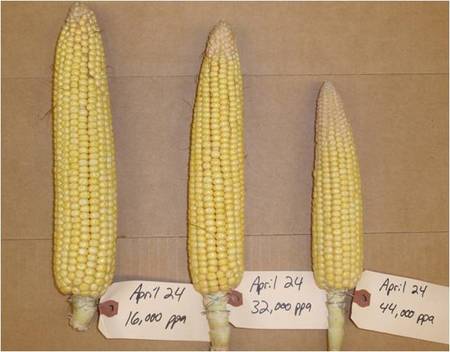
When pulling back husks, you may find poor tip fill. This can be caused by poor pollination and kernel abortion.
For example, the ovules may not have been pollinated because of:
- Silk clipping by insects.
- Delayed silk emergence.
- Silk deterioration due to heat or drought stress.
- A lack of viable pollen due to the same heat or drought stress.
Stress resulting from heat, drought or severe nutrient deficiencies can cause kernels to dry out and be lost, especially at the tip end of the ear, because the silks emerge last from these kernels.
Tip fill correlates with plant population. The optimum plant population will typically have about 1 inch of poor tip fill, as grain yield is a balance between the number of plants per acre and the number of kernels per ear.
Crop maturity and early freeze
Kernel moisture at the onset of denting is around 59 percent, and it generally takes approximately 25 more days from the start of denting to reach physiological maturity (black layer).
A light freeze killing only the leaves at the half milkline stage can be expected to reduce final grain yield by 5 percent, while a hard freeze killing the whole plant at this same stage would reduce final grain yield by about 10 percent.
The following table lists average long-term dates of critical fall temperatures recorded from 1948 to 2005 for various locations in Minnesota.
Median dates of critical fall temperatures (1948 to 2005)
| Location | 32°F | 28°F |
|---|---|---|
| Northwest: Crookston | Sept. 23 | Oct. 2 |
| North central: Bemidji | Sept. 22 | Sept. 26 |
| West central: Morris | Sept. 29 | Oct. 6 |
| Central: Stewart | Oct. 1 | Oct. 10 |
| East central: Forest Lake | Oct. 5 | Oct. 17 |
| Southwest: Lamberton | Sept. 28 | Oct. 7 |
| South central: Faribault | Sept. 29 | Oct. 12 |
| Southeast: Rochester | Oct. 1 | Oct. 12 |
Table source: Minnesota Department of Natural Resources State Climatology Office
In-field dry-down rates
Typical in-field dry-down rates for corn grain in Minnesota after it has reached physiological maturity can vary based on weather conditions. For example, if September is cold, cloudy, and rainy, while early October is warm, sunny, dry, and windy, the drying rates listed below can reverse.
- September 15-25: Grain dries at about 0.75 to 1.00 percentage points per day.
- September 26 to October 5: Grain dries at about 0.50 to 0.75 percentage points per day.
- October 6 to October 15: Grain dries at about 0.25 to 0.50 percentage points per day.
- October 16 and later: Grain dries at 0.00 to 0.33 percentage points per day.
Hybrid selection
Fall is the time to start thinking about hybrids for the following spring, as success in the next year begins with decisions made in the fall.
When selecting hybrids, spread out your risk by planting multiple hybrids of differing maturity.
Identify and select hybrids that consistently are top performers over multiple sites or years within a region. Consistency over multiple environments is critical because you cannot predict next year’s growing conditions.
Base hybrid selection on information from numerous sources, including universities, grower associations, seed companies and on-farm strip trials.
Results from the current year’s trials are posted soon after harvest.
Reviewed in 2025