

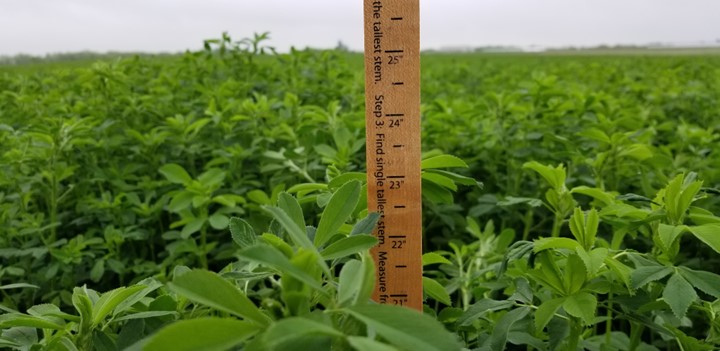
You can estimate alfalfa relative feed value (RFV) and neutral detergent fiber (NDF) levels with the Predictive Equations for Alfalfa Quality (PEAQ) system, which gives alfalfa producers a simple way to schedule harvests. A PEAQ stick can be a useful tool when implementing this approach.
The PEAQ stick is currently used in the central Minnesota Harvest Alert/Scissor Cut Program.
The PEAQ stick method was developed by the University of Wisconsin. Sticks can be purchased through the Midwest Forage Association RFV PEAQ stick order form.
How to sample using the PEAQ method
This procedure is most accurate for good stands of pure alfalfa with healthy growth. Follow these steps:
- Choose a representative 2-square-foot area in the field.
- Determine the most mature stem in the 2-square-foot sampling area using the staging criteria shown in the relative feed values (RFV) table below.
- Measure the length of the tallest stem in the 2-square-foot area.
- Measure it from the soil surface (next to plant crown) to the tip of the stem; not to the tip of the highest leaf blade.
- Straighten the stem to accurately measure its length.
- The tallest stem may not be the most mature stem.
- Based on the most mature stem and length of the tallest stem, use the RFV table to determine the standing alfalfa forage’s estimated RFV content. Use the Neutral detergent fiber table to estimate NDF.
- Repeat steps 1 to 4 in four or five representative areas across the field. For fields larger than 30 acres, sample more times.
Estimating tables
The PEAQ sampling procedure estimates alfalfa relative feed value (RFV) of the standing crop based on alfalfa maturity and height. It doesn't account for changes in quality due to wilting, harvesting and storage. These factors may further lower RFV by 15 to 25 points, assuming good wilting and harvesting conditions.
The general recommendation is to harvest when the PEAQ estimate is 15 to 25 RFV points higher than what you want to have in the feed bunk.
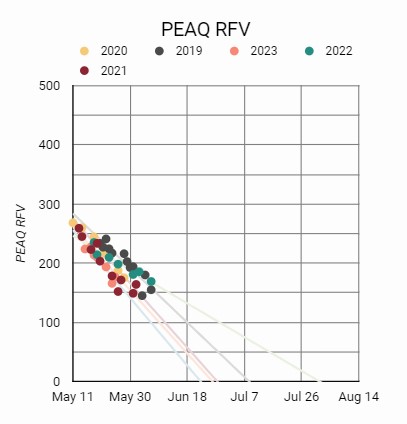
NOTE: Quality factors are generally expected to change each day. RFV declines 3 to 4 units per day. Relative forage quality (RFQ) declines 4 to 5 units per day.
PEAQ stick estimate of relative feed value (RFV) using alfalfa stem height and maturity stage
| Height | Late vegetative RFV | Bud stage RFV | Flower stage RFV |
|---|---|---|---|
| 16 inches | 237 | 225 | 210 |
| 17 inches | 230 | 218 | 204 |
| 18 inches | 224 | 212 | 198 |
| 19 inches | 217 | 207 | 193 |
| 20 inches | 211 | 201 | 188 |
| 21 inches | 205 | 196 | 183 |
| 22 inches | 200 | 190 | 178 |
| 23 inches | 195 | 185 | 174 |
| 24 inches | 190 | 181 | 170 |
| 25 inches | 185 | 176 | 166 |
| 26 inches | 180 | 172 | 162 |
| 27 inches | 175 | 168 | 158 |
| 28 inches | 171 | 164 | 154 |
| 29 inches | 167 | 160 | 151 |
| 30 inches | 163 | 156 | 147 |
| 31 inches | 159 | 152 | 144 |
| 32 inches | 155 | 149 | 140 |
| 33 inches | 152 | 145 | 137 |
| 34 inches | 148 | 142 | 134 |
| 35 inches | 145 | 139 | 131 |
| 36 inches | 142 | 136 | 128 |
| 37 inches | 138 | 133 | 126 |
| 38 inches | 135 | 130 | 123 |
| 39 inches | 132 | 127 | 121 |
| 40 inches | 129 | 124 | 118 |
The PEAQ sampling procedure estimates alfalfa neutral detergent fiber (NDF) content of the standing crop. It doesn’t account for changes in quality due to wilting, harvesting and storage. These factors may further raise NDF content by three to six units, assuming good wilting and harvesting conditions.
PEAQ stick estimate of neutral detergent fiber (NDF) using alfalfa stem height and maturity stage
| Length of tallest stem | Late vegetative % NDF | Bud stage % NDF | Flower stage % NDF |
|---|---|---|---|
| 16 inches | 28.5 | 29.7 | 31.4 |
| 17 inches | 29.2 | 30.4 | 32 |
| 18 inches | 29.9 | 31.1 | 32.7 |
| 19 inches | 30.6 | 31.8 | 33.4 |
| 20 inches | 31.3 | 32.5 | 34.1 |
| 21 inches | 32 | 33.2 | 34.8 |
| 22 inches | 32.7 | 33.9 | 35.5 |
| 23 inches | 33.4 | 34.6 | 36.2 |
| 24 inches | 34 | 35.3 | 36.9 |
| 25 inches | 34.7 | 35.9 | 37.6 |
| 26 inches | 35.4 | 36.6 | 38.3 |
| 27 inches | 36.1 | 37.3 | 38.9 |
| 28 inches | 36.8 | 38 | 39.6 |
| 29 inches | 37.5 | 38.7 | 40.3 |
| 30 inches | 38.2 | 39.4 | 41 |
| 31 inches | 38.9 | 40.1 | 41.7 |
| 32 inches | 39.6 | 40.8 | 42.4 |
| 33 inches | 40.3 | 41.5 | 43.1 |
| 34 inches | 40.9 | 42.2 | 43.8 |
| 35 inches | 41.6 | 42.8 | 44.5 |
| 36 inches | 42.3 | 43.5 | 45.2 |
| 37 inches | 43 | 44.2 | 45.8 |
| 38 inches | 43.7 | 44.9 | 46.5 |
| 39 inches | 44.4 | 45.6 | 47.2 |
| 40 inches | 45.1 | 46.3 | 47.9 |
Reviewed in 2025